


How the Covid-19 epidemic is challenging our practice in clinical nutrition-feedback from the field
- PMID: 32939042
- PMCID: PMC7492685
- DOI: 10.1038/s41430-020-00757-6
How the Covid-19 epidemic is challenging our practice in clinical nutrition-feedback from the field
Abstract
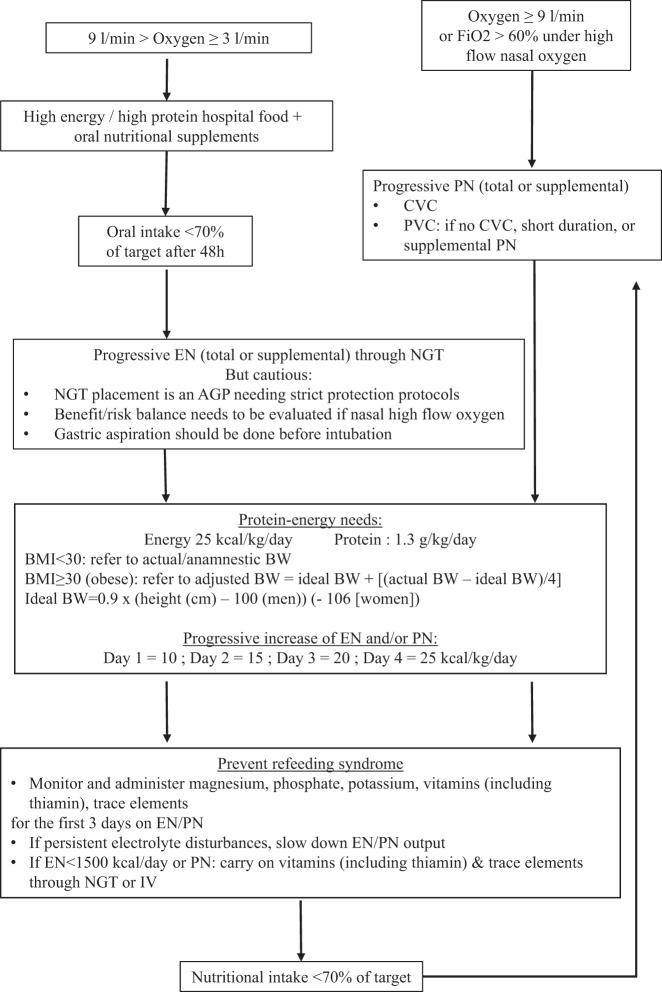
The viral epidemic caused by the new Coronavirus SARS-CoV-2 is responsible for the new Coronavirus disease-2019 (Covid-19). Fifteen percent of the Covid-19 patients will require hospital stay, and 10% of them will need urgent respiratory and hemodynamic support in the intensive care unit (ICU). Covid-19 is an infectious disease characterized by inflammatory syndrome, itself leading to reduced food intake and increased muscle catabolism. Therefore Covid-19 patients are at high risk of being malnourished, making the prevention of malnutrition and the nutritional management key aspects of care. Urgent, brutal and massive arrivals of patients needing urgent respiratory care and artificial ventilation lead to the necessity to reorganize hospital care, wards and staff. In that context, nutritional screening and care may not be considered a priority. Moreover, at the start of the epidemic, due to mask and other protecting material shortage, the risk of healthcare givers contamination have led to not using enteral nutrition, although indicated, because nasogastric tube insertion is an aerosol-generating procedure. Clinical nutrition practice based on the international guidelines should therefore adapt and the use of degraded procedures could unfortunately be the only way. Based on the experience from the first weeks of the epidemic in France, we emphasize ten challenges for clinical nutrition practice. The objective is to bring objective answers to the most frequently met issues to help the clinical nutrition caregivers to promote nutritional care in the hospitalized Covid-19 patient. We propose a flow chart for optimizing the nutrition management of the Covid-19 patients in the non-ICU wards.
Conflict of interest statement
RT received consulting and conference fees: Aguettant, Baxter, B. Braun, Fresenius-Kabi, Nutricia, Roche; conference fees: Astra-Zeneca, Homeperf, Lactalis, Nestlé, Shire; designed and received royalties for the Simple Evaluation of Food Intake® (SEFI®) (Knoë, le Kremlin Bicêtre, France). MC declared no conflict of interest. FJ received consulting and conference fees: Baxter, Fresenius-Kabi. JB received consulting and conference fees: Baxter, Fresenius-Kabi, Nestlé Health Science. SMS received consulting, conference, and investigator honoraria from B. Braun, Baxter, Cardinal Health, Fresenius-Kabi, Homeperf, Laboratoires Grand Fontaine, Nestlé Health Science, Nutricia, Theradial, Pierre Déchelotte stakeholder and consulting fees: TagEDys SA; conference fees: Baxter, Fresenius, Nestlé Health Science; consulting fees: Nestlé, Sanofi, Servier.
Figures
References
-
- Thibault R, Quilliot D, Seguin P, Tamion F, Schneider S, Déchelotte P. Nutritional care at hospital during the Covid-19 viral epidemic: expert opinion from the French-speaking Society for Clinical Nutrition and Metabolism (SFNCM) Nutr Clin Metab. 2020;34:97–104.
Publication types
MeSH terms
LinkOut - more resources
Full Text Sources
Medical
Miscellaneous
