Review
. 2020 Nov;16(11):686-696.
doi: 10.1038/s41581-020-00335-w. Epub 2020 Sep 16.

Modelling kidney disease using ontology: insights from the Kidney Precision Medicine Project

Affiliations
Review

Modelling kidney disease using ontology: insights from the Kidney Precision Medicine Project

Edison Ong et al. Nat Rev Nephrol. 2020 Nov.

Abstract

An important need exists to better understand and stratify kidney disease according to its underlying pathophysiology in order to develop more precise and effective therapeutic agents. National collaborative efforts such as the Kidney Precision Medicine Project are working towards this goal through the collection and integration of large, disparate clinical, biological and imaging data from patients with kidney disease. Ontologies are powerful tools that facilitate these efforts by enabling researchers to organize and make sense of different data elements and the relationships between them. Ontologies are critical to support the types of big data analysis necessary for kidney precision medicine, where heterogeneous clinical, imaging and biopsy data from diverse sources must be combined to define a patient's phenotype. The development of two new ontologies - the Kidney Tissue Atlas Ontology and the Ontology of Precision Medicine and Investigation - will support the creation of the Kidney Tissue Atlas, which aims to provide a comprehensive molecular, cellular and anatomical map of the kidney. These ontologies will improve the annotation of kidney-relevant data, and eventually lead to new definitions of kidney disease in support of precision medicine.


Conflict of interest statement

Competing interests

The authors declare no conflicts of interest.

Figures
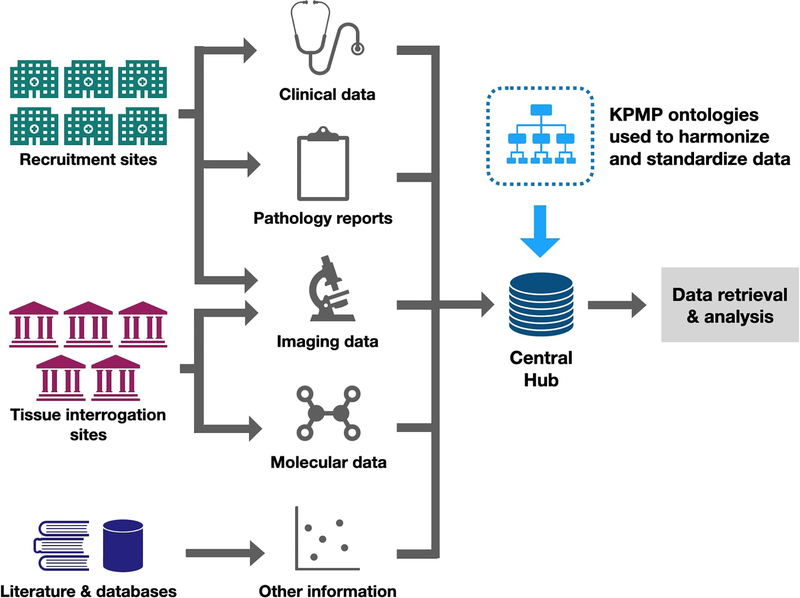
FIG. 1:
FIG. 1:. Overview of KPMP centers and the flow of KPMP data from different provenances.
Clinical data and pathology reports from recruitment centers, and molecular data and imaging data from tissue interrogation sites are integrated with data from the scientific literature and omics databases at the KPMP central hub using KPMP ontologies. Six recruitment sites enroll participants with common forms of acute and chronic kidney disease, and collect biosamples including a research kidney biopsy. Five tissue interrogation sites process and perform molecular analysis of participant biosamples. The central hub manages and aggregates data from all sites for systematic analysis, develops visualization tools and Application Programming Interfaces (APIs) to facilitate community access to data. Data harmonization and standardization with KPMP ontologies facilitate flexible data retrieval and analysis.
FIG. 2.
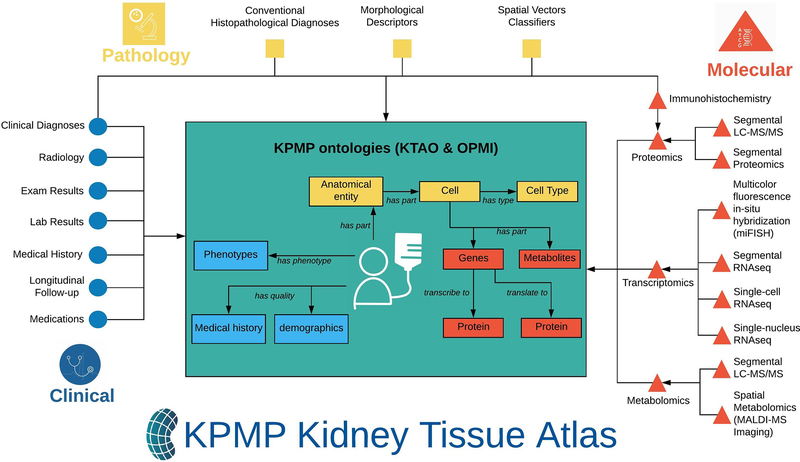
FIG. 2.. The KPMP ontology framework for supporting data representation, integration, and analysis.
Clinical, pathology, and molecular data collected from KPMP recruitment sites and tissue interrogation sites will be deposited in the KPMP Kidney Tissue Atlas. Arrows outside of the box indicate different types of data flowing into the KPMP ontology environment. Two KPMP ontologies, KTAO and OPMI, provide the semantic framework for modeling relations among the heterogeneous data in the atlas. Arrows inside the box represent ontological relations among entity types represented in the KPMP ontologies.
FIG. 3.
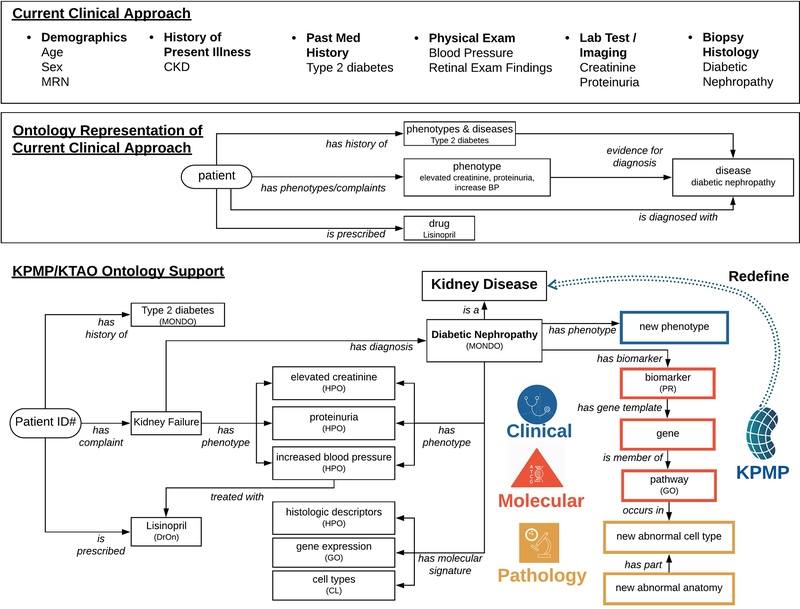
FIG. 3.. The KPMP KTAO ontology supports molecular and histopathologic extensions to current clinical approaches to kidney disease diagnosis.
The top layer lists different data types and example data fields collected during current clinical practice. The middle layer provides a representation of how these data elements can be used to model or support disease diagnosis and treatment with current ontologies. The bottom layer provides an integrative ontology-based point of view that also incorporates molecular and pathologic data in addition to clinical measures, and demonstrates the data harmonization goals of the KPMP. The diagnosis of diabetic nephropathy is used as an example. The KPMP Kidney Atlas, supported by ontologies (e.g., KTAO and OPMI), will be used to redefine kidney diseases (bottom layer) based on molecular mechanisms combined with traditional clinical and histopathologic features to identify critical cells, pathways, and targets for the development of novel diagnosis and therapies.

References

    1. Abrahams E Right drug-right patient-right time: personalized medicine coalition. Clin. Transl. Sci 1, 11–12 (2008). - PMC - PubMed
    1. Khwaja A KDIGO clinical practice guidelines for acute kidney injury. Nephron Clin. Pract 120, c179–84 (2012). - PubMed
    1. Stevens PE, Levin A & Kidney Disease: Improving Global Outcomes Chronic Kidney Disease Guideline Development Work Group Members. Evaluation and management of chronic kidney disease: synopsis of the kidney disease: improving global outcomes 2012 clinical practice guideline. Ann. Intern. Med 158, 825–830 (2013). - PubMed
    1. Hawrylycz M et al. The Allen Brain Atlas. Springer Handbook of Bio-/Neuroinformatics 1111–1126 (2014) doi:10.1007/978-3-642-30574-0_62. - DOI

    1. Cancer Genome Atlas Research Network et al. The Cancer Genome Atlas Pan-Cancer analysis project. Nat. Genet 45, 1113–1120 (2013). - PMC - PubMed

Publication types