


Firing up the cold tumors by targeting Vps34
- PMID: 32939326
- PMCID: PMC7480807
- DOI: 10.1080/2162402X.2020.1809936
Firing up the cold tumors by targeting Vps34
Abstract
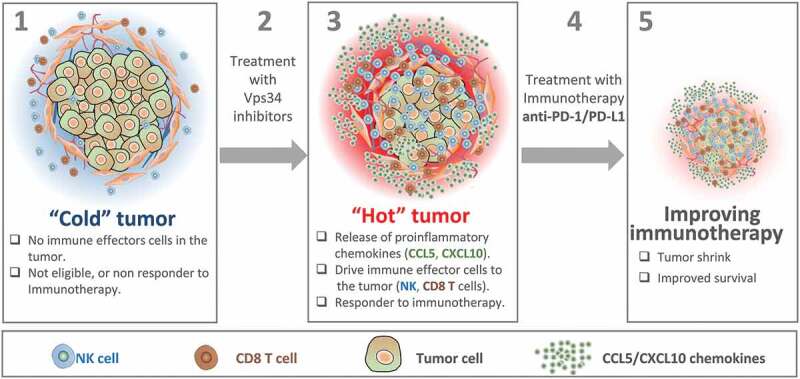
Cancer immunotherapy based on anti-PD-1/PD-L1 blockade is particularly effective in responding to patients with hot tumors. These tumors are characterized by the accumulation of proinflammatory cytokines and T cell infiltration. In our recent report published in Science Advances, we demonstrate that targeting the autophagy-related protein Vps34 switched cold immune desert tumors into hot inflamed immune-infiltrated tumors and enhanced the efficacy of anti-PD-1/PD-L1. Our study provides the preclinical rationale to set up combination immunotherapy clinical trials using selective Vps34 inhibitors and immune checkpoint blockers in melanoma and CRC.
Keywords: Autophagy; CCL5; CXCL10; NK cells; T CD8 lymphocytes; VPS34; anti-PD-1/PD-L1; cancer immunotherapy; cold/hot tumors; colon cancer; immune landscape; melanoma; proinflammatory cytokines.
© 2020 The Author(s). Published with license by Taylor & Francis Group, LLC.
Figures
References
-
- Noman MZ, Janji B, Kaminska B, Van Moer K, Pierson S, Przanowski P, Buart S, Berchem G, Romero P, Mami-Chouaib F, et al. Blocking hypoxia-induced autophagy in tumors restores cytotoxic T-cell activity and promotes regression. Cancer Res. 2011;71(18):5976–5986. doi:10.1158/0008-5472.CAN-11-1094. - DOI - PubMed
-
- Baginska J, Viry E, Berchem G, Poli A, Noman MZ, van Moer K, Medves S, Zimmer J, Oudin A, Niclou SP, et al. Granzyme B degradation by autophagy decreases tumor cell susceptibility to natural killer-mediated lysis under hypoxia. Proc Natl Acad Sci U S A. 2013;110(43):17450–17455. doi:10.1073/pnas.1304790110. - DOI - PMC - PubMed
-
- Mgrditchian T, Arakelian T, Paggetti J, Noman MZ, Viry E, Moussay E, Van Moer K, Kreis S, Guerin C, Buart S, et al. Targeting autophagy inhibits melanoma growth by enhancing NK cells infiltration in a CCL5-dependent manner. Proc Natl Acad Sci U S A. 2017;114(44):E9271–E9. doi:10.1073/pnas.1703921114. - DOI - PMC - PubMed
Publication types
MeSH terms
Substances
LinkOut - more resources
Full Text Sources
Medical
Research Materials
