


The use of imaging in COVID-19-results of a global survey by the International Society of Radiology
- PMID: 32939620
- PMCID: PMC7494433
- DOI: 10.1007/s00330-020-07252-3
The use of imaging in COVID-19-results of a global survey by the International Society of Radiology
Abstract
Objectives: This survey conducted by the International Society of Radiology and supported by the European Society of Radiology aimed to collect information regarding radiology departments' current practices in the management of patients with COVID-19.
Methods: Responses from 50 radiology departments involved in the management of COVID-19 patients representing 33 countries across all continents were analyzed. The analysis revealed important variations in imaging practices related to COVID-19 across the world for different disease severity and various clinical scenarios.
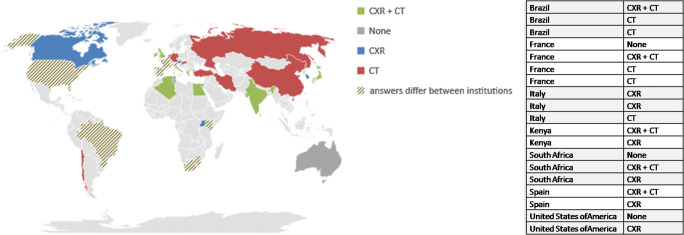
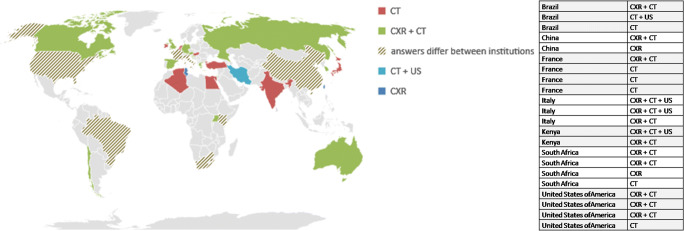
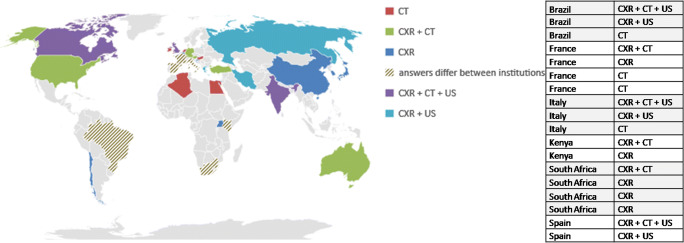
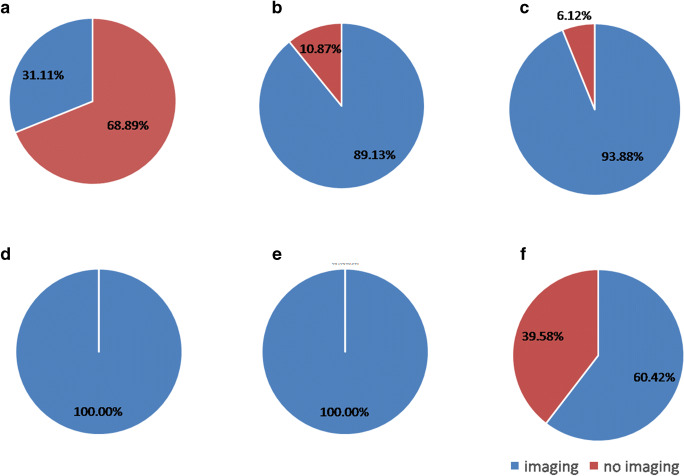
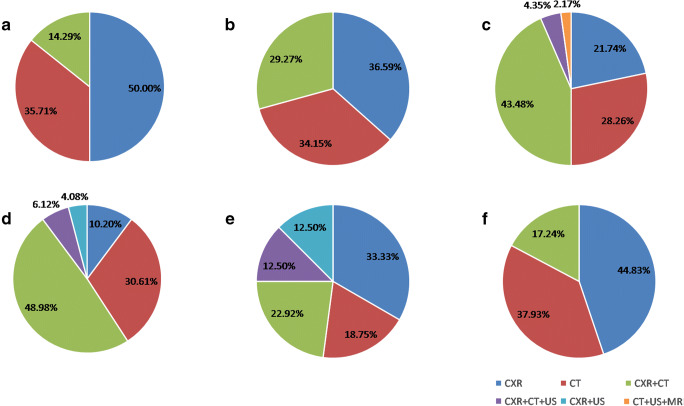
Results: Imaging is usually not performed in asymptomatic patients (69% of institutions do not image) but is used at the end of confinement (in 60% of institutions). In the majority of institutions, chest imaging is used in suspected or confirmed patients with COVID-19 (89% and 94%). All imaging departments involved in this survey reported the use of imaging in COVID-19 patients showing severe symptoms or who were critically ill. However, there is a wide variation in imaging modality type used for each clinical scenario. The use of imaging is applied in line with existing guidelines and recommendations in 98% of institutions with structured reporting recorded in 58% of institutions. The vast majority of institutions reported a significant impact of the COVID-19 pandemic on the imaging department's routine activity (83%).
Conclusion: We believe that the results of this survey will help to understand current heterogeneities in radiology practice and to identify needs and gaps in the organization and function of radiology departments worldwide in relation to the COVID-19 pandemic. The results of this survey may inform the development of an overall strategy for radiology department organization and imaging protocols in pandemic conditions.
Key points: • The results of this survey, which included responses from 50 radiology departments representing 33 countries, showed important variations in imaging practices related to COVID-19 across the world. • While imaging is usually not performed in asymptomatic patients (69% of institutions), it is used in suspected or confirmed patients with COVID-19, in COVID-19 patients showing severe symptoms or who were critically ill, and at the end of confinement (89%, 94%, 100%, 100%, 60% of institutions, respectively). However, there is a wide variation in imaging modality type used for each clinical scenario. • In 98% of institutions, the use of imaging is applied in line with existing guidelines and recommendations, with structured reporting recorded in 58% of institutions. COVID-19 pandemic made a significant impact on the imaging department's routine activity in 83% of institutions.
Keywords: COVID-19 pandemic; Radiology department; Survey.
Conflict of interest statement
The authors of this manuscript declare no relationships with any companies, whose products or services may be related to the subject matter of the article.
Figures

References
MeSH terms
LinkOut - more resources
Full Text Sources
Medical
