


Short- and potential long-term adverse health outcomes of COVID-19: a rapid review
- PMID: 32940572
- PMCID: PMC7586446
- DOI: 10.1080/22221751.2020.1825914
Short- and potential long-term adverse health outcomes of COVID-19: a rapid review
Abstract
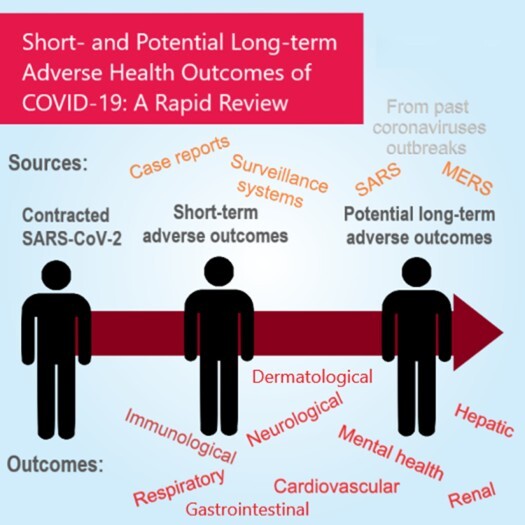
The coronavirus disease 2019 (COVID-19) pandemic has resulted in millions of patients infected worldwide and indirectly affecting even more individuals through disruption of daily living. Long-term adverse outcomes have been reported with similar diseases from other coronaviruses, namely Middle East Respiratory Syndrome (MERS) and Severe Acute Respiratory Syndrome (SARS). Emerging evidence suggests that COVID-19 adversely affects different systems in the human body. This review summarizes the current evidence on the short-term adverse health outcomes and assesses the risk of potential long-term adverse outcomes of COVID-19. Major adverse outcomes were found to affect different body systems: immune system (including but not limited to Guillain-Barré syndrome and paediatric inflammatory multisystem syndrome), respiratory system (lung fibrosis and pulmonary thromboembolism), cardiovascular system (cardiomyopathy and coagulopathy), neurological system (sensory dysfunction and stroke), as well as cutaneous and gastrointestinal manifestations, impaired hepatic and renal function. Mental health in patients with COVID-19 was also found to be adversely affected. The burden of caring for COVID-19 survivors is likely to be huge. Therefore, it is important for policy makers to develop comprehensive strategies in providing resources and capacity in the healthcare system. Future epidemiological studies are needed to further investigate the long-term impact on COVID-19 survivors.
Keywords: COVID-19; SARS-CoV-2; complications; coronavirus infection; health outcomes; long term adverse outcomes; short-term adverse outcomes.
Conflict of interest statement
No potential conflict of interest was reported by the author(s).
References
-
- World Health Organization . Coronavirus disease (COVID-2019) situation report - 163 2020 [updated July 28; cited 2020 Jul 29]. Available from: https://www.who.int/emergencies/diseases/novel-coronavirus-2019/situatio....
-
- World Health Organization . Coronavirus worldwide graphs - recovered and discharged 2020 [updated July 28; cited 2020 Jul 29]. Available from: https://www.worldometers.info/coronavirus/worldwide-graphs/#recovered.
-
- National Heart Lung and Blood Institute . Looking forward: understanding the long-term effects of COVID-19 2020 [updated Jun 3; cited 2020 Jul 13]. Available from: https://www.nhlbi.nih.gov/news/2020/looking-forward-understanding-long-t....
Publication types
MeSH terms
LinkOut - more resources
Full Text Sources
Other Literature Sources
Miscellaneous
