


Primary immune regulatory disorders: a growing universe of immune dysregulation
- PMID: 32941318
- PMCID: PMC7769114
- DOI: 10.1097/ACI.0000000000000689
Primary immune regulatory disorders: a growing universe of immune dysregulation
Abstract
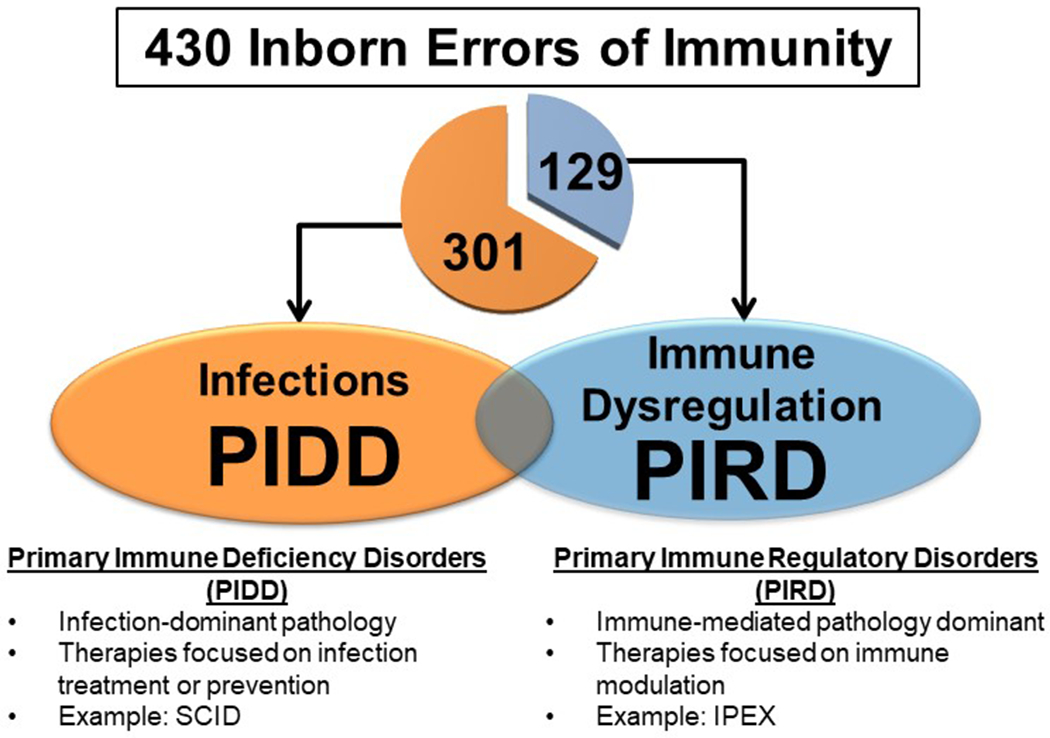
Purpose of review: Primary immune regulatory disorders (PIRD) are a growing subset of diseases referred to as inborn errors of immunity. Unlike classical primary immune deficiency disorders that typically present with severe, recurrent, or unusual infections, the clinical manifestations of PIRD are dominated by immune-mediated diseases (autoimmunity, autoinflammation/hyperinflammation, lymphoproliferation, malignancy, and severe atopy). This review introduces the concept of PIRD including clinical phenotypes, treatments, and new PIRD-associated gene defects.
Recent findings: The number of genetic defects associated with PIRD is rapidly growing. The identified genes often encode proteins that play critical roles in regulating the immune response to various triggers. Understanding the molecular mechanisms underlying PIRD has shed light on the clinical phenotypes and has helped to identify targeted therapies. In some cases, hematopoietic cell transplant (HCT) has been successfully employed as a cure.
Summary: It is important to recognize the broad clinical manifestations of PIRD as patients may have symptoms atypical of classical 'immunodeficiency'. Because of their diverse immune dysregulation problems, they are often primarily managed by other subspecialists. Immunologists can help connect the diverse immune-mediated pathologies to a gene defect. This, in turn, can play a significant role in directing clinical management, selecting effective therapy, and deciding on appropriateness of HCT.
Conflict of interest statement
Conflicts of interest
AC is a consultant for Invitae. TRT is a consultant for Takeda, Grifols, and CSL Behring.
Figures
References
-
- Chan AY, Leiding JW, Liu X, Logan BR, Burroughs LM, Allenspach EJ, et al. Hematopoietic Cell Transplantation in Patients With Primary Immune Regulatory Disorders (PIRD): A Primary Immune Deficiency Treatment Consortium (PIDTC) Survey. Front Immunol. 2020;11:239. - PMC - PubMed
-
This study introduces the PIRD term and illustrates the overall survival of transplant in PIRD.
-
- Gambineri E, Ciullini Mannurita S, Hagin D, Vignoli M, Anover-Sombke S, DeBoer S, et al. Clinical, Immunological, and Molecular Heterogeneity of 173 Patients With the Phenotype of Immune Dysregulation, Polyendocrinopathy, Enteropathy, X-Linked (IPEX) Syndrome. Front Immunol. 2018;9(Journal Article):2411. - PMC - PubMed
-
- Cepika A-M, Sato Y, Liu JM-H, Uyeda MJ, Bacchetta R, Roncarolo MG. Tregopathies: Monogenic diseases resulting in regulatory T-cell deficiency. J Allergy Clin Immunol. 2018. December 1;142(6):1679–95. - PubMed
