


Progress Toward Poliovirus Containment Implementation - Worldwide, 2019-2020
- PMID: 32941411
- PMCID: PMC7498175
- DOI: 10.15585/mmwr.mm6937a7
Progress Toward Poliovirus Containment Implementation - Worldwide, 2019-2020
Abstract
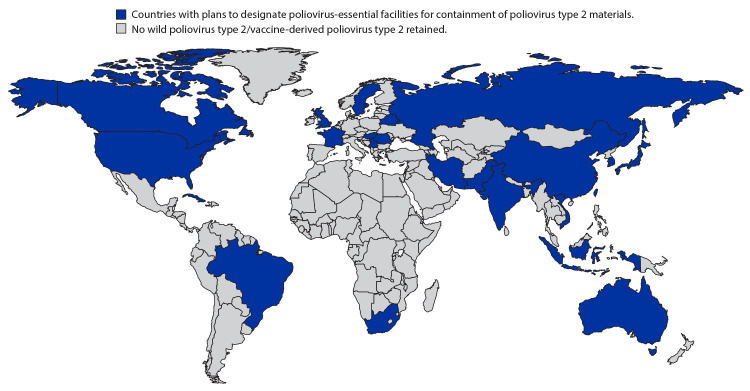
Since 1988, when World Health Organization (WHO) Member States and partners launched the Global Polio Eradication Initiative, the number of wild poliovirus (WPV) cases has declined from 350,000 in 125 countries to 176 in only two countries in 2019 (1). The Global Commission for the Certification of Poliomyelitis Eradication (GCC) declared two of the three WPV types, type 2 (WPV2) and type 3 (WPV3), eradicated globally in 2015 and 2019, respectively (1). Wild poliovirus type 1 (WPV1) remains endemic in Afghanistan and Pakistan (1). Containment under strict biorisk management measures is vital to prevent reintroduction of eradicated polioviruses into communities from poliovirus facilities. In 2015, Member States committed to contain type 2 polioviruses (PV2) in poliovirus-essential facilities (PEFs) certified in accordance with a global standard (2). Member states agreed to report national PV2 inventories annually, destroy unneeded PV2 materials, and, if retaining PV2 materials, establish national authorities for containment (NACs) and a PEF auditing process. Since declaration of WPV3 eradication in October 2019, these activities are also required with WPV3 materials. Despite challenges faced during 2019-2020, including the coronavirus disease 2019 (COVID-19) pandemic, the global poliovirus containment program continues to work toward important milestones. To maintain progress, all WHO Member States are urged to adhere to the agreed containment resolutions, including officially establishing legally empowered NACs and submission of PEF Certificates of Participation.
Conflict of interest statement
All authors have completed and submitted the International Committee of Medical Journal Editors form for disclosure of potential conflicts of interest. No potential conflicts of interest were disclosed.
Figures
References
-
- World Health Organization. WHO global action plan to minimize poliovirus facility-associated risk after type-specific eradication of wild polioviruses and sequential cessation of oral polio vaccine use—GAPIII. 3rd ed. Geneva, Switzerland: World Health Organization; 2015.
MeSH terms
Substances
LinkOut - more resources
Full Text Sources
Medical
