. 2020 Sep 17;17(9):e1003331.
doi: 10.1371/journal.pmed.1003331. eCollection 2020 Sep.

Combined associations of body mass index and adherence to a Mediterranean-like diet with all-cause and cardiovascular mortality: A cohort study

Affiliations

Combined associations of body mass index and adherence to a Mediterranean-like diet with all-cause and cardiovascular mortality: A cohort study

Karl Michaëlsson et al. PLoS Med. .

Abstract

Background: It is unclear whether the effect on mortality of a higher body mass index (BMI) can be compensated for by adherence to a healthy diet and whether the effect on mortality by a low adherence to a healthy diet can be compensated for by a normal weight. We aimed to evaluate the associations of BMI combined with adherence to a Mediterranean-like diet on all-cause and cardiovascular disease (CVD) mortality.

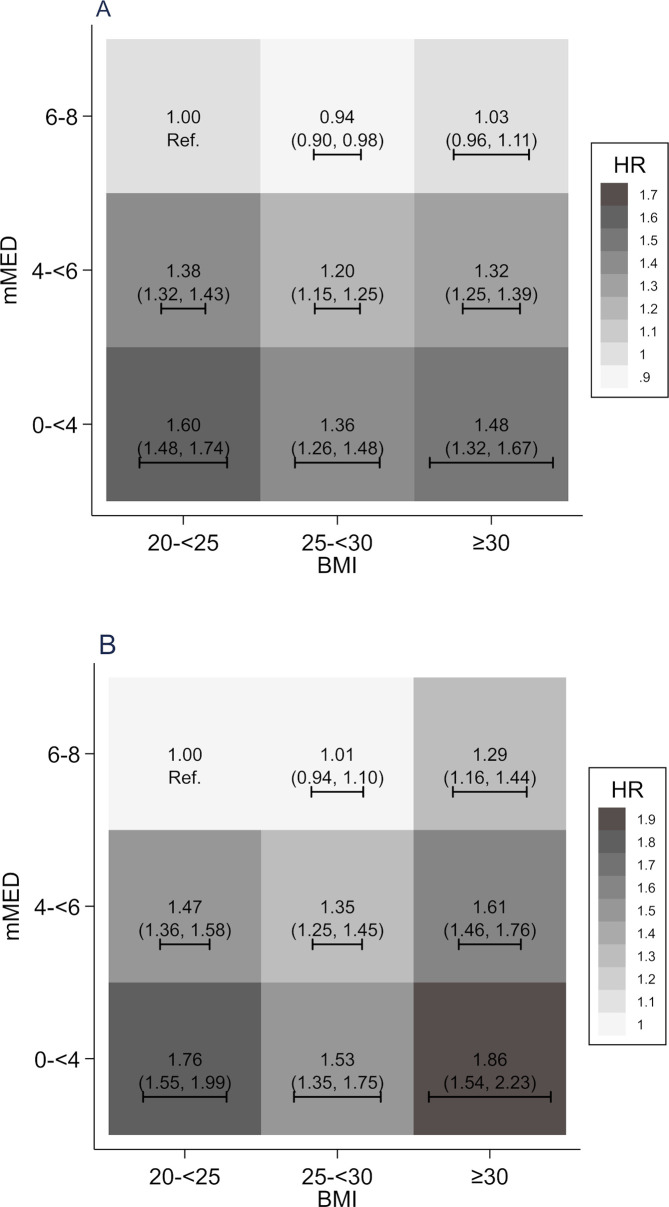
Methods and findings: Our longitudinal cohort design included the Swedish Mammography Cohort (SMC) and the Cohort of Swedish Men (COSM) (1997-2017), with a total of 79,003 women (44%) and men (56%) and a mean baseline age of 61 years. BMI was categorized into normal weight (20-24.9 kg/m2), overweight (25-29.9 kg/m2), and obesity (30+ kg/m2). Adherence to a Mediterranean-like diet was assessed by means of the modified Mediterranean-like diet (mMED) score, ranging from 0 to 8; mMED was classified into 3 categories (0 to <4, 4 to <6, and 6-8 score points), forming a total of 9 BMI × mMED combinations. We identified mortality by use of national Swedish registers. Cox proportional hazard models with time-updated information on exposure and covariates were used to calculate the adjusted hazard ratios (HRs) of mortality with their 95% confidence intervals (CIs). Our HRs were adjusted for age, baseline educational level, marital status, leisure time physical exercise, walking/cycling, height, energy intake, smoking habits, baseline Charlson's weighted comorbidity index, and baseline diabetes mellitus. During up to 21 years of follow-up, 30,389 (38%) participants died, corresponding to 22 deaths per 1,000 person-years. We found the lowest HR of all-cause mortality among overweight individuals with high mMED (HR 0.94; 95% CI 0.90, 0.98) compared with those with normal weight and high mMED. Using the same reference, obese individuals with high mMED did not experience significantly higher all-cause mortality (HR 1.03; 95% CI 0.96-1.11). In contrast, compared with those with normal weight and high mMED, individuals with a low mMED had a high mortality despite a normal BMI (HR 1.60; 95% CI 1.48-1.74). We found similar estimates among women and men. For CVD mortality (12,064 deaths) the findings were broadly similar, though obese individuals with high mMED retained a modestly increased risk of CVD death (HR 1.29; 95% CI 1.16-1.44) compared with those with normal weight and high mMED. A main limitation of the present study is the observational design with self-reported lifestyle information with risk of residual or unmeasured confounding (e.g., genetic liability), and no causal inferences can be made based on this study alone.

Conclusions: These findings suggest that diet quality modifies the association between BMI and all-cause mortality in women and men. A healthy diet may, however, not completely counter higher CVD mortality related to obesity.


Conflict of interest statement

The authors have declared that no competing interests exist.

Figures
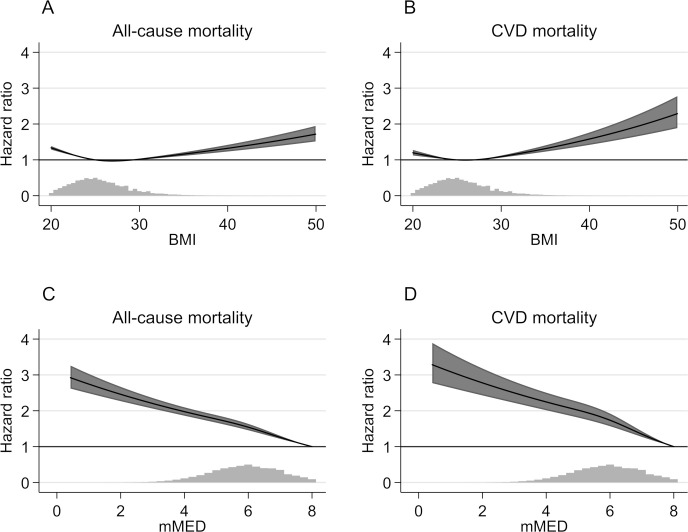
Fig 1
Fig 1. Association between BMI (A for all-cause mortality and B for cardiovascular mortality) and an mMED score (C for all-cause mortality and D for cardiovascular mortality) with mortality.
The dark gray shaded regions in the figures correspond to 95% CIs, and the spike plots represent the distribution of BMI and mMED scores, respectively. Assessed by multivariable-adjusted HRs using of Cox regression analysis and restricted cubic splines, with a BMI of 25 kg/m2 and mMED score of 8 units as references. HRs adjusted for sex, age (splines with 2 knots), educational level (≤9, 10–12, >12 years, other), living alone (yes or no), leisure time physical exercise during the past year (<1 h/w, 1 h/w, 2–3 h/w, 4–5 h/w, >5 h/w), walking/cycling (almost never, <20 min/d, 20–40 min/d, 40–60 min/d, 1–1.5 h/d, >1.5 h/d), height (splines with 2 knots), energy intake (splines with 2 knots), smoking habits (current, former, never), Charlson’s weighted comorbidity index (continuous; 1–16), and diabetes mellitus (yes/no). BMI, body mass index; CI, confidence interval; CVD, cardiovascular disease; HR, hazard ratio; mMED, modified Mediterranean-like diet.
Fig 2
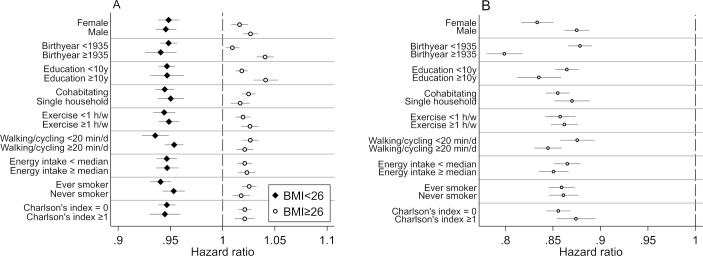
Fig 2. Subgroup analysis for BMI as continuous variable below or above the median of 26 kg/m2 (A) and for mMED (B) as a continuous variable by categories of the covariates.
The whiskers represent 95% CIs. Associations expressed as multivariable-adjusted HRs of all-cause mortality by 1 unit change in BMI or mMED score. HRs adjusted for sex, age (splines with 2 knots), educational level (≤9, 10–12, >12 years, other), living alone (yes or no), leisure time physical exercise during the past year (<1 h/w, 1 h/w, 2–3 h/w, 4–5 h/w, >5 h/w), walking/cycling (almost never, <20 min/d, 20–40 min/d, 40–60 min/d, 1–1.5 h/d, >1.5 h/d), height (splines with 2 knots), energy intake (splines with 2 knots), smoking habits (current, former, never), Charlson’s weighted comorbidity index (continuous; 1–16), and diabetes mellitus (yes/no). BMI, body mass index; CI, confidence interval; HR, hazard ratio; mMED, modified Mediterranean-like diet.
Fig 3
Fig 3. Associations of combinations of BMI and adherence to an mMED with all-cause (A) and CVD mortality (B).
Estimated by multivariable-adjusted HRs by use of Cox regression analysis with a normal BMI and high adherence to mMED as the reference. The CI in each subpanel is expressed both in numbers and as a line representing the width. HRs adjusted for sex, age (splines with 2 knots), educational level (≤9, 10–12, >12 years, other), living alone (yes or no), leisure time physical exercise during the past year (<1 h/w, 1 h/w, 2–3 h/w, 4–5 h/w, >5 h/w), walking/cycling (almost never, <20 min/d, 20–40 min/d, 40–60 min/d, 1–1.5 h/d, >1.5 h/d), height (splines with 2 knots), energy intake (splines with 2 knots), smoking habits (current, former, never), Charlson’s weighted comorbidity index (continuous; 1–16), and diabetes mellitus (yes/no). BMI, body mass index; CI, confidence interval; CVD, cardiovascular disease; HR, hazard ratio; mMED, modified Mediterranean-like diet.

References

    1. Collaborators GBDO, Afshin A, Forouzanfar MH, Reitsma MB, Sur P, Estep K, et al. Health Effects of Overweight and Obesity in 195 Countries over 25 Years. N Engl J Med. 2017;377(1):13–27. 10.1056/NEJMoa1614362 . - DOI - PMC - PubMed
    1. Global BMIMC, Di Angelantonio E, Bhupathiraju Sh N, Wormser D, Gao P, Kaptoge S, et al. Body-mass index and all-cause mortality: individual-participant-data meta-analysis of 239 prospective studies in four continents. Lancet. 2016;388(10046):776–86. 10.1016/S0140-6736(16)30175-1 . - DOI - PMC - PubMed
    1. Bhaskaran K, Dos-Santos-Silva I, Leon DA, Douglas IJ, Smeeth L. Association of BMI with overall and cause-specific mortality: a population-based cohort study of 3.6 million adults in the UK. The lancet Diabetes & endocrinology. 2018;6(12):944–53. 10.1016/S2213-8587(18)30288-2 . - DOI - PMC - PubMed
    1. Adams KF, Schatzkin A, Harris TB, Kipnis V, Mouw T, Ballard-Barbash R, et al. Overweight, obesity, and mortality in a large prospective cohort of persons 50 to 71 years old. N Engl J Med. 2006;355(8):763–78. 10.1056/NEJMoa055643 . - DOI - PubMed
    1. Berrington de Gonzalez A, Hartge P, Cerhan JR, Flint AJ, Hannan L, MacInnis RJ, et al. Body-mass index and mortality among 1.46 million white adults. N Engl J Med. 2010;363(23):2211–9. 10.1056/NEJMoa1000367 . - DOI - PMC - PubMed

Publication types