Review
. 2021 Jan 1;94(1117):20200975.
doi: 10.1259/bjr.20200975. Epub 2020 Sep 17.

Artificial intelligence in paediatric radiology: Future opportunities

Affiliations
Review

Artificial intelligence in paediatric radiology: Future opportunities

Natasha Davendralingam et al. Br J Radiol. .

Abstract

Artificial intelligence (AI) has received widespread and growing interest in healthcare, as a method to save time, cost and improve efficiencies. The high-performance statistics and diagnostic accuracies reported by using AI algorithms (with respect to predefined reference standards), particularly from image pattern recognition studies, have resulted in extensive applications proposed for clinical radiology, especially for enhanced image interpretation. Whilst certain sub-speciality areas in radiology, such as those relating to cancer screening, have received wide-spread attention in the media and scientific community, children's imaging has been hitherto neglected.In this article, we discuss a variety of possible 'use cases' in paediatric radiology from a patient pathway perspective where AI has either been implemented or shown early-stage feasibility, while also taking inspiration from the adult literature to propose potential areas for future development. We aim to demonstrate how a 'future, enhanced paediatric radiology service' could operate and to stimulate further discussion with avenues for research.


Figures
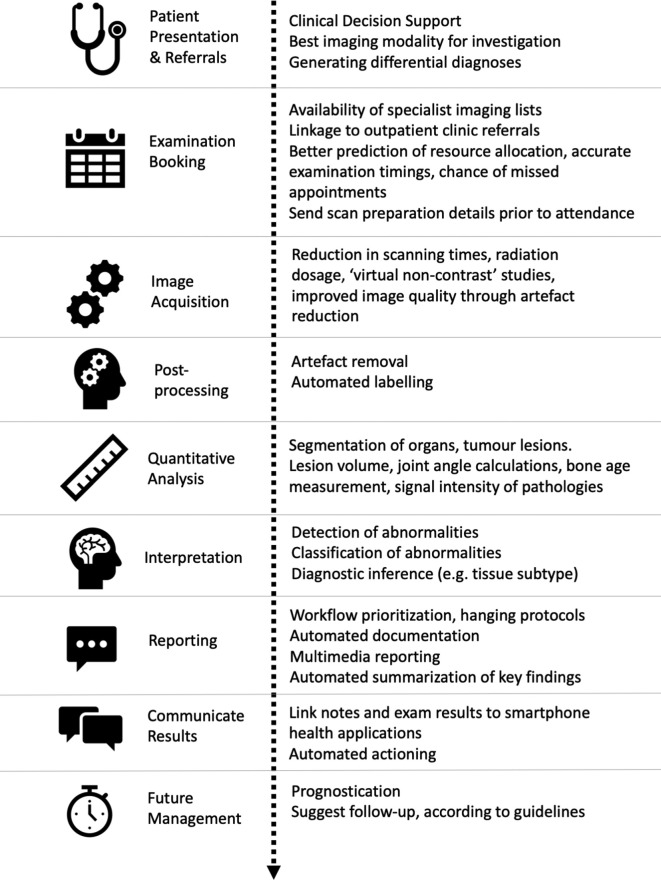
Figure 1.
Figure 1.
Diagram depicting the patient pathway from hospital admission to radiology report and follow-up, with summary of how artificial intelligence tools may enhance clinical practice and patient experience.
Figure 2.
Figure 2.
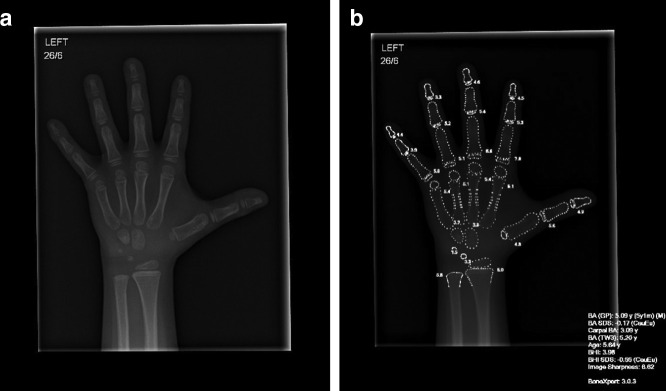
An example of how artificial intelligence software (i.e., BoneXpertTM v.3.0.3) is already being used in some radiology departments for the rapid, automated assessment of bone age. (a) A plain radiograph of the left hand in a male child with short stature aged 5 years and 7 months old. (b) After assessment by the BoneXpertTM software, a duplicate image is produced with an image overlay (white text and outlines), providing details in the bottom right of the image for the bone age according to Greulich and Pyle (5 years 1 month) and estimated standard deviation (−0.17). Additional details are also provided for estimated bone age according to Tanner Whitehouse 3 (TW3: 5.2 years) and a bone health index (BHI).
Figure 3.
Figure 3.
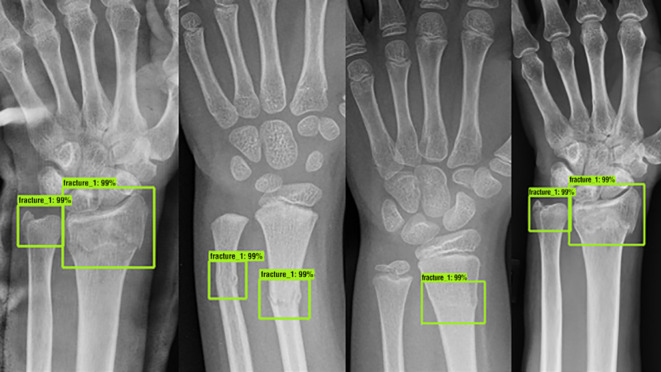
Fracture detection using artificial intelligence on plain frontal wrist radiographs. These examples are from different patients, all with fracture of the distal radius with and without additional ulnar fractures which have been assessed by a deep-learning neural network (the ‘Faster R-convolutional neural network’) trained to detect and localise fractures. Green boxes denote the location of the suspected abnormalities, with percentages provided to reflect the confidence score by the network for a fracture located within the marked box. Reproduced with permission from Thian YL et al. Radiology: Artificial Intelligence. 2019;1(1):e180001

References

    1. LIT L, Kanthasamy S, Ayyalaraju RS, Ganatra R. The current state Fo artificial intelligence in medical imaging and nuclear medicine. BJR Open 2019;: 20190037; (: 201900371. - PMC - PubMed
    1. Royal College of Radiologists National Audit of Paediatric Radiology Services in Hospitals. 2015. Available from: https://www.rcr.ac.uk/sites/default/files/auditreport_paediatricrad.pdf [accessed 24 May 2020].
    1. Letzen B, Wang CJ, Chapiro J. The role of artificial intelligence in interventional oncology: a primer. Journal of Vascular and Interventional Radiology 2019; 30: 38–41. doi: 10.1016/j.jvir.2018.08.032 - DOI - PubMed
    1. Moore MM, Slonimsky E, Long AD, Sze RW, Iyer RS, concepts Mlearning. Concerns and opportunities for a pediatric radiologist. Pediatr Radiol 2019; 49: 509–16. - PubMed
    1. Razavian N, Knoll F, Geras KJ. Artificial intelligence explained for Nonexperts. Semin Musculoskelet Radiol 2020; 24: 003–11. doi: 10.1055/s-0039-3401041 - DOI - PMC - PubMed