. 2020 Oct 7;28(4):516-525.e5.
doi: 10.1016/j.chom.2020.09.002. Epub 2020 Sep 3.

Human B Cell Clonal Expansion and Convergent Antibody Responses to SARS-CoV-2

Affiliations

Human B Cell Clonal Expansion and Convergent Antibody Responses to SARS-CoV-2

Sandra C A Nielsen et al. Cell Host Microbe. .

Abstract

B cells are critical for the production of antibodies and protective immunity to viruses. Here we show that patients infected with severe acute respiratory syndrome coronavirus 2 (SARS-CoV-2) who develop coronavirus disease 2019 (COVID-19) display early recruitment of B cells expressing a limited subset of IGHV genes, progressing to a highly polyclonal response of B cells with broader IGHV gene usage and extensive class switching to IgG and IgA subclasses with limited somatic hypermutation in the initial weeks of infection. We identify convergence of antibody sequences across SARS-CoV-2-infected patients, highlighting stereotyped naive responses to this virus. Notably, sequence-based detection in COVID-19 patients of convergent B cell clonotypes previously reported in SARS-CoV infection predicts the presence of SARS-CoV/SARS-CoV-2 cross-reactive antibody titers specific for the receptor-binding domain. These findings offer molecular insights into shared features of human B cell responses to SARS-CoV-2 and SARS-CoV.

Keywords: B cells; COVID-19; SARS-CoV-2; antibodies; antibody repertoire; clonal expansion; convergent antibody response; immunogenetics; immunology; primary infection.


Conflict of interest statement

Declaration of Interests A.T.S. is a scientific founder of Immunai and receives research funding from Arsenal Biosciences not related to this study. M.H. is an employee of ATUM. S.D.B. has consulted for Regeneron, Sanofi, and Novartis on topics unrelated to this study. S.D.B., K.R., P.S.K., and A.E.P. have filed provisional patent applications related to serological tests for SARS-CoV-2 antibodies. K.C.N. reports grants from National Institute of Allergy and Infectious Diseases (NIAID), Food Allergy Research & Education (FARE), and End Allergies Together (EAT); National Heart, Lung, and Blood Institute (NHLBI), and National Institute of Environmental Health Sciences (NIEHS), and is the director of FARE and World Allergy Organization (WAO) Center of Excellence at Stanford; advisor at Cour Pharma; co-founder of Before Brands, Alladapt, Latitude, and IgGenix; National Scientific Committee member at Immune Tolerance Network (ITN) and National Institutes of Health (NIH); a recipient of a Research Sponsorship from Nestle; Consultant and Advisory Board Member at Before Brands, Alladapt, Iggenix, NHLBI, and Probio; Data and Safety Monitoring Board member at NHLBI; and has US patents for basophil testing, multifood immunotherapy and prevention, monoclonal antibodies from plasmablasts, and devices for diagnostics. The remaining authors declare that they have no competing interests.

Figures

None
Graphical abstract
Figure 1
Figure 1
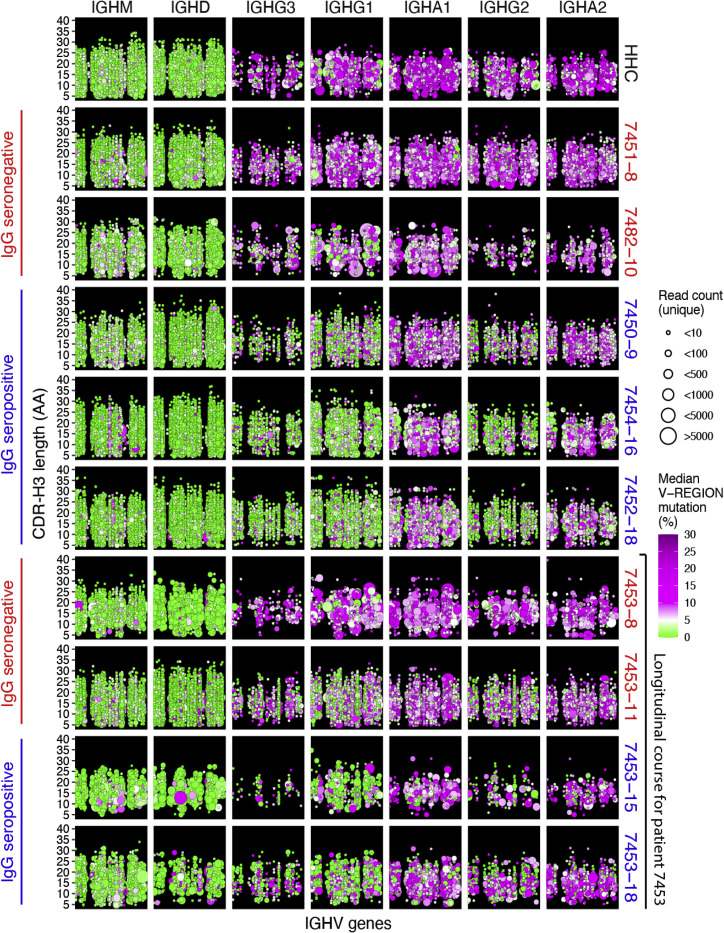
COVID-19 Patient IGH Repertoires Show Early and Extensive Class Switching to IgG and IgA Subclasses without Significant Somatic Mutation Points indicate B cell clonal lineages. Panel rows are different blood samples (HHC or patient ID), and panel column indicates the clone member’s isotype. Within panels, IGHV gene is indicated on the x axis, in the same order and position in each panel, not listed by name due to space constraints, and CDR-H3 length in amino acids (AAs) is indicated on the y axis. Point color indicates median IGHV SHM frequency for each clone, and point size indicates the number of unique reads in the clone. Points are jittered to decrease over-plotting. Patient label colors indicate IgG seroconversion status (red is seronegative, and blue is seropositive) and the number following the patient ID corresponds to days post-symptom onset. The final four rows of panels show the IGH repertoire changes within a single participant (7453) prior to and after seroconversion.
Figure 2
Figure 2
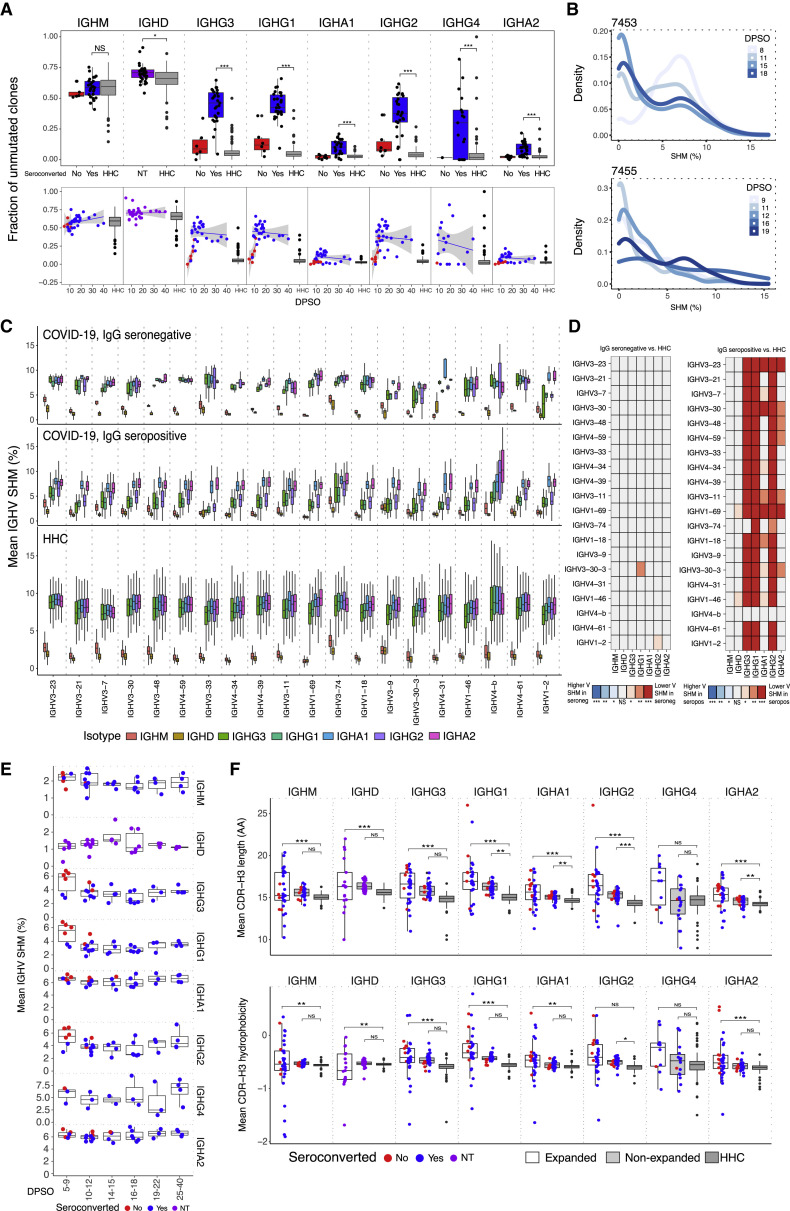
IGH Repertoire Signatures of SARS-CoV-2 Infection (A) Fraction of unmutated (<1% SHM) B cell lineages for each isotype subclass grouped by seroconversion status (top) or plotted by DPSO (bottom). Box colors indicate seronegative (red) or seropositive (blue) for the isotype (IgM serology for IgM; IgG serology for IgG subclasses; and IgA serology for IgA subclasses), with gray for HHC. IgD is indicated in purple as serology was not tested (NT). Points are shown for all COVID-19 samples, and for outliers in the 114 HHC samples. (B) Distribution of clone SHM percentage plotted as kernel density for clones detected at multiple time points from patients 7453 and 7455. Lines are colored by DPSO. Statistical test: two-sided Wilcoxon-Mann-Whitney. (C) Mean IGHV SHM percentage for each isotype subclass in IgG seronegative (top), IgG seropositive (middle), or HHC samples (bottom). The 20 most common IGHVs are ordered by frequency in IgM in the patients. Isotypes are plotted by chromosomal ordering. Rare outlier points with extreme values are not shown but were included in all analyses. (D) Heatmap of IGHV gene SHM for non-seroconverted and seroconverted samples in comparison with HHC. The color scale encodes the significance level and SHM increase (blue) or decrease (red) in COVID-19 in relation with HHC. Statistical test: paired Wilcoxon test with Bonferroni correction for multiple hypothesis testing. (E) Longitudinal SHM for COVID-19 patients is binned by DPSO and colored by seroconversion status. (F) Mean CDR-H3 length (top) or hydrophobicity (bottom) for each isotype. COVID-19 patient expanded (white) or non-expanded (light gray) clones, and total clones from HHC (dark gray) are shown. Statistical test: one-way ANOVA with Tukey’s HSD test. Significance cut-offs: NS, not significant (>0.05), ∗p ≤ 0.05, ∗∗p < 0.01, ∗∗∗p < 0.001. See also Figures S1–S3.
Figure 3
Figure 3
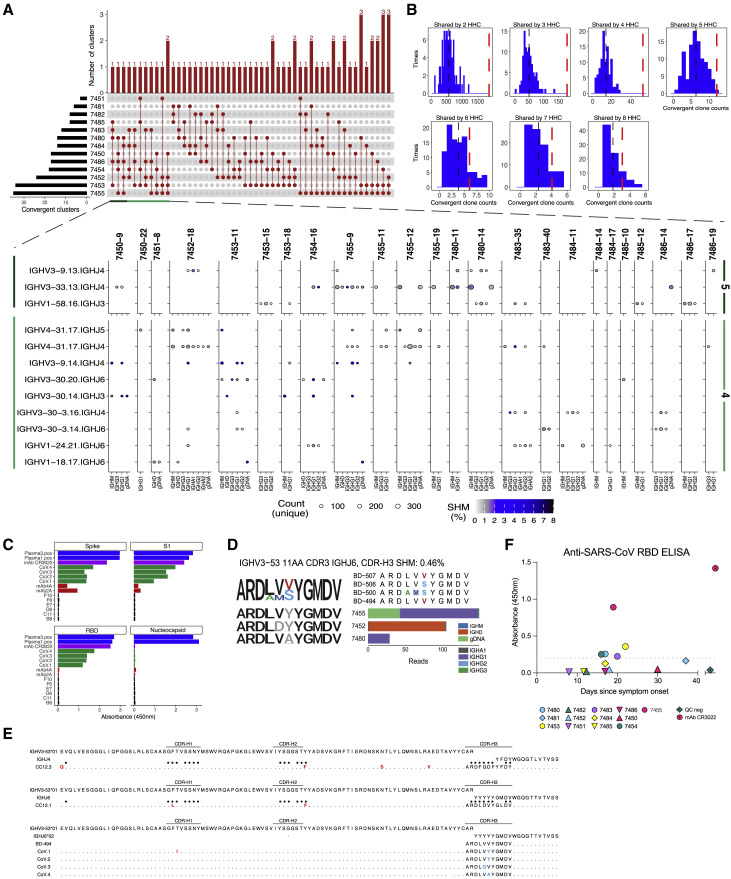
Convergent IGH Sequences among COVID-19 Patients and to Reported Antigen-Specific IGH for SARS-CoV-2 and SARS-CoV (A) Convergent IGH clusters among patient samples (top panel). The sample distribution is indicated by the lines and dots with the number of clusters sharing that sample distribution indicated by the vertical histogram bars. The total number of convergent clusters identified in each sample is indicated in the histogram to the left of the plot. (Expanded panel) Lineages belonging to convergent clusters (y axis) shared across four or five patients (light green or dark green brackets, respectively) are plotted by the expressed isotype (x axis). Point color indicates SHM and size shows the number of unique reads. (B) Distribution of the number of convergent clones shared in two to eight HHC subjects, determined by using 100 resamplings of 13 HHC individuals from the 114 total HHCs. The histogram shows the distribution of convergent clones shared by HHC samples over these trials. The black dashed line is the mean value, and the wide red dashed line is the number of convergent clones shared among the 13 COVID-19 participants. (C) ELISA results for mAb binding to SARS-CoV-2 spike protein (Spike), S1 domain (S1), RBD, and nucleocapsid. Purified mAbs (mAb2A, mAb4A, B8, C11, D6, E7, F6, F10, mAb CR3022) or HEK293 cell supernatants (CoV.1–CoV.4) were tested. mAbs generated from COVID-19 patient convergent clones (red) or clones convergent with BD-494 (green) were compared to negative control mAbs B8, C11, D6, E7, F6, and F10 (black). The SARS-CoV-2 RBD-binding mAb CR3022 (purple) and pooled SARS-CoV-2 patient plasma (Plasma1.pos and Plasma3.pos) were positive controls. Purified mAbs were tested at 50 μg/mL except for mAb CR3022, which was tested at 0.506 μg/mL. (D) CDR-H3 AA sequence logos from anti-SARS-CoV-2 convergent IGH. The reported antigen-specific CDR-H3 is shown at the top, and clones from each patient are aligned below (black if matching a conserved residue in the reported CDR-H3, colored for non-conserved, or gray if not matching). Read count per patient, by isotype, is plotted. The SHM frequency is shown after the convergent IGH label. (E) AA sequence alignment for BD-494-convergent mAbs from (C). SARS-CoV-2-neutralizing mAbs CC12.1 and CC12.3 (Yuan et al., 2020) are shown for reference. Contact residues for CC12.1 and CC12.3 with SARS-CoV-2 RBD are indicated by filled black circles. Residue changes relative to germline IGHV are shown in red. Bases in the CDR-H3 of CoV.1-CoV.4 that differ from the BD-494 CDR-H3 are highlighted in blue. Identical AAs are indicated by small dots. (F) SARS-CoV RBD IgG ELISA of plasma samples from COVID-19 patients, using the latest sample available for each patient. A pre-pandemic healthy blood donor sample pool was used as a negative quality control (QC), and mAb CR3022 was a positive control for SARS-CoV RBD binding (ter Meulen et al., 2006). The dotted line denotes the cut-off value for seroconversion. Assays were performed in duplicate and mean OD values are shown. See also Figure S4 and Table S2.

Update of

Comment in

References

    1. Appanna R., Kg S., Xu M.H., Toh Y.X., Velumani S., Carbajo D., Lee C.Y., Zuest R., Balakrishnan T., Xu W. Plasmablasts During Acute Dengue Infection Represent a Small Subset of a Broader Virus-specific Memory B Cell Pool. EBioMedicine. 2016;12:178–188. - PMC - PubMed
    1. Avnir Y., Watson C.T., Glanville J., Peterson E.C., Tallarico A.S., Bennett A.S., Qin K., Fu Y., Huang C.Y., Beigel J.H. IGHV1-69 polymorphism modulates anti-influenza antibody repertoires, correlates with IGHV utilization shifts and varies by ethnicity. Sci. Rep. 2016;6:20842. - PMC - PubMed
    1. Cao Y., Su B., Guo X., Sun W., Deng Y., Bao L., Zhu Q., Zhang X., Zheng Y., Geng C. Potent Neutralizing Antibodies against SARS-CoV-2 Identified by High-Throughput Single-Cell Sequencing of Convalescent Patients’ B Cells. Cell. 2020;182:73–84.e16. - PMC - PubMed
    1. Corman V.M., Landt O., Kaiser M., Molenkamp R., Meijer A., Chu D.K., Bleicker T., Brünink S., Schneider J., Schmidt M.L. Detection of 2019 novel coronavirus (2019-nCoV) by real-time RT-PCR. Euro Surveill. 2020;25:2000045. - PMC - PubMed
    1. Coughlin M., Lou G., Martinez O., Masterman S.K., Olsen O.A., Moksa A.A., Farzan M., Babcook J.S., Prabhakar B.S. Generation and characterization of human monoclonal neutralizing antibodies with distinct binding and sequence features against SARS coronavirus using XenoMouse. Virology. 2007;361:93–102. - PMC - PubMed

MeSH terms