Review
. 2020 Sep 15;9(9):2102.
doi: 10.3390/cells9092102.

Nano-Enhanced Cancer Immunotherapy: Immunology Encounters Nanotechnology

Affiliations
Review

Nano-Enhanced Cancer Immunotherapy: Immunology Encounters Nanotechnology

Ernesto Bockamp et al. Cells. .

Abstract

Cancer immunotherapy utilizes the immune system to fight cancer and has already moved from the laboratory to clinical application. However, and despite excellent therapeutic outcomes in some hematological and solid cancers, the regular clinical use of cancer immunotherapies reveals major limitations. These include the lack of effective immune therapy options for some cancer types, unresponsiveness to treatment by many patients, evolving therapy resistance, the inaccessible and immunosuppressive nature of the tumor microenvironment (TME), and the risk of potentially life-threatening immune toxicities. Given the potential of nanotechnology to deliver, enhance, and fine-tune cancer immunotherapeutic agents, the combination of cancer immunotherapy with nanotechnology can overcome some of these limitations. In this review, we summarize innovative reports and novel strategies that successfully combine nanotechnology and cancer immunotherapy. We also provide insight into how nanoparticular combination therapies can be used to improve therapy responsiveness, to reduce unwanted toxicity, and to overcome adverse effects of the TME.

Keywords: CAR T cell therapy; PD-1; PD-L1; bi-specific antibody therapy; immune checkpoint inhibitor; macrophage; myeloid derived suppressor cells (MDSC); siRNA; toll like receptor (TLR); tumor microenvironment.


Conflict of interest statement

The authors declare no conflict of interest.

Figures
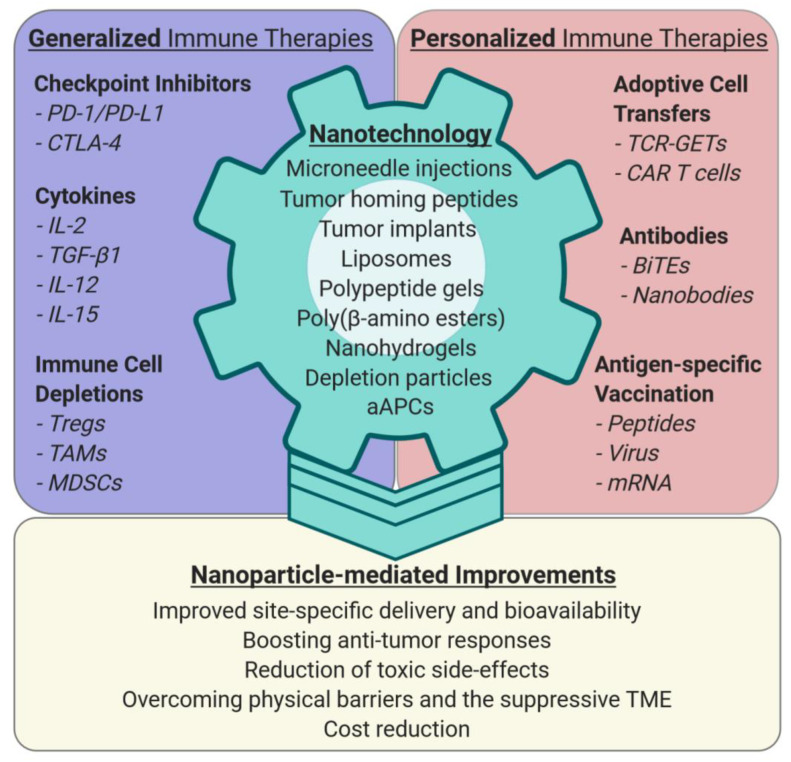
Figure 1
Figure 1
Nanotechnology to improve general and personalized cancer immunotherapies. Nanoparticles can guide given therapeutic agents to specific sites in the body via systemic application, tumor implants, microneedle injection, or tumor homing peptides to improve their bioavailability and stability. Nanomaterials with in vivo efficacy and tolerability are, for example, liposomes, polypeptide gels, poly-β-amino esters, nanohydrogels, or guided aAPCs (artificial antigen presenting cells). They can be engineered to deplete or inhibit immune cell subtypes. Nanoparticle-enhanced efficacy of immune therapies can result in better anti-tumor responses, reduction of systemic toxicities, and cost reduction, because lower amounts of expensive immunotherapeutic agents are needed to achieve a comparable or superior therapeutic effect. Moreover, nanoparticle-mediated targeting of immune suppressive cell types in the TME (tumor microenvironment), especially myeloid cells (TAMs, MDSCs), can make solid tumors more accessible to T- and cancer cell-directed immunotherapy. Abbreviations: programmed cell death protein 1 (PD-1), programmed cell death 1 ligand 1 (PD-L1), cytotoxic T-lymphocyte-associated protein 4 (CTLA-4), interleukins (IL), regulatory T cell (Treg), tumor associated macrophage (TAM), myeloid-derived suppressor cell (MDSC), T cell receptor genetically engineered T cells (TCR-GETs), chimeric antigen receptor (CAR), artificial antigen presenting cell (aAPC).
Figure 2
Figure 2
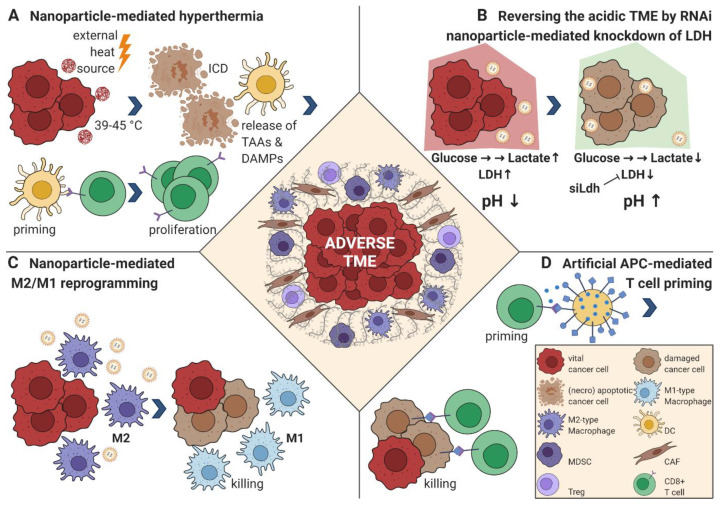
Strategies to reprogram the suppressive TME. (A) Targeted nanoparticles are administered and home to the TME. Upon external irradiation with an energy source (light, magnetic field, radiofrequency application), the surrounding tissue is heated to 39–45 °C, which induces cell stress that triggers the unfolded protein response (UPR) [79]. The UPR can lead to immunogenic cell death (ICD); the release of tumor-associated antigens (TAAs) and danger-associated molecular patterns (DAMPs); and activation of myeloid cells, especially dendritic cells (DCs), that prime T cells to initiate an antigen-specific adaptive anti-cancer immune response executed mainly by CD8+ cytotoxic T cells [70]. (B) RNA-binding nanoparticles are loaded with siRNA targeting lactate dehydrogenase A (LDH). The functional knockdown of LDH minimizes lactate production, reversing the acidic pH of the TME, with a subsequently enhanced immune response and a reduced tumor neoangiogenesis [75]. (C) Nanoparticles for TAM-specific delivery of TLR agonists [80,81] or small molecules inhibiting colony-stimulating factor 1 receptor (CSF-1R) [82] can shift the immune-suppressive M2 phenotype into an inflammatory M1 phenotype promoting CD8+ T cell mediated killing of cancer cells. (D) Artificial antigen presenting cells (aAPCs) express at least one peptide-MHC complex (for example, loaded with a highly expressed intracellular TAA) and a costimulatory signal, for example, anti-CD28 for effective T cell priming. They can also be further modified and loaded with cytokines or ICIs. In comparison with their cellular counterparts, they have the benefit of maintaining an “always on” state that cannot be inactivated [83], allowing for an effective anti-cancer CD8+ T cell priming in the otherwise immunosuppressive TME. Abbreviations: dendritic cell (DC), myeloid-derived suppressor cell (MDSC), cancer-associated fibroblast (CAF), regulatory T cell (Treg), siRNA directed to LDH (siLdh).

References

    1. Nakajima H., Nakatsura T. Towards the era of immune checkpoint inhibitors and personalized cancer immunotherapy. Immunol. Med. 2020:1–6. doi: 10.1080/25785826.2020.1785654. - DOI - PubMed
    1. Topalian S.L. Targeting Immune Checkpoints in Cancer Therapy. JAMA. 2017;318:1647–1648. doi: 10.1001/jama.2017.14155. - DOI - PubMed
    1. June C.H., O’Connor R.S., Kawalekar O.U., Ghassemi S., Milone M.C. CAR T cell immunotherapy for human cancer. Science. 2018;359:1361–1365. doi: 10.1126/science.aar6711. - DOI - PubMed
    1. Sharma P., Hu-Lieskovan S., Wargo J.A., Ribas A. Primary, Adaptive, and Acquired Resistance to Cancer Immunotherapy. Cell. 2017;168:707–723. doi: 10.1016/j.cell.2017.01.017. - DOI - PMC - PubMed
    1. Sharma P., Allison J.P. Dissecting the mechanisms of immune checkpoint therapy. Nat. Rev. Immunol. 2020;20:75–76. doi: 10.1038/s41577-020-0275-8. - DOI - PubMed

Publication types