


Electroencephalography Might Improve Diagnosis of Acute Stroke and Large Vessel Occlusion
- PMID: 32942967
- PMCID: PMC7606743
- DOI: 10.1161/STROKEAHA.120.030150
Electroencephalography Might Improve Diagnosis of Acute Stroke and Large Vessel Occlusion
Abstract
Background and purpose: Clinical methods have incomplete diagnostic value for early diagnosis of acute stroke and large vessel occlusion (LVO). Electroencephalography is rapidly sensitive to brain ischemia. This study examined the diagnostic utility of electroencephalography for acute stroke/transient ischemic attack (TIA) and for LVO.
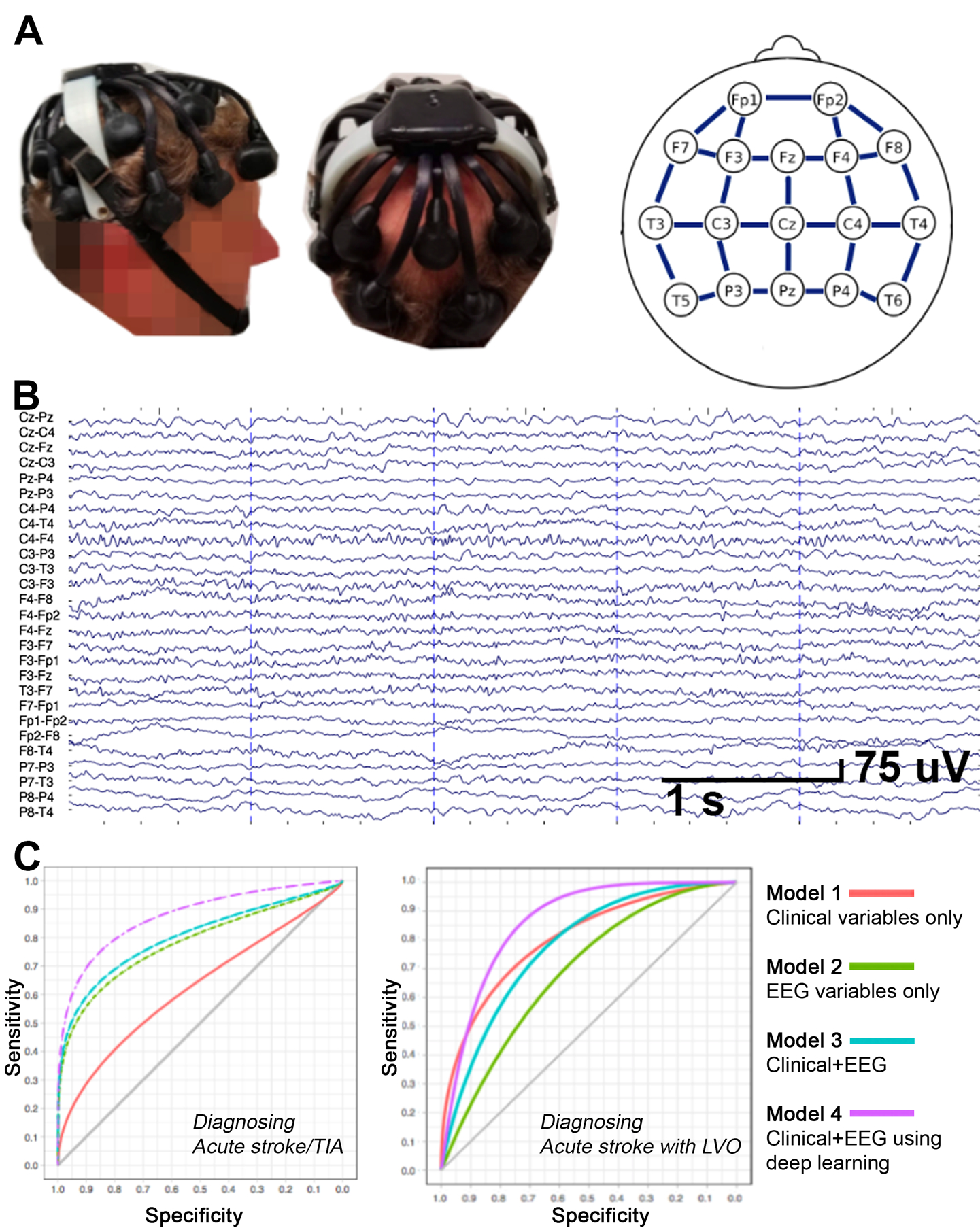
Methods: Patients (n=100) with suspected acute stroke in an emergency department underwent clinical exam then electroencephalography using a dry-electrode system. Four models classified patients, first as acute stroke/TIA or not, then as acute stroke with LVO or not: (1) clinical data, (2) electroencephalography data, (3) clinical+electroencephalography data using logistic regression, and (4) clinical+electroencephalography data using a deep learning neural network. Each model used a training set of 60 randomly selected patients, then was validated in an independent cohort of 40 new patients.
Results: Of 100 patients, 63 had a stroke (43 ischemic/7 hemorrhagic) or TIA (13). For classifying patients as stroke/TIA or not, the clinical data model had area under the curve=62.3, whereas clinical+electroencephalography using deep learning neural network model had area under the curve=87.8. Results were comparable for classifying patients as stroke with LVO or not.
Conclusions: Adding electroencephalography data to clinical measures improves diagnosis of acute stroke/TIA and of acute stroke with LVO. Rapid acquisition of dry-lead electroencephalography is feasible in the emergency department and merits prehospital evaluation.
Keywords: brain; deep learning; early diagnosis; electroencephalography; transient ischemic attack.
Figures
References
-
- Smith EE, Kent DM, Bulsara KR, Leung LY, Lichtman JH, Reeves MJ, Towfighi A, Whiteley WN, Zahuranec DB, American Heart Association Stroke Council. Accuracy of prediction instruments for diagnosing large vessel occlusion in individuals with suspected stroke: A systematic review for the 2018 guidelines for the early management of patients with acute ischemic stroke. Stroke. 2018;49:e111–e122 - PubMed
-
- Astrup JS L; Branston NM; Lassen NA Cortical evoked potential and extracellular K+ and H+ at critical levels of brain ischemia. Stroke. 1977;8:51–57 - PubMed
-
- Marini F, Lee C, Wagner J, Makeig S, Gola M. A comparative evaluation of signal quality between a research-grade and a wireless dry-electrode mobile EEG system. J Neural Eng. 2019;16:054001. - PubMed
-
- Hosmer D, Lemeshow S. Applied logistic regression. New York, NY: John Wiley and Sons; 2000:160–164.
