Review
. 2020 Sep 17;13(1):125.
doi: 10.1186/s13045-020-00962-7.

BCMA-targeted immunotherapy for multiple myeloma

Affiliations
Review

BCMA-targeted immunotherapy for multiple myeloma

Bo Yu et al. J Hematol Oncol. .

Abstract

B cell maturation antigen (BCMA) is a novel treatment target for multiple myeloma (MM) due to its highly selective expression in malignant plasma cells (PCs). Multiple BCMA-targeted therapeutics, including antibody-drug conjugates (ADC), chimeric antigen receptor (CAR)-T cells, and bispecific T cell engagers (BiTE), have achieved remarkable clinical response in patients with relapsed and refractory MM. Belantamab mafodotin-blmf (GSK2857916), a BCMA-targeted ADC, has just been approved for highly refractory MM. In this article, we summarized the molecular and physiological properties of BCMA as well as BCMA-targeted immunotherapeutic agents in different stages of clinical development.

Keywords: Antibody-drug conjugate; B cell maturation antigen; BCMA; Belantamab mafodotin; Bispecific T cell engager; CAR-T.


Conflict of interest statement

The authors declare that they have no competing interests.

Figures
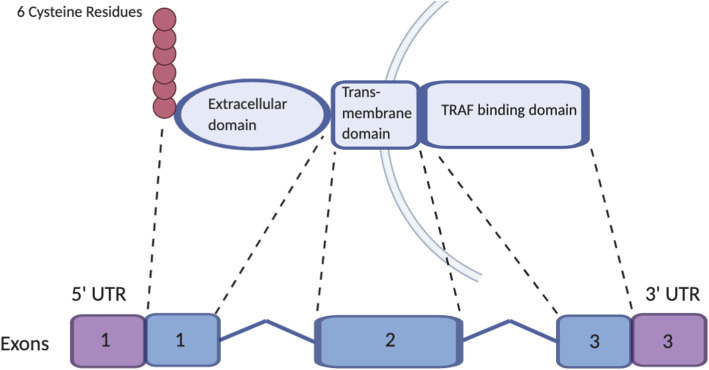
Fig. 1
Fig. 1
BCMA gene and protein. BCMA is encoded by the TNFRSF17 gene (BCMA gene) located on the short arm of chromosome 16 (16p13.13). The BCMA gene comprised of 3 exons separated by 2 introns. BCMA is a type III transmembrane glycoprotein, with an extracellular N terminus containing a conserved motif of 6 cysteines and an intracellular tumor necrosis factor receptor-associated factor (TRAF) binding domain that triggers the activation of nuclear factor κ-light-chain enhancer of activated B cells (NF-κβ) signaling
Fig. 2.
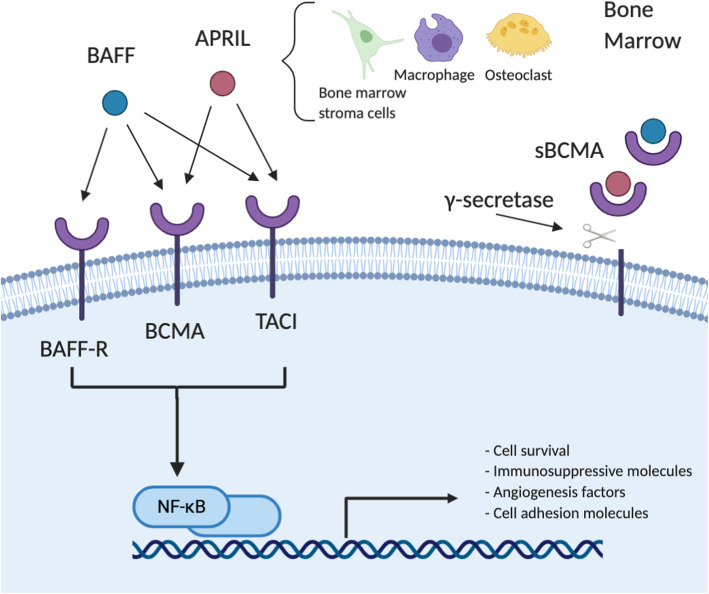
Fig. 2.
BCMA signaling pathway. BCMA has two agonist ligands: a proliferation-inducing ligand (APRIL) and B cell activating factor (BAFF), which are mainly secreted by the bone marrow (BM) stromal cells, osteoclasts, and macrophages in a paracrine manner in the BM. APRIL exhibits a much higher binding affinity to BCMA than BAFF, and it also binds to TACI, while BAFF endorses more selectivity to BAFF-R. Multiple growth and survival signaling cascades are subsequently activated in the multiple myeloma (MM) cells, most frequently through NF-κβ, leading to upregulation of anti-apoptotic proteins and production of cell adhesion molecules, angiogenesis factors, and immunosuppressive molecules. These lead to increased survival of MM cells. Membrane BCMA can be cleaved by γ-secretase and released to the plasma as soluble BCMA (sBCMA). sBCMA can bind to APRIL and BAFF, which may interfere with the activation of BCMA signaling pathways
Fig. 3
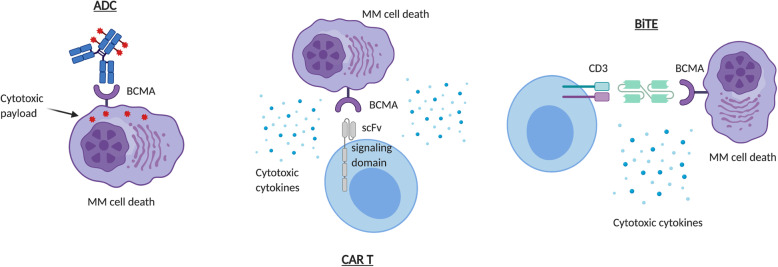
Fig. 3
BCMA-targeted immunotherapies. a Antibody-drug conjugate (ADC). Upon binding to BCMA on the surface of multiple myeloma (MM) cells, ADC is internalized first and the linker is hydrolyzed inside of the lysosomes or endosomes, releasing the payloads that lead to cell death. b Chimeric antigen receptor (CAR)-T cells. The ectodomain of the BCMA scFv on the CAR-T cells binds to BCMA on the surface of MM cells. This leads to activation of the CAR-T cells which release cytotoxic cytokines and cause MM cell death. c Bispecific T cell engager (BiTE). The dual BCMA- and CD3-scFv-containing BiTE binds concomitantly to CD3 and BCMA, facilitating T cell/MM cell crosslinking, followed by CD4+/CD8+ T cell activation and secretion of cytotoxic cytokines, leading to MM cell death

References

    1. Raza S, Safyan RA, Lentzsch S. Immunomodulatory drugs (IMiDs) in multiple myeloma. Curr Cancer Drug Targets. 2017;17(9):846–857. - PubMed
    1. Chehab S, Panjic EH, Gleason C, Lonial S, Nooka AK. Daratumumab and its use in the treatment of relapsed and/or refractory multiple myeloma. Future Oncol. 2018;14(30):3111–3121. doi: 10.2217/fon-2018-0275. - DOI - PubMed
    1. Le Ray E, Jagannath S, Palumbo A. Advances in targeted therapy for the treatment of patients with relapsed/refractory multiple myeloma. Expert Rev Hematol. 2016;9(1):91–105. doi: 10.1586/17474086.2016.1119041. - DOI - PubMed
    1. Bray F, Ferlay J, Soerjomataram I, Siegel RL, Torre LA, Jemal A. Global cancer statistics 2018: GLOBOCAN estimates of incidence and mortality worldwide for 36 cancers in 185 countries. CA Cancer J Clin. 2018;68(6):394–424. doi: 10.3322/caac.21492. - DOI - PubMed
    1. Liu J, Liu W, Mi L, Zeng X, Cai C, Ma J, Wang L. Union for China Lymphoma Investigators of the Chinese Society of Clinical O, Union for China Leukemia Investigators of the Chinese Society of Clinical O: Incidence and mortality of multiple myeloma in China, 2006–2016: an analysis of the Global Burden of Disease Study 2016. J Hematol Oncol. 2019;12(1):136. doi: 10.1186/s13045-019-0807-5. - DOI - PMC - PubMed

MeSH terms