


Development of a serum miRNA panel for detection of early stage non-small cell lung cancer
- PMID: 32943537
- PMCID: PMC7547174
- DOI: 10.1073/pnas.2006212117
Development of a serum miRNA panel for detection of early stage non-small cell lung cancer
Abstract
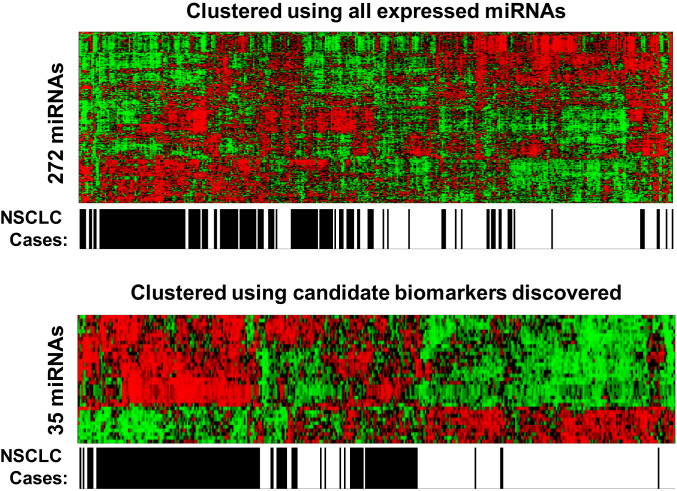
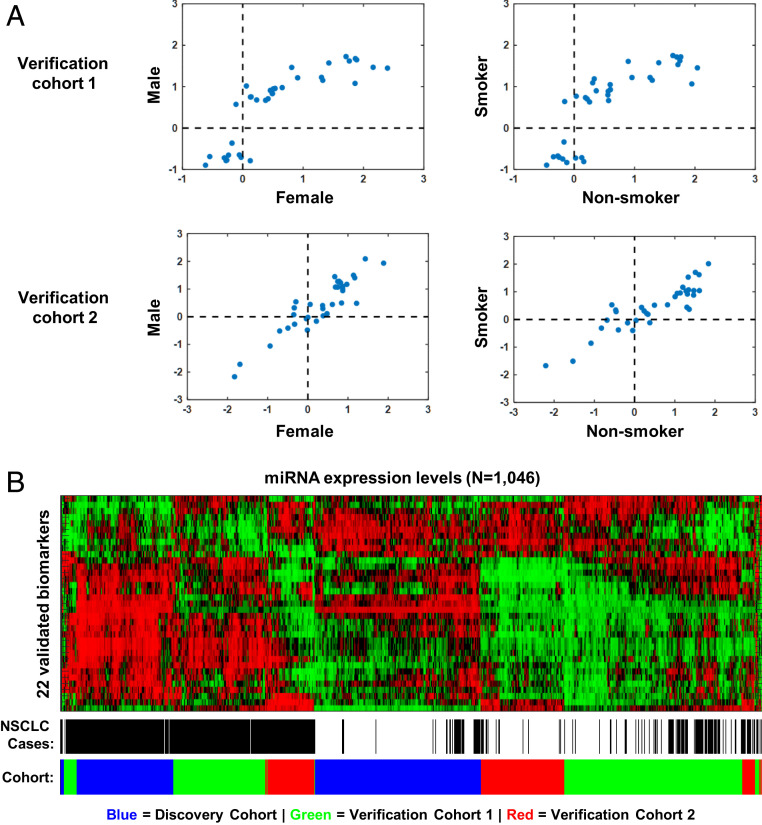
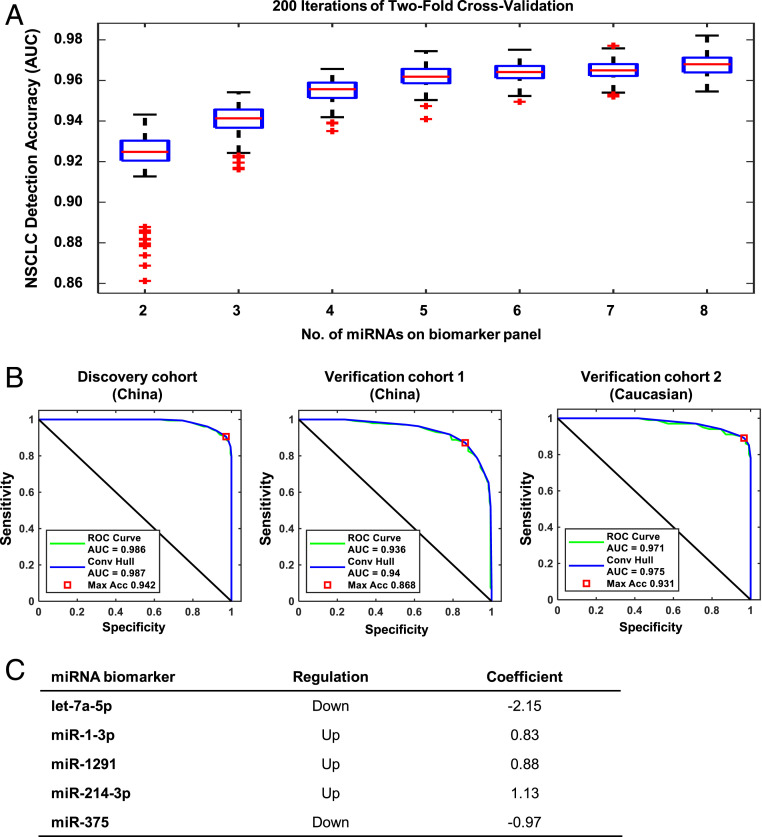
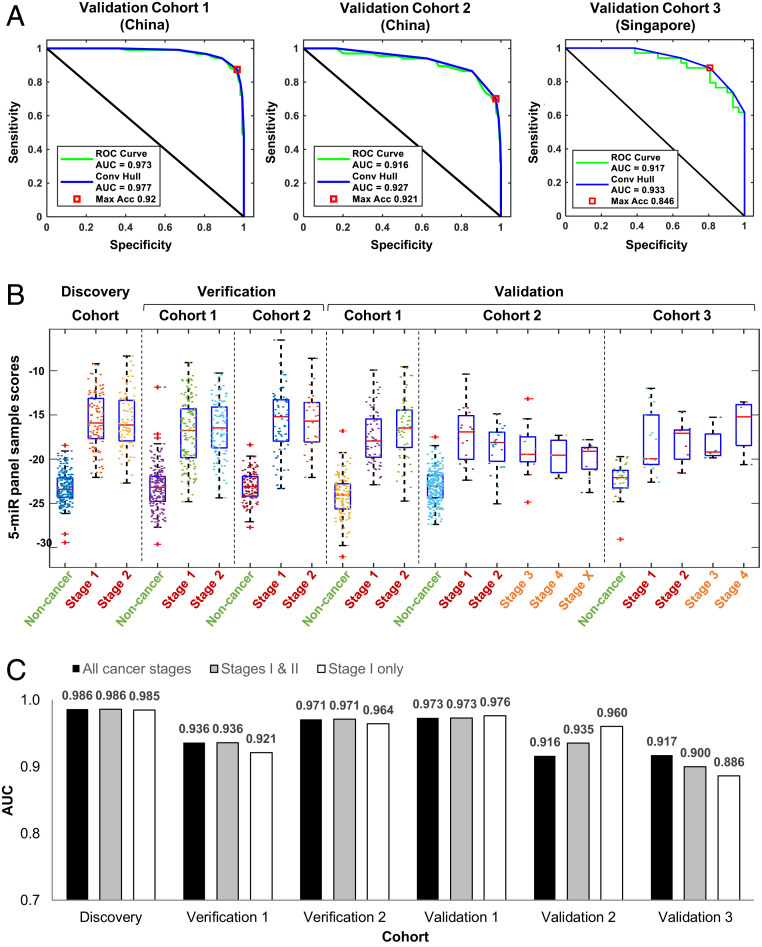
Minimally invasive testing for early detection of lung cancer to improve patient survival is a major unmet clinical need. This study aimed to develop and validate a serum multi-microRNA (multimiR) panel as a minimally invasive test for early detection of nonsmall cell lung cancer (NSCLC) regardless of smoking status, gender, and ethnicity. Our study included 744 NSCLC cases and 944 matched controls, including smokers and nonsmokers, male and female, with Asian and Caucasian subjects. Using RT-qPCR and a tightly controlled workflow, we quantified the absolute expression of 520 circulating microRNAs (miRNAs) in a Chinese cohort of 180 early stage NSCLC cases and 216 healthy controls (male smokers). Candidate biomarkers were verified in two case-control cohorts of 432 Chinese and 218 Caucasians, respectively (including females and nonsmokers). A multimiR panel for NSCLC detection was developed using a twofold cross-validation and validated in three additional Asian cohorts comprising 642 subjects. We discovered 35 candidate miRNA biomarkers, verified 22 of them, and developed a five-miR panel that detected NSCLC with area under curve (AUC) of 0.936-0.984 in the discovery and verification cohorts. The panel was validated in three independent cohorts with AUCs of 0.973, 0.916, and 0.917. The sensitivity of five-miR test was 81.3% for all stages, 82.9% for stages I and II, and 83.0% for stage I NSCLC, when the specificity is at 90.7%. We developed a minimally invasive five-miR serum test for detecting early stage NSCLC and validated its performance in multiple patient cohorts independent of smoking status, gender, and ethnicity.
Keywords: blood biomarker; early detection; microRNA.
Conflict of interest statement
Competing interest statement: R.Z. is the chairman and chief executive officer (CEO) of MIRXES (Hangzhou) Biotechnology Co., Ltd and has ownership interest (including patents) in the same. L.Z. is co-CEO of MIRXES (Hangzhou) Biotechnology Co., Ltd and has ownership interest (including patents) in the same.
Figures
References
-
- Islami F. et al., Proportion and number of cancer cases and deaths attributable to potentially modifiable risk factors in the United States. CA Cancer J. Clin. 68, 31–54 (2018). - PubMed
-
- Chen W. et al., Cancer statistics in China, 2015. CA Cancer J. Clin. 66, 115–132 (2016). - PubMed
-
- Ganti A. K., Mulshine J. L., Lung cancer screening. Oncologist 11, 481–487 (2006). - PubMed
-
- Goodgame B. et al., A clinical model to estimate recurrence risk in resected stage I non-small cell lung cancer. Am. J. Clin. Oncol. 31, 22–28 (2008). - PubMed
-
- Goldstraw P. et al.; International Association for the Study of Lung Cancer Staging and Prognostic Factors Committee, Advisory Boards, and Participating Institutions; International Association for the Study of Lung Cancer Staging and Prognostic Factors Committee Advisory Boards and Participating Institutions , The IASLC lung cancer staging project: Proposals for revision of the TNM stage groupings in the forthcoming (eighth) edition of the TNM classification for lung cancer. J. Thorac. Oncol. 11, 39–51 (2016). - PubMed
Publication types
MeSH terms
Substances
LinkOut - more resources
Full Text Sources
Other Literature Sources
