


Functional impairment and disability among patients with migraine: evaluation of galcanezumab in a long-term, open-label study
- PMID: 32944843
- PMCID: PMC7886775
- DOI: 10.1007/s11136-020-02632-0
Functional impairment and disability among patients with migraine: evaluation of galcanezumab in a long-term, open-label study
Erratum in
-
Correction to: Functional impairment and disability among patients with migraine: evaluation of galcanezumab in a long-term, open-label study.Qual Life Res. 2021 Feb;30(2):465-466. doi: 10.1007/s11136-020-02720-1. Qual Life Res. 2021. PMID: 33340061 Free PMC article. No abstract available.
Abstract
Purpose: Migraine can negatively impact patient functioning and quality of life. Here, we report the effects of galcanezumab (GMB), a humanized monoclonal antibody that binds to calcitonin gene-related peptide, on patient-reported outcome (PRO) measures in migraine.
Methods: CGAJ was a Phase III, randomized, open-label study (12-month open-label and 4-month post-treatment follow-up) in patients with episodic or chronic migraine. Patients aged 18-65 years with diagnosis of migraine (≥ 4 migraine headache days per month) as defined by International Classification of Headache Disorders (ICHD)-3 beta guidelines were included in the study. Patients were randomized 1:1 with subcutaneous GMB 120 mg (with a loading dose of 240 mg) or GMB 240 mg given once monthly for 12 months. Changes from baseline in PRO measures such as Migraine-Specific Quality of Life Questionnaire v2.1 (MSQ) and Migraine Disability Assessment (MIDAS) were assessed.
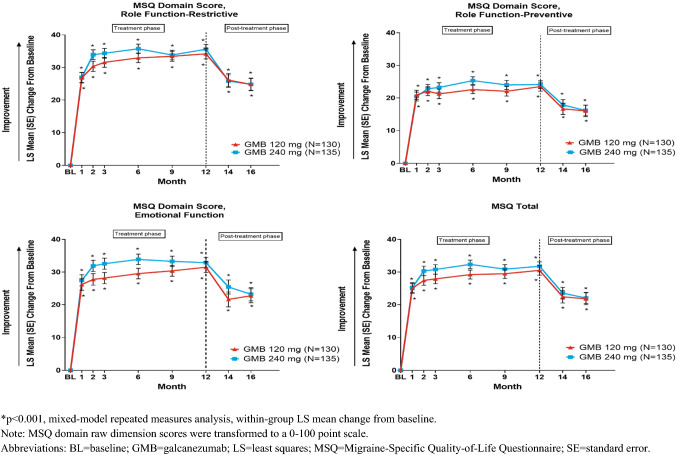
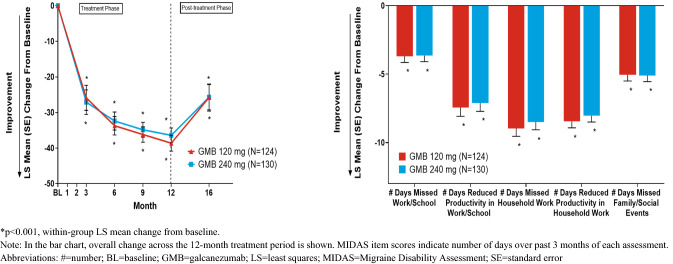
Results: A total of 135 patients were randomized to each galcanezumab dose group. Mean (SD) baseline MSQ total scores were 53.85 (20.34) [GMB 120 mg] and 53.69 (18.79) [GMB 240 mg]. For MIDAS, mean (SD) total scores were 45.77 (42.06) [GMB 120 mg] and 53.96 (61.24) [GMB 240 mg]. Within-group mean improvement from baseline on MSQ and MIDAS total scores and all individual item/domain scores were statistically significant for both GMB dose groups, at all-time points during the treatment phase (p < 0.001). For MSQ domain scores, greatest improvement was observed in the Role function-restrictive (RF-R) domain (overall least squares (LS) mean change ± SE: 31.55 ± 1.20 [GMB 120 mg] and 33.40 ± 1.16 [GMB 240 mg]). For MIDAS, the overall LS mean change ± SE from baseline across the entire 12-month treatment phase in total scores were: -33.58 ± 2.11 (GMB 120 mg) and -32.67 ± 2.04 (GMB 240 mg).
Conclusion: Galcanezumab was associated with statistically significant changes from baseline in the PRO measures across the entire 12-month treatment period. These results indicate improved health-related quality of life and decreased disability among patients treated with galcanezumab.
Keywords: Galcanezumab; Migraine; Migraine disability assessment; Migraine-specific quality of life; Open-label study; Patient reported outcomes.
Conflict of interest statement
Janet Ford, Virginia Stauffer, Matthew Sexson, David Ayer, Shufang Wang are employees of Eli Lilly and Company, Indianapolis, IN, USA and hold company stock. Peter McAllister is an employee of New England Institute for Neurology and Headache, USA. He is an independent contractor and part of speaker bureaus at Teva Pharmaceuticals, Amgen and Allergan. Sreelatha Akkala is a full-time employee of Eli Lilly Services India Pvt. Ltd, India.
Figures
References
-
- Disease GBD, Injury I, Prevalence C. Global, regional, and national incidence, prevalence, and years lived with disability for 328 diseases and injuries for 195 countries, 1990–2016: A systematic analysis for the Global Burden of Disease Study 2016. Lancet. 2017;390(10100):1211–1259. doi: 10.1016/S0140-6736(17)32154-2. - DOI - PMC - PubMed
-
- Headache Classification Committee of the International Headache, S The International Classification of Headache Disorders, 3rd edition. Cephalalgia. 2018;38:1–211. - PubMed
Publication types
MeSH terms
Substances
LinkOut - more resources
Full Text Sources
Medical
