


Tricuspid regurgitant jet velocity and myocardial tissue Doppler parameters predict mortality in a cohort of patients with sickle cell disease spanning from pediatric to adult age groups - revisiting this controversial concept after 16 years of additional evidence
- PMID: 32944977
- PMCID: PMC7746595
- DOI: 10.1002/ajh.26003
Tricuspid regurgitant jet velocity and myocardial tissue Doppler parameters predict mortality in a cohort of patients with sickle cell disease spanning from pediatric to adult age groups - revisiting this controversial concept after 16 years of additional evidence
Abstract
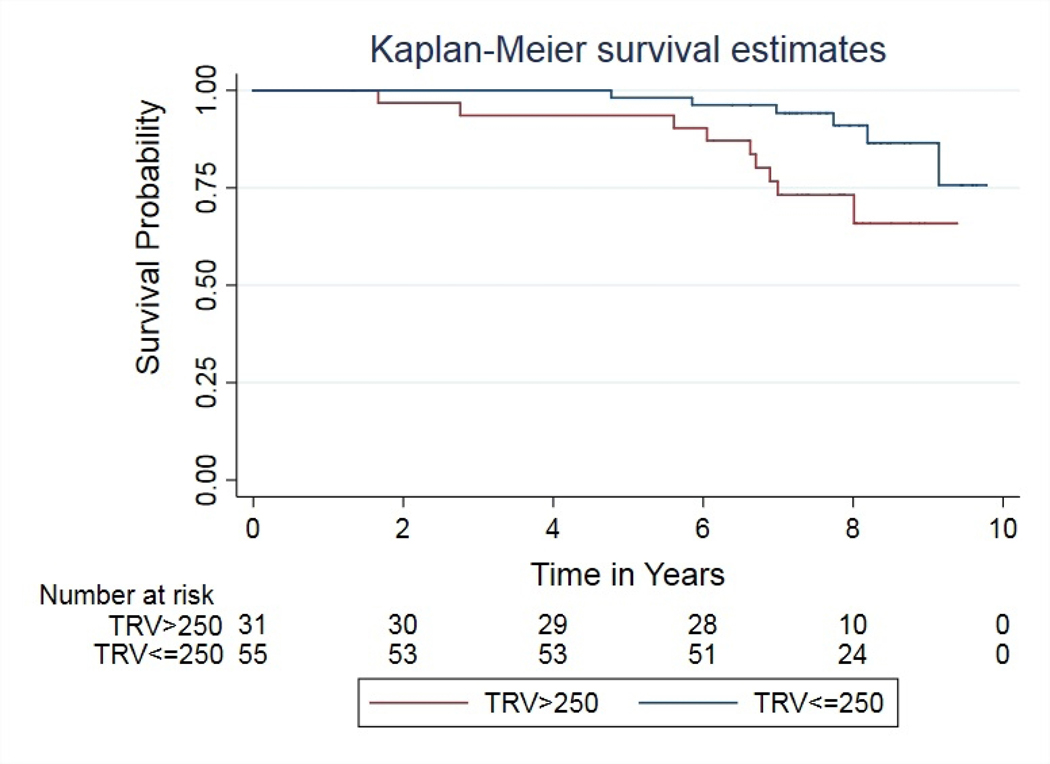
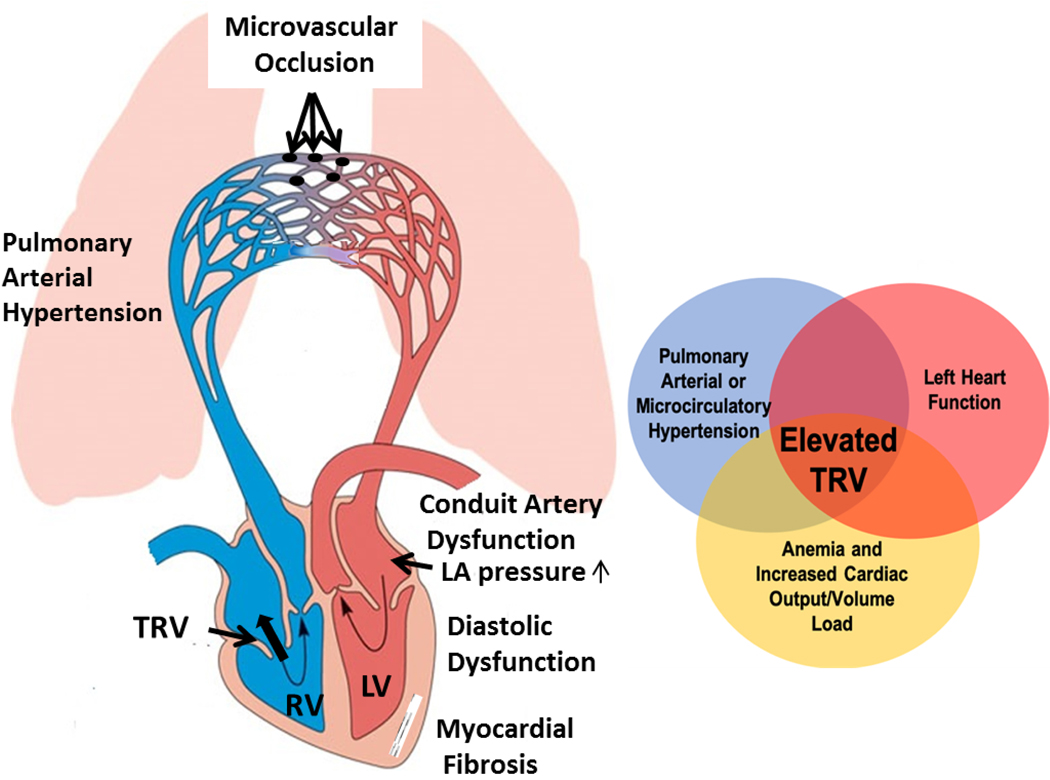
Sickle cell disease (SCD) is a monogenic hemoglobinopathy associated with significant morbidity and mortality. Cardiopulmonary, vascular and sudden death are the reasons for the majority of young adult mortality in SCD. To better understand the clinical importance of multi-level vascular dysfunction, in 2009 we assessed cardiac function including tricuspid regurgitant jet velocity (TRV), tissue velocity in systole(S') and diastole (E'), inflammatory, rheologic and hemolytic biomarkers as predictors of mortality in patients with SCD. With up to 9 years of follow up, we determined survival in 95 children, adolescents and adults with SCD. Thirty-eight patients (40%) were less than 21 years old at initial evaluation. Survival and Cox proportional-hazards analysis were performed. There was 19% mortality in our cohort, with median age at death of 35 years. In the pediatric subset, there was 11% mortality during the follow up period. The causes of death included cardiovascular and pulmonary complications in addition to other end-organ failure. On Cox proportional-hazards analysis, our model predicts that a 0.1 m/s increase in TRV increases risk of mortality 3%, 1 cm/s increase in S' results in a 91% increase, and 1 cm/s decrease in E' results in a 43% increase in mortality. While excluding cardiac parameters, higher plasma free hemoglobin was significantly associated with risk of mortality (p=.049). In conclusion, elevated TRV and altered markers of cardiac systolic and diastolic function predict mortality in a cohort of adolescents and young adult patients with SCD. These predictors should be considered when counseling cardiovascular risk and therapeutic optimization at transition to adult providers.
© 2020 Wiley Periodicals LLC.
Figures
Comment in
-
Identifying adolescent and young adult patients with sickle cell disease at highest risk of death.Am J Hematol. 2021 Jan;96(1):9-11. doi: 10.1002/ajh.26035. Epub 2020 Nov 6. Am J Hematol. 2021. PMID: 33108017 No abstract available.
References
-
- CDC. Data & Statistics on Sickle Cell Disease | CDC. Centers for Disease Control and Prevention. Published August 31, 2016. Accessed February 18, 2019 https://www.cdc.gov/ncbddd/sicklecell/data.html
-
- Sickle Cell Disease | National Heart, Lung, and Blood Institute (NHLBI). Accessed July 10, 2019 https://www.nhlbi.nih.gov/health-topics/sickle-cell-disease
Publication types
MeSH terms
Grants and funding
- R03 HL 138321-01/National Institute of Health/International
- U54 HL090511/HL/NHLBI NIH HHS/United States
- P41 EB001978/EB/NIBIB NIH HHS/United States
- K12 HD52954-6 A1/National Institute of Health/International
- K23 HL 119627-01A1/National Institute of Health/International
- 1RC HL099412-01/National Institute of Health/International
- K23 HL119627/HL/NHLBI NIH HHS/United States
- UL1 TR001855/TR/NCATS NIH HHS/United States
- R03 HL138321/HL/NHLBI NIH HHS/United States
- RC1 HL099412/HL/NHLBI NIH HHS/United States
- K12 HD052954/HD/NICHD NIH HHS/United States
- U54 HL090511-01/National Institute of Health/International
- U01 HL117718/HL/NHLBI NIH HHS/United States
LinkOut - more resources
Full Text Sources
Medical