


Survival outcomes in men with a positive family history of prostate cancer: a registry based study
- PMID: 32948129
- PMCID: PMC7499864
- DOI: 10.1186/s12885-020-07174-9
Survival outcomes in men with a positive family history of prostate cancer: a registry based study
Abstract
Background: To investigate the correlation between family history of prostate cancer (PCa) and survival (overall and cancer specific) in patients undergoing treatment for PCa.
Methods: ine thousand four hundred fifty-nine patients with PCa were extracted from the South Australian Prostate Cancer Clinical Outcomes Collaborative (SA-PCCOC) database. Diagnosis occurred after 1998 and treatment before 2014. Cox proportional-hazards modeling was used to assess the effect of family history on overall survival after adjustment for confounders (age at diagnosis, NCCN risk category and year of treatment), and with stratification by primary treatment group. Competing risks regression modelling was used to assess PCa specific mortality.
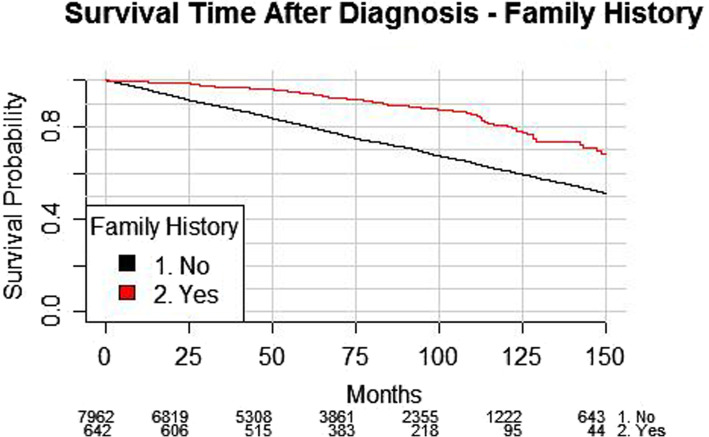
Results: Men with a positive family history of PCa appear to have a lower Gleason score at the time of diagnosis (50% with Gleason < 7, compared to 39% in those without family history) and be diagnosed at a lower age (64 vs 69). Men with a positive family history of PCa appear to have better overall survival outcomes (p < 0.001, log rank test). In analysis adjusting for age at diagnosis, NCCN risk category and year of treatment, family history remained a significant factor when modelling overall survival (HR 0.72 95% CI 0.55-0.95, p = 0.021). There were no significant differences in treatment subgroups of radical prostatectomy (p = 0.7) and radiotherapy (0.054).
Conclusion: Men with a positive family history of PCa appear to have better overall survival outcomes. This better survival may represent lead time bias and early initiation of PSA screening. Family history of PCa was not associated with different survival outcomes in men who were treated with either radical prostatectomy or radiotherapy.
Keywords: Family history; Genetics; Outcomes; Prostate Cancer; Survival.
Conflict of interest statement
No authors declare conflicts of interest.
Figures


References
MeSH terms
LinkOut - more resources
Full Text Sources
Medical
Research Materials
Miscellaneous
