


Positive association between triglyceride glucose index and arterial stiffness in hypertensive patients: the China H-type Hypertension Registry Study
- PMID: 32948181
- PMCID: PMC7501677
- DOI: 10.1186/s12933-020-01124-2
Positive association between triglyceride glucose index and arterial stiffness in hypertensive patients: the China H-type Hypertension Registry Study
Abstract
Background: Data are limited on whether TyG index is an independent predictor of arterial stiffness in hypertensive patients. The purpose of this study was to assess the association between the TyG index and arterial stiffness, and examined whether there were effect modifiers, in hypertensive patients.
Methods: This study included 4718 hypertensive adults, a subset of the China H-type Hypertension Registry Study. The TyG index was calculated as ln[fasting triglycerides (mg/dL) × fasting glucose (mg/dL)/2]. Arterial stiffness was determined by measuring brachial-ankle pulse wave velocity (baPWV).
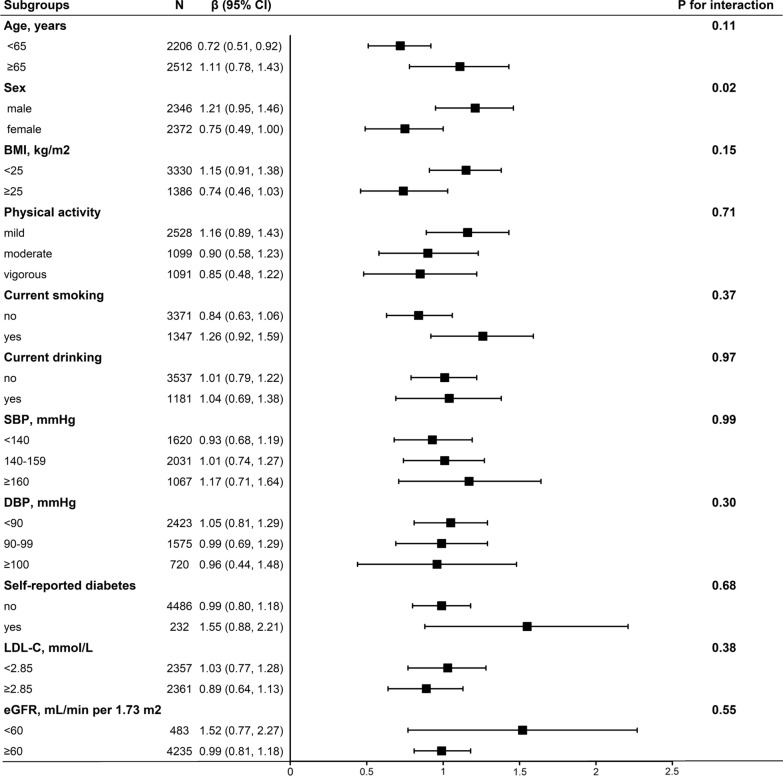
Results: The overall mean TyG index was 8.84. Multivariate linear regression analyses showed that TyG index was independently and positively associated with baPWV (β, 1.02; 95% confidence interval [CI] 0.83, 1.20). Consistently, Multiple logistic analyses showed a positive association between TyG index risk of elevated baPWV (> 75th percentile) (odds ratio [OR], 2.12; 95% CI 1.80, 2.50). Analyses using restricted cubic spline confirmed that the associations of TyG index with baPWV and elevated baPWV were linear. Subgroup analyses showed that stronger associations between TyG index and baPWV were detected in men (all P for interaction < 0.05).
Conclusion: TyG index was independently and positively associated with baPWV and elevated baPWV among hypertensive patients, especially in men. The data suggest that TyG index may serve as a simple and effective tool for arterial stiffness risk assessment in daily clinical practice.
Keywords: Arterial stiffness; Brachial-ankle pulse wave velocity; Hypertension; Triglyceride glucose index.
Conflict of interest statement
The authors declare that they have no conflict of interest.
Figures

References
-
- Ben-Shlomo Y, Spears M, Boustred C, May M, Anderson SG, Benjamin EJ, Boutouyrie P, Cameron J, Chen CH, Cruickshank JK, et al. Aortic pulse wave velocity improves cardiovascular event prediction: an individual participant meta-analysis of prospective observational data from 17,635 subjects. J Am Coll Cardiol. 2014;63(7):636–646. doi: 10.1016/j.jacc.2013.09.063. - DOI - PMC - PubMed
-
- Ohkuma T, Ninomiya T, Tomiyama H, Kario K, Hoshide S, Kita Y, Inoguchi T, Maeda Y, Kohara K, Tabara Y, et al. Brachial-Ankle pulse wave velocity and the risk prediction of cardiovascular disease: an individual participant data meta-analysis. Hypertension. 2017;69(6):1045–1052. doi: 10.1161/HYPERTENSIONAHA.117.09097. - DOI - PubMed
Publication types
MeSH terms
Substances
LinkOut - more resources
Full Text Sources
Medical
