. 2020 Nov 5;10(11):3907-3919.
doi: 10.1534/g3.120.401612.

A Reference Genome Sequence for Giant Sequoia

Affiliations

A Reference Genome Sequence for Giant Sequoia

Alison D Scott et al. G3 (Bethesda). .

Abstract

The giant sequoia (Sequoiadendron giganteum) of California are massive, long-lived trees that grow along the U.S. Sierra Nevada mountains. Genomic data are limited in giant sequoia and producing a reference genome sequence has been an important goal to allow marker development for restoration and management. Using deep-coverage Illumina and Oxford Nanopore sequencing, combined with Dovetail chromosome conformation capture libraries, the genome was assembled into eleven chromosome-scale scaffolds containing 8.125 Gbp of sequence. Iso-Seq transcripts, assembled from three distinct tissues, was used as evidence to annotate a total of 41,632 protein-coding genes. The genome was found to contain, distributed unevenly across all 11 chromosomes and in 63 orthogroups, over 900 complete or partial predicted NLR genes, of which 375 are supported by annotation derived from protein evidence and gene modeling. This giant sequoia reference genome sequence represents the first genome sequenced in the Cupressaceae family, and lays a foundation for using genomic tools to aid in giant sequoia conservation and management.

Keywords: Sequoiadendron giganteum; conifer; disease resistance genes; genome assembly; giant sequoia; gymnosperm.


Figures

Figure 1
Figure 1
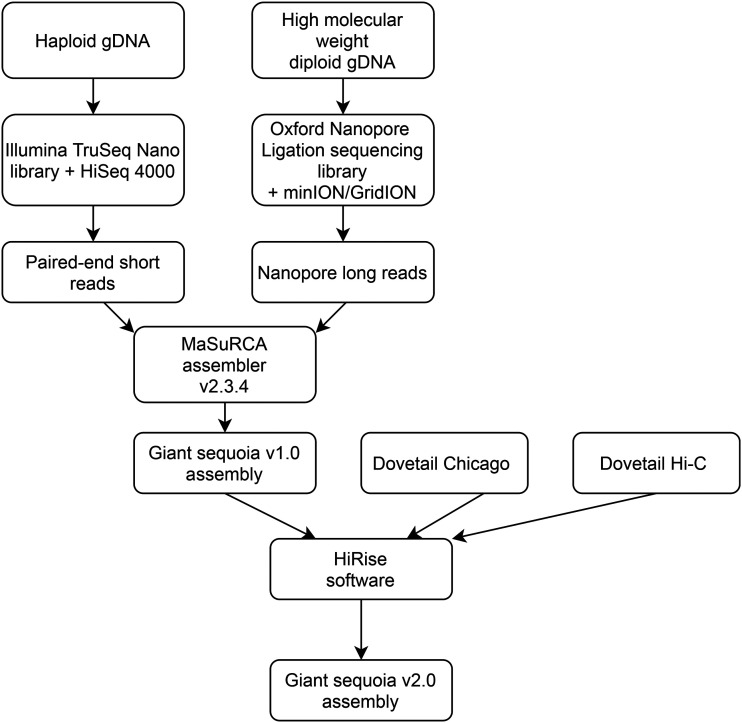
Flowchart of inputs and processing steps contributing to the giant sequoia v2.0 assembly.
Figure 2
Figure 2
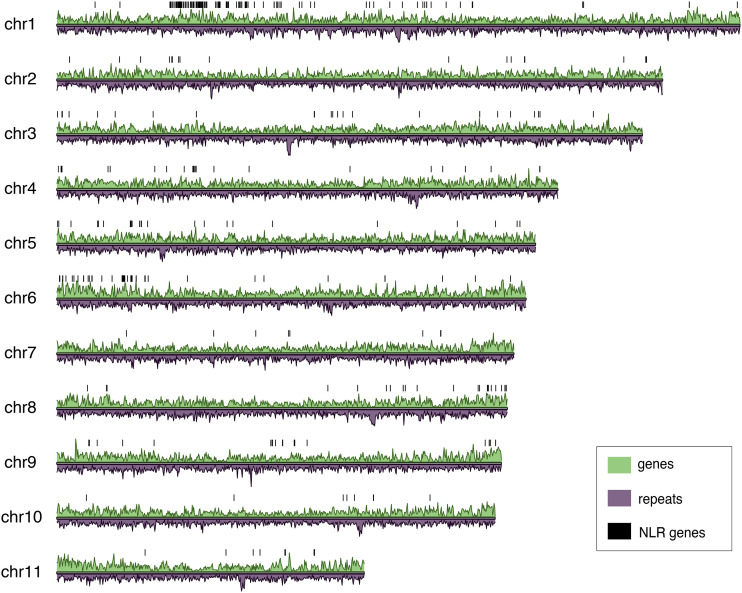
Repeat and gene density of giant sequoia 2.0. Gene density shown in green, repeat density shown in purple, both plotted in 1Mb windows. Locations of the consensus NLR genes indicated by black bars.
Figure 3
Figure 3
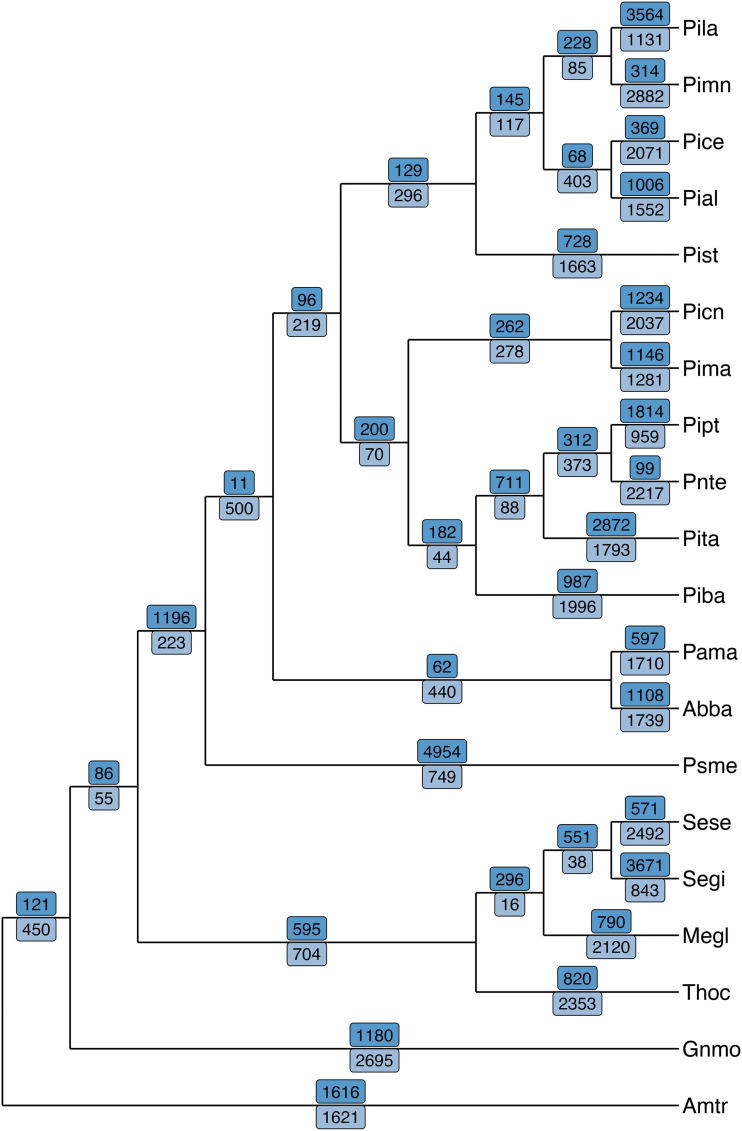
Gene family evolution along a gymnosperm cladogram. Numbers of expanded (bright blue, above branches) and contracted (light blue, below branches) orthogroups indicated in along each branch. Giant sequoia (Segi) experienced an overall expansion, with 3,671 orthogroups expanding and 843 contracting.
Figure 4
Figure 4
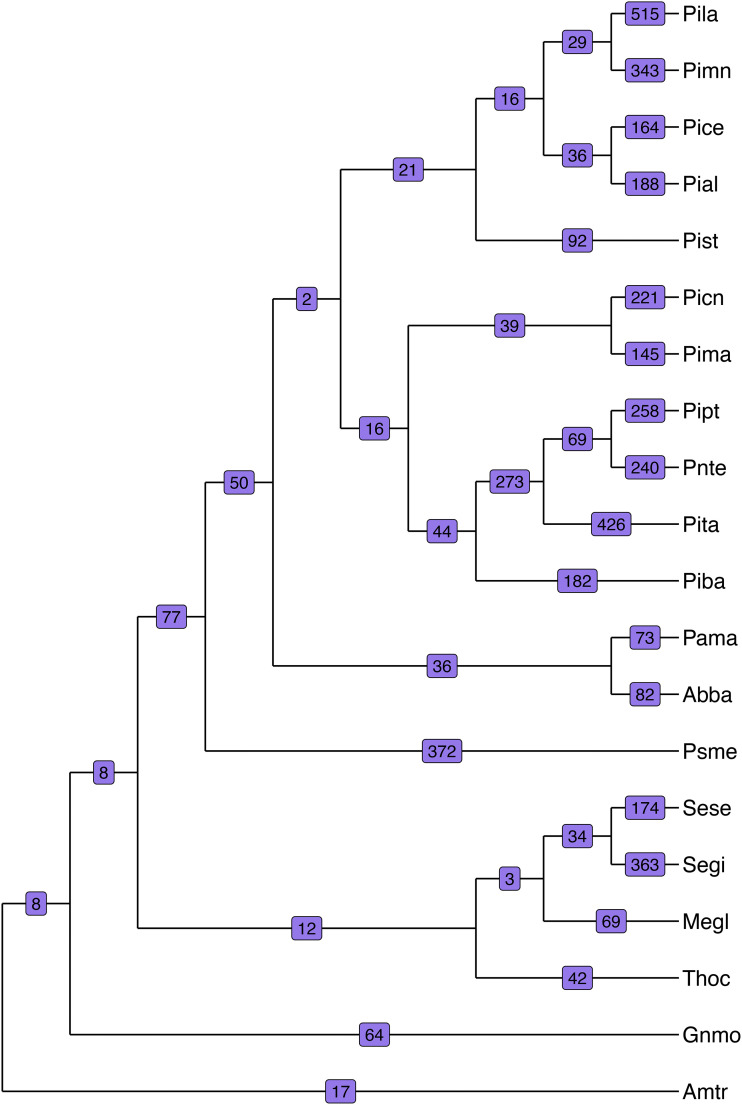
Rapid evolution along a gymnosperm cladogram. Numbers on each branch indicate the number of rapidly evolving gene families. Giant sequoia (Segi) has experienced rapid evolution in 363 gene families.
Figure 5
Figure 5
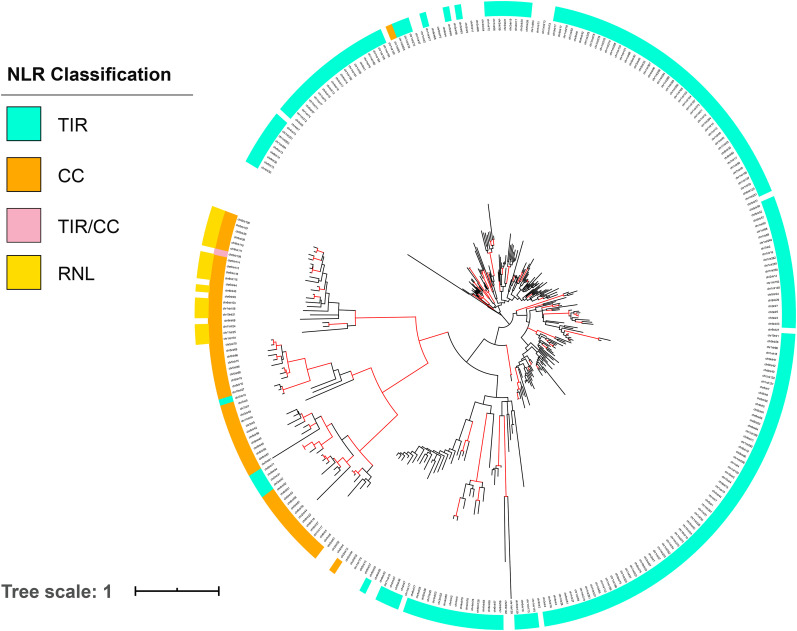
Maximum likelihood tree of encoded NB-ARC domains of the 300 consensus NLRgenes detected in the giant sequoia 2.0 assembly. Red branches indicate bootstrap support greater than 80%. The inner ring indicates predicted N-terminal TIR (blue) or CC (orange) domains. One of the 300 NLR contains motifs present in TIR and CC NLR proteins (pink). The outer ring indicates presence of an RPW8 motif present in the RNL sub-group of CC-NLRs. Tree is available at: http://itol.embl.de/shared/acr242

References

    1. Amborella Genome Project , 2013. The Amborella genome and the evolution of flowering plants. Science 342: 1241089 10.1126/science.1241089 - DOI - PubMed
    1. Benson G., 1999. Tandem repeats finder: a program to analyze DNA sequences. Nucleic Acids Res. 27: 573–580. 10.1093/nar/27.2.573 - DOI - PMC - PubMed
    1. Buchholz J. T., 1939. The Generic Segregation of the Sequoias. Am. J. Bot. 26: 535–538. 10.1002/j.1537-2197.1939.tb09314.x - DOI
    1. Burns E. E., Campbell R., and Cowan P. D., 2018. State of Redwoods Conservation Report, Save the Redwoods League, San Francisco.
    1. Bush S. J., Castillo-Morales A., Tovar-Corona J. M., Chen L., Kover P. X. et al. , 2014. Presence–absence variation in A. thaliana is primarily associated with genomic signatures consistent with relaxed selective constraints. Mol. Biol. Evol. 31: 59–69. 10.1093/molbev/mst166 - DOI - PMC - PubMed

Publication types

LinkOut - more resources