


Predictors of mammographic microcalcifications
- PMID: 32949149
- PMCID: PMC7821182
- DOI: 10.1002/ijc.33302
Predictors of mammographic microcalcifications
Abstract
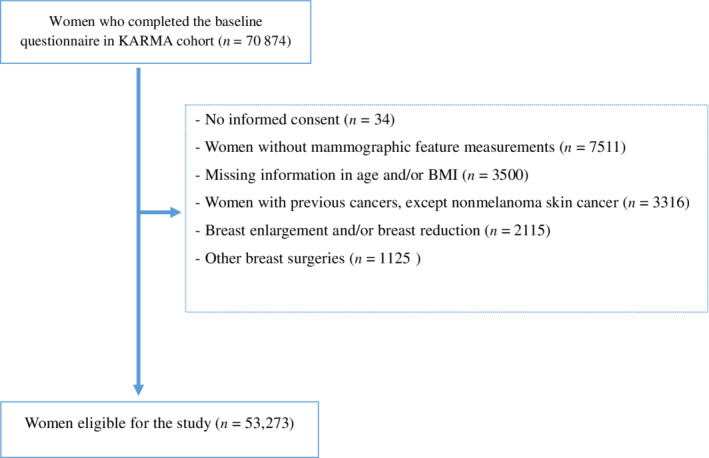
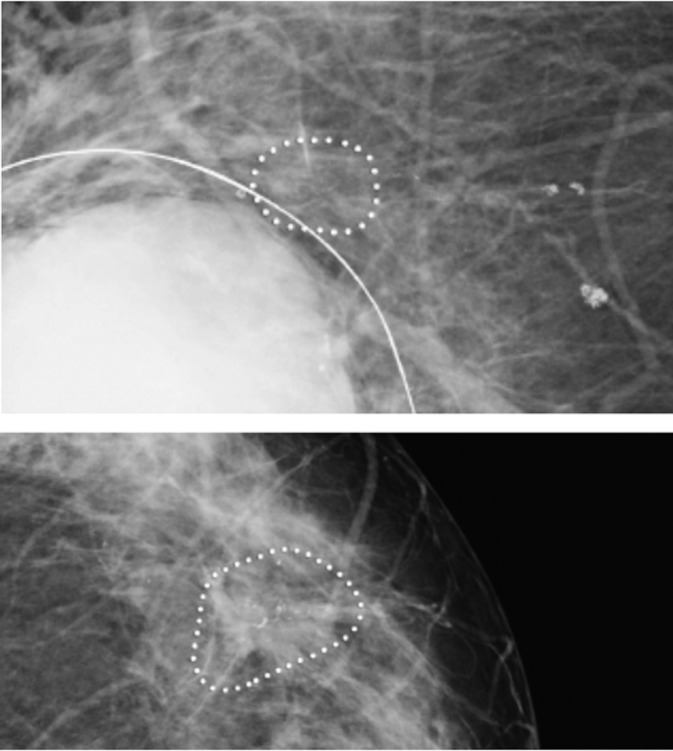
We examined the association between established risk factors for breast cancer and microcalcification clusters and their asymmetry. A cohort study of 53 273 Swedish women aged 30 to 80 years, with comprehensive information on breast cancer risk factors and mammograms, was conducted. Total number of microcalcification clusters and the average mammographic density area were measured using a Computer Aided Detection system and the STRATUS method, respectively. A polygenic risk score for breast cancer, including 313 single nucleotide polymorphisms, was calculated for those women genotyped (N = 7387). Odds ratios (ORs) and 95% confidence intervals (CIs), with adjustment for potential confounders, were estimated. Age was strongly associated with microcalcification clusters. Both high mammographic density (>40 cm2 ), and high polygenic risk score (80-100 percentile) were associated with microcalcification clusters, OR = 2.08 (95% CI = 1.93-2.25) and OR = 1.22 (95% CI = 1.06-1.48), respectively. Among reproductive risk factors, life-time breastfeeding duration >1 year was associated with microcalcification clusters OR = 1.22 (95% CI = 1.03-1.46). The association was confined to postmenopausal women. Among lifestyle risk factors, women with a body mass index ≥30 kg/m2 had the lowest risk of microcalcification clusters OR = 0.79 (95% CI = 0.73-0.85) and the association was stronger among premenopausal women. Our results suggest that age, mammographic density, genetic predictors of breast cancer, having more than two children, longer duration of breast-feeding are significantly associated with increased risk of microcalcification clusters. However, most lifestyle risk factors for breast cancer seem to protect against presence of microcalcification clusters. More research is needed to study biological mechanisms behind microcalcifications formation.
Keywords: cohort study; mammographic feature; mammographic microcalcifications.
© 2020 The Authors. International Journal of Cancer published by John Wiley & Sons Ltd on behalf of Union for International Cancer Control.
Conflict of interest statement
Per Hall, Kamila Czene and Mikael Eriksson are collaborating with iCAD to develop a fully automated risk tool that takes mammographic density and microcalcifications in to consideration when assessing the risk of breast cancer.
Figures
References
-
- Henrot P, Leroux A, Barlier C, Genin P. Breast microcalcifications: the lesions in anatomical pathology. Diagn Interv Imaging. 2014;95:141‐152. - PubMed
-
- Stomper PC, Geradts J, Edge SB, Levine EG. Mammographic predictors of the presence and size of invasive carcinomas associated with malignant microcalcification lesions without a mass. AJR Am J Roentgenol. 2003;181:1679‐1684. - PubMed
-
- Hernández P, Estrada T, Pizarro A, Tapia M. Breast calcifications: description and classification according to BI‐RADS 5th edition. Chil J Radiol. 2016;22:80‐91.
Publication types
MeSH terms
LinkOut - more resources
Full Text Sources
Medical
