


Application of machine learning to the prediction of postoperative sepsis after appendectomy
- PMID: 32951903
- PMCID: PMC7927311
- DOI: 10.1016/j.surg.2020.07.045
Application of machine learning to the prediction of postoperative sepsis after appendectomy
Abstract
Background: We applied various machine learning algorithms to a large national dataset to model the risk of postoperative sepsis after appendectomy to evaluate utility of such methods and identify factors associated with postoperative sepsis in these patients.
Methods: The National Surgery Quality Improvement Program database was used to identify patients undergoing appendectomy between 2005 and 2017. Logistic regression, support vector machines, random forest decision trees, and extreme gradient boosting machines were used to model the occurrence of postoperative sepsis.
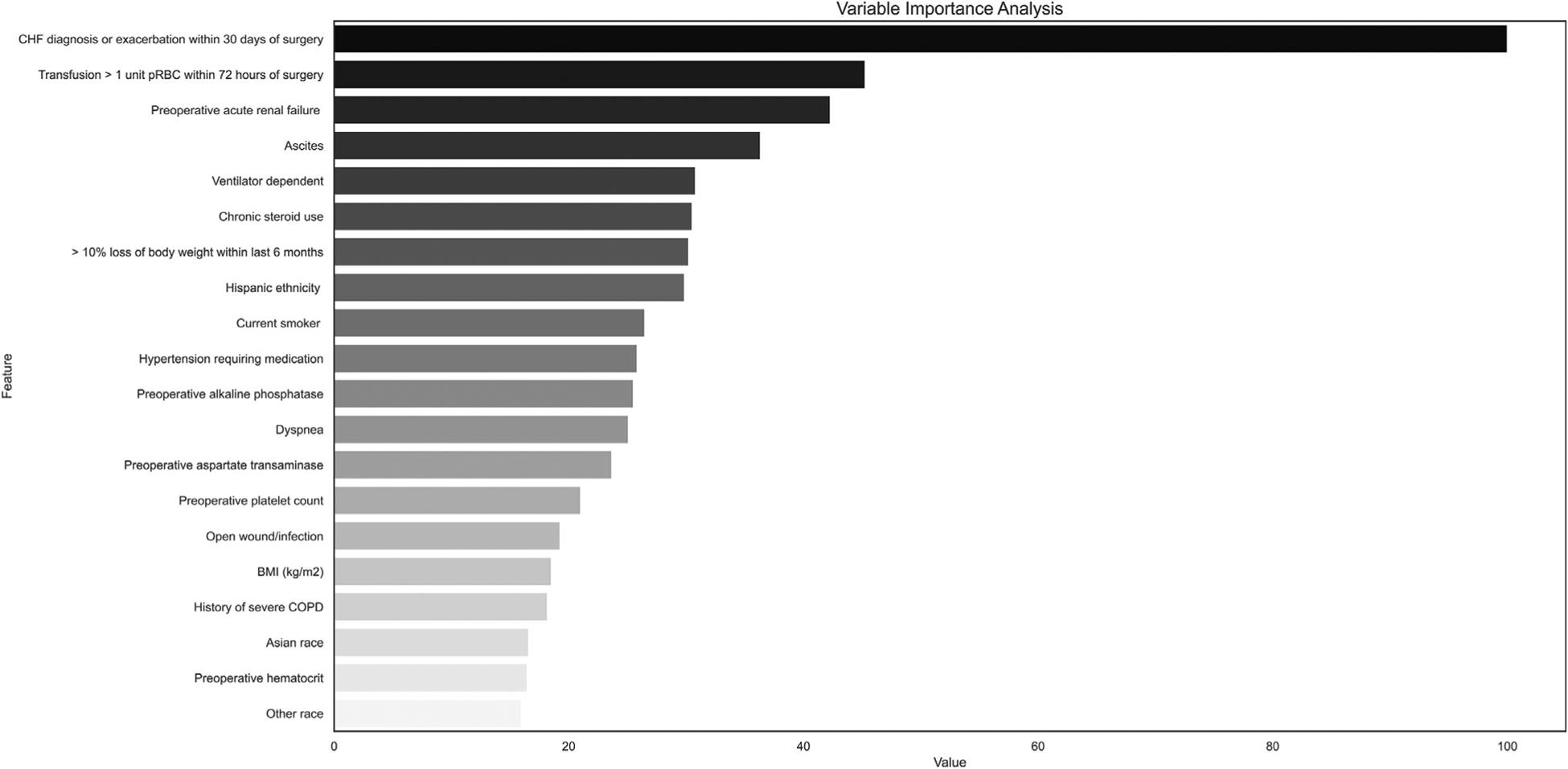
Results: In the study, 223,214 appendectomies were identified; 2,143 (0.96%) were indicated as having postoperative sepsis. Logistic regression (area under the curve 0.70; 95% confidence interval, 0.68-0.73), random forest decision trees (area under the curve 0.70; 95% confidence interval, 0.68-0.73), and extreme gradient boosting (area under the curve 0.70; 95% confidence interval, 0.68-0.73) afforded similar performance, while support vector machines (area under the curve 0.51; 95% confidence interval, 0.50-0.52) had worse performance. Variable importance analyses identified preoperative congestive heart failure, transfusion, and acute renal failure as predictors of postoperative sepsis.
Conclusion: Machine learning methods can be used to predict the development of sepsis after appendectomy with moderate accuracy. Such predictive modeling has potential to ultimately allow for preoperative recognition of patients at risk for developing postoperative sepsis after appendectomy thus facilitating early intervention and reducing morbidity.
Copyright © 2020 Elsevier Inc. All rights reserved.
Conflict of interest statement
Conflicts of interest/Disclosure
The authors have no related conflicts of interest to declare.
Figures
References
-
- Moore LJ, Moore FA, Todd SR, Jones SL, Turner KL, Bass BL. Sepsis in general surgery: The 2005–2007 national surgical quality improvement program perspective. Arch Surg. 2010;145:695–700. - PubMed
-
- Lagu T, Rothberg MB, Shieh M-S, Pekow PS, Steingrub JS, Lindenauer PK. Hospitalizations, costs, and outcomes of severe sepsis in the United States 2003 to 2007. Crit Care Med. 2012;40:754–761. - PubMed
-
- Stewart B, Khanduri P, McCord C, et al. Global disease burden of conditions requiring emergency surgery. Br J Surg. 2014;101:e9–e22. - PubMed
-
- Ninh A, Wood K, Bui AH, Leitman IM. Risk factors and outcomes for sepsis after appendectomy in adults. Surg Infect (Larchmt). 2019;20:601–606. - PubMed
Publication types
MeSH terms
Grants and funding
LinkOut - more resources
Full Text Sources
Other Literature Sources
Medical
