


Pandemic practice: Horror fans and morbidly curious individuals are more psychologically resilient during the COVID-19 pandemic
- PMID: 32952249
- PMCID: PMC7492010
- DOI: 10.1016/j.paid.2020.110397
Pandemic practice: Horror fans and morbidly curious individuals are more psychologically resilient during the COVID-19 pandemic
Abstract
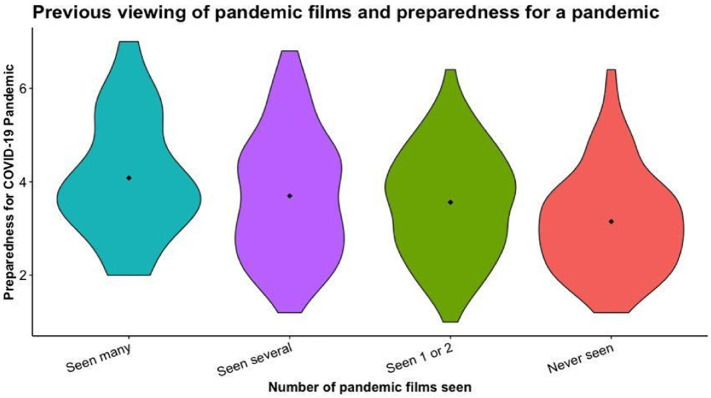
One explanation for why people engage in frightening fictional experiences is that these experiences can act as simulations of actual experiences from which individuals can gather information and model possible worlds. Conducted during the COVID-19 pandemic, this study (n = 310) tested whether past and current engagement with thematically relevant media fictions, including horror and pandemic films, was associated with greater preparedness for and psychological resilience toward the pandemic. Since morbid curiosity has previously been associated with horror media use during the COVID-19 pandemic, we also tested whether trait morbid curiosity was associated with pandemic preparedness and psychological resilience during the COVID-19 pandemic. We found that fans of horror films exhibited greater resilience during the pandemic and that fans of "prepper" genres (alien-invasion, apocalyptic, and zombie films) exhibited both greater resilience and preparedness. We also found that trait morbid curiosity was associated with positive resilience and interest in pandemic films during the pandemic. Taken together, these results are consistent with the hypothesis that exposure to frightening fictions allow audiences to practice effective coping strategies that can be beneficial in real-world situations.
Keywords: COVID-19; Emotion regulation; Fiction; Horror; Morbid curiosity; Resilience; Simulation.
© 2020 Elsevier Ltd. All rights reserved.
Figures
References
-
- Biesele M. How hunter-gatherers’ stories “make sense”: Semantics and adaptation. Cultural Anthropology. 1986;1(2):157–170.
-
- Boulton M.J., Smith P.K. The social nature of play fighting and play chasing: Mechanisms and strategies underlying cooperation and compromise. In: Barkow J.H., Cosmides L., Tooby J., editors. The adapted mind: Evolutionary psychology and the generation of culture. Oxford University Press; 1992. pp. 429–444.
-
- Clasen M. Oxford University Press; New York: 2017. Why horror seduces.
-
- Clasen M. Imagining the end of the world: A biocultural analysis of post-apocalyptic fiction. In: Vanderbeke D., Cooke B., editors. Evolution and popular narrative. Brill; 2019. pp. 64–82.
-
- Clasen M., Kjeldgaard-Christiansen J., Johnson J.A. Horror, personality, and threat simulation: A survey on the psychology of scary media. Evolutionary Behavioral Sciences. 2018 doi: 10.1037/ebs0000152. - DOI
LinkOut - more resources
Full Text Sources
Other Literature Sources
Miscellaneous