


Density-dependent sex-biased development of macroptery in a water strider
- PMID: 32953079
- PMCID: PMC7487258
- DOI: 10.1002/ece3.6644
Density-dependent sex-biased development of macroptery in a water strider
Abstract
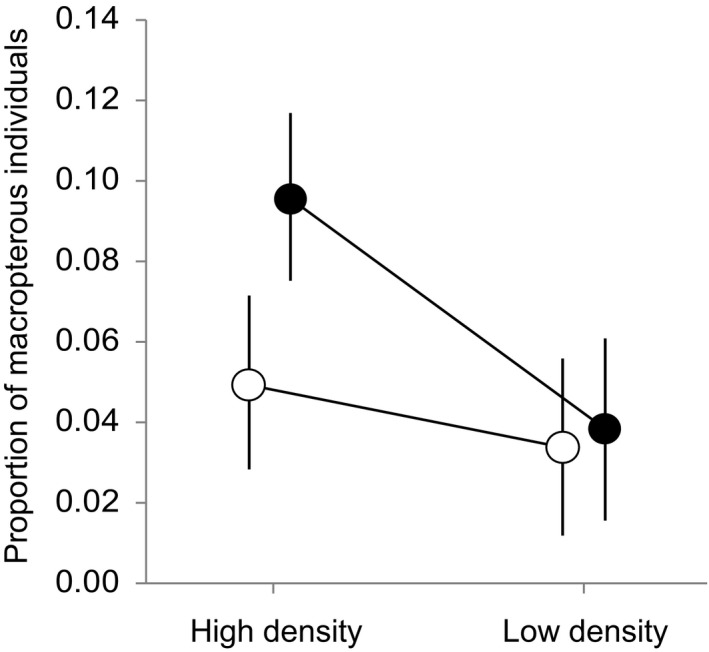
In wing-polymorphic insects, wing morphs differ not only in dispersal capability but also in life history traits because of trade-offs between flight capability and reproduction. When the fitness benefits and costs of producing wings differ between males and females, sex-specific trade-offs can result in sex differences in the frequency of long-winged individuals. Furthermore, the social environment during development affects sex differences in wing development, but few empirical tests of this phenomenon have been performed to date. Here, I used the wing-dimorphic water strider Tenagogerris euphrosyne to test how rearing density and sex ratio affect the sex-specific development of long-winged dispersing morphs (i.e., sex-specific macroptery). I also used a full-sib, split-family breeding design to assess genetic effects on density-dependent, sex-specific macroptery. I reared water strider nymphs at either high or low densities and measured their wing development. I found that long-winged morphs developed more frequently in males than in females when individuals were reared in a high-density environment. However, the frequency of long-winged morphs was not biased according to sex when individuals were reared in a low-density environment. In addition, full-sib males and females showed similar macroptery incidence rates at low nymphal density, whereas the macroptery incidence rates differed between full-sib males and females at high nymphal density. Thus complex gene-by-environment-by-sex interactions may explain the density-specific levels of sex bias in macroptery, although this interpretation should be treated with some caution. Overall, my study provides empirical evidence for density-specific, sex-biased wing development. My findings suggest that social factors as well as abiotic factors can be important in determining sex-biased wing development in insects.
Keywords: Tenagogerris euphrosyne; density dependence; gene‐by‐environment; gene‐by‐sex; sex‐biased dispersal; wing dimorphism.
© 2020 The Authors. Ecology and Evolution published by John Wiley & Sons Ltd.
Conflict of interest statement
None declared.
Figures


References
-
- Albrectsen, B. , & Nachman, G. (2001). Female‐biased density‐dependent dispersal of a tephritid fly in a fragmented habitat and its implications for population regulation. Oikos, 94, 263–272. 10.1034/j.1600-0706.2001.940206.x - DOI
-
- Andersen, N. M. (1982). The semiaquatic bugs (Hemiptera, Gerromorpha): Phylogeny, adaptations, biogeography and classification. Entomonograph 3. Klampenborg, Denmark: Scandinavian Science Press.
-
- Andersen, N. M. (1994). The evolution of sexual size dimorphism and mating systems in water striders (Hemiptera: Gerridae): A phylogenetic approach. Ecoscience, 1, 208–214. 10.1080/11956860.1994.11682244 - DOI
Associated data
LinkOut - more resources
Full Text Sources
Other Literature Sources
