


Improving Sexual Function in People With Chronic Kidney Disease: A Narrative Review of an Unmet Need in Nephrology Research
- PMID: 32953127
- PMCID: PMC7485155
- DOI: 10.1177/2054358120952202
Improving Sexual Function in People With Chronic Kidney Disease: A Narrative Review of an Unmet Need in Nephrology Research
Abstract
Purpose of review: Sexual dysfunction occurs commonly in people with chronic kidney disease (CKD) and has been recognized as a research priority. We sought to evaluate the current state of the literature addressing sexual dysfunction in people with CKD and identify barriers and strategies to improve our management of this important symptom.
Sources of information: OVID Medline and Google Scholar were searched for English, peer-reviewed studies using keywords and terms related to "Chronic Kidney Disease," "sexuality," and "sexual dysfunction OR function."
Methods: In this narrative review, we describe definitions of sexual dysfunction and contributors exacerbated by CKD, barriers to researching sexual dysfunction in people with CKD, and possible avenues for future research.
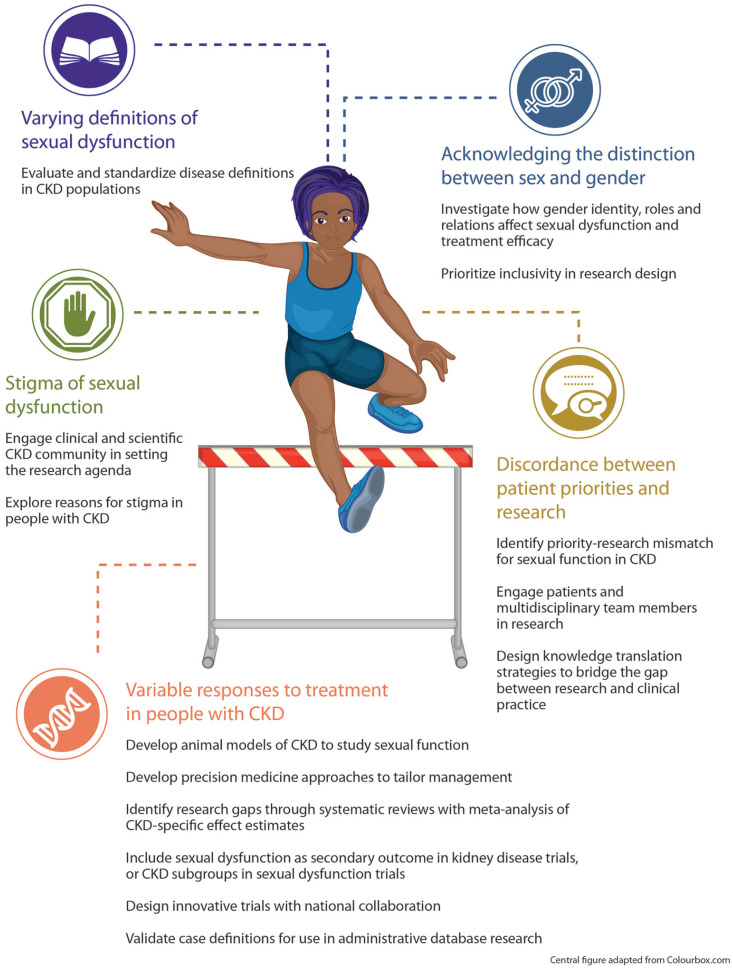
Key findings: Sexual dysfunction is common in people with CKD and results from a combination of kidney disease itself, as well as its associated physical (ie, comorbidities) and nonphysical factors. Barriers to the study of sexual dysfunction in CKD include inconsistent disease definitions, stigma, variable efficacy and safety of established therapies, and evolving gender roles in sexual function. Potential avenues for future research to improve the sexual function in people with CKD may include evaluating the safety and efficacy of established therapies in people with CKD using a variety of observational and interventional study designs, engaging people with CKD and multidisciplinary team members in research, and using implementation science methods to translate what is known about sexual function into clinical practice. Concerted efforts are required to break down barriers and improve sexual function in people with CKD. Patients have identified this as an important research priority, and national networks need to direct efforts to reduce symptom burden.
Limitations: This narrative review was limited by a paucity of high-quality studies examining sexual dysfunction specifically in people with kidney disease.
Contexte motivant la revue: Les dysfonctions sexuelles sont fréquentes chez les personnes atteintes d’insuffisance rénale chronique (IRC) et ont été reconnues comme une priorité de recherche. Cette revue avait pour objectif d’évaluer la documentation actuelle traitant du dysfonctionnement sexuel chez les personnes atteintes d’IRC et de répertorier les obstacles à la recherche dans ce domaine et les stratégies qui permettent d’améliorer la gestion de cet important symptôme.
Sources: Les bases de données OVID Medline et Google Scholar ont été consultées à la recherche des études rédigées en anglais et évaluées par des pairs à l’aide de mots-clés et de termes liés à Chronic Kidney Disease (insuffisance rénale chronique), sexuality (sexualité) et sexual dysfunction OR function (dysfonction OU fonction sexuelle).
Méthodologie: Cette revue narrative présente les définitions de la dysfonction sexuelle et les contributeurs exacerbés par l’IRC. Elle décrit également les obstacles limitant la recherche sur le dysfonctionnement sexuel chez les personnes atteintes d’IRC et cerne de possibles pistes pour les recherches futures.
Principaux résultats: Le dysfonctionnement sexuel est fréquent chez les personnes atteintes d’IRC et résulte d’une combinaison de la néphropathie elle-même et de facteurs physiques (c.-à-d. les maladies concomitantes) et non physiques qui y sont associés. Les obstacles limitant l’étude de la dysfonction sexuelle en contexte d’IRC comprennent: 1) l’incohérence dans les différentes définitions de maladie; 2) la stigmatization; 3) l’efficacité et l’innocuité variables des thérapies existantes; et 4) le caractère évolutif des rôles des genres dans la fonction sexuelle. Les possibles axes de recherche pour les études futures pourraient inclure: 1) l’utilization d’une variété de modèles d’études observationnelles et interventionnelles pour évaluer l’innocuité et l’efficacité des thérapies existantes dans cette population de patients; 2) la participation de patients et de membres de l’équipe multidisciplinaire à la recherche, et 3) l’utilization de méthodes scientifiques de mise en œuvre afin de traduire les connaissances dans la pratique clinique. Des efforts concertés sont nécessaires pour éliminer les obstacles à la recherche et améliorer la fonction sexuelle des personnes atteintes d’IRC. Il s’agit d’une importante priorité de recherche pour les patients, et les réseaux nationaux se doivent d’orienter leurs efforts vers la réduction du fardeau des symptômes.
Limites: Cette revue narrative était limitée par le manque d’études de haute qualité examinant spécifiquement la dysfonction sexuelle chez les personnes atteintes de néphropathies.
Keywords: chronic kidney disease; narrative review; sexual function; sexual health.
© The Author(s) 2020.
Conflict of interest statement
Declaration of Conflicting Interests: The author(s) declared the following potential conflicts of interest with respect to the research, authorship, and/or publication of this article: M.B.L. has received compensation as a speaker and advisory board member for Otsuka Pharmaceutical. No other disclosures to report.
Figures
References
-
- Fraser SDS, Taal MW. Multimorbidity in people with chronic kidney disease: implications for outcomes and treatment. Curr Opin Nephrol Hypertens. 2016;25(6):465-472. - PubMed
-
- Finkelstein FO, Shirani S, Wuerth D, Finkelstein SH. Therapy insight: sexual dysfunction in patients with chronic kidney disease. Nat Clin Pract Nephrol. 2007;3(4):200-207. - PubMed
-
- Sungur MZ, Gündüz A. A comparison of DSM-IV-TR and DSM-5 definitions for sexual dysfunctions: critiques and challenges. J Sex Med. 2014;11(2):364-373. - PubMed
-
- American Psychiatric Association. Diagnostic and Statistical Manual of Mental Disorders, Fifth Edition (DSM-5). Arlington, VA: American Psychiatric Association; 2013.
-
- Ishak WW, Tobia G. DSM-5 Changes in diagnostic criteria of sexual dysfunctions. Reprod Syst Sex Disord. 2013;2:1-3.
Publication types
LinkOut - more resources
Full Text Sources
Research Materials
