COVID-19 and early-stage lung cancer both featuring ground-glass opacities: a propensity score-matched study
- PMID: 32953523
- PMCID: PMC7481645
- DOI: 10.21037/tlcr-20-892
COVID-19 and early-stage lung cancer both featuring ground-glass opacities: a propensity score-matched study
Abstract
Background: Radiological manifestations of coronavirus disease 2019 (COVID-19) featured ground-glass opacities (GGOs), especially in the early stage, which might create confusion in differential diagnosis with early lung cancer. We aimed to specify the radiological characteristics of COVID-19 and early lung cancer and to unveil the discrepancy between them.
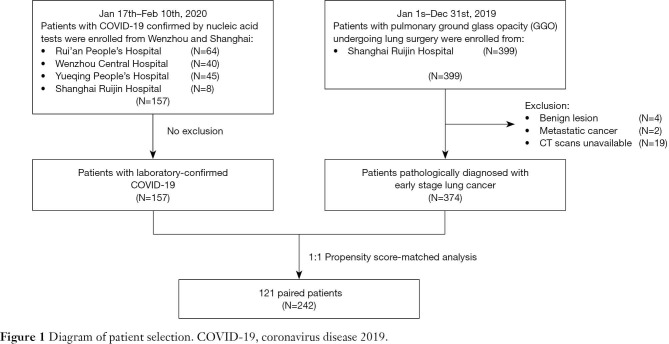
Methods: One hundred and fifty-seven COVID-19 patients and 374 early lung cancer patients from four hospitals in China were retrospectively enrolled. Epidemiological, clinical, radiological, and pathological characteristics were compared between the two groups using propensity score-matched (PSM) analysis.
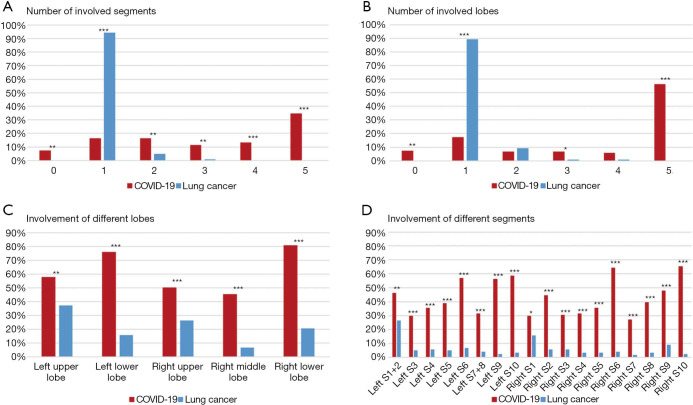
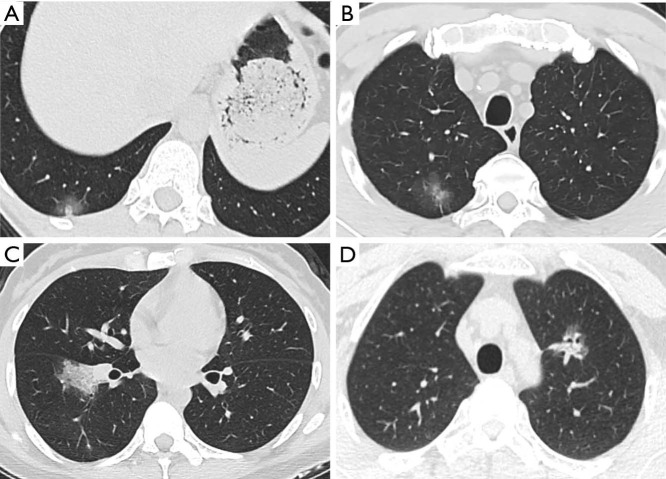
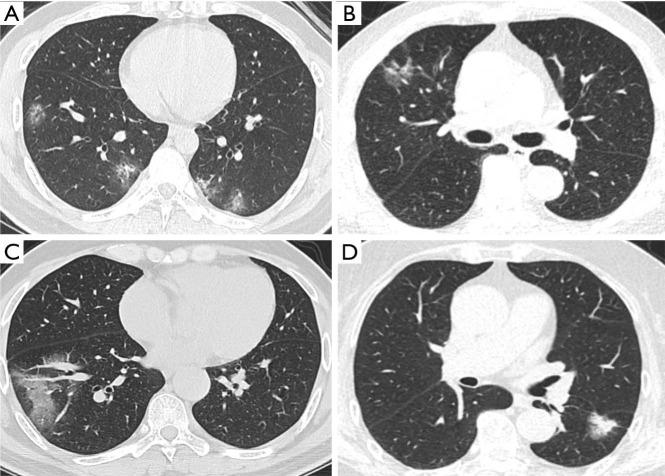
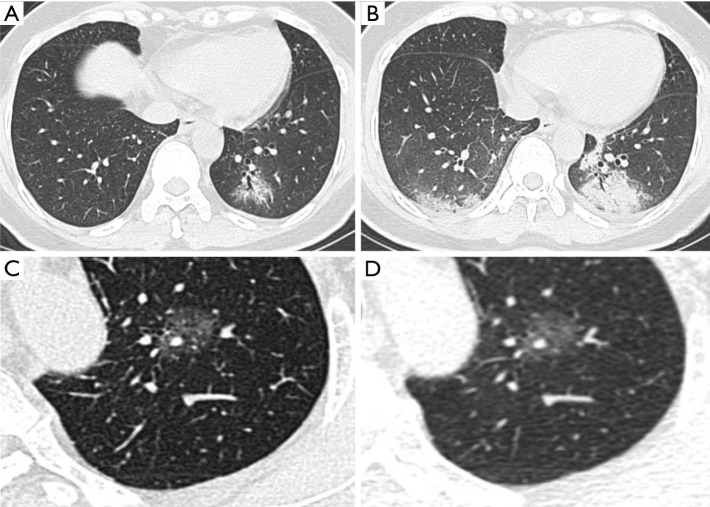
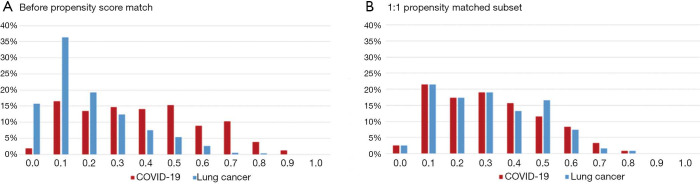
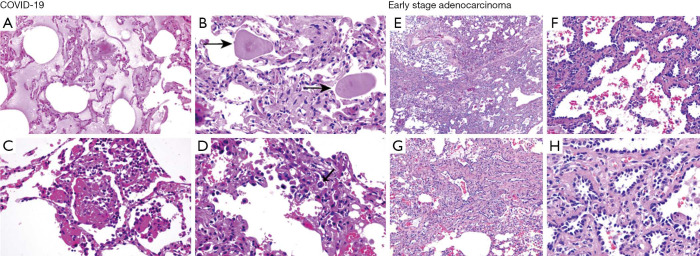
Results: COVID-19 patients had more distinct symptoms, tended to be younger (P<0.0001), male (P<0.0001), and had a higher body mass index (P=0.014). After 1:1 PSM, 121 matched pairs were identified. Regarding radiological characteristics, patients with a single lesion accounted for 17% in COVID-19 and 89% in lung cancer (P<0.0001). Most lesions were peripherally found in both groups. Lesions in COVID-19 involved more lobes (median 3.5 vs. 1; P<0.0001) and segments (median 6 vs. 1; P<0.0001) and tended to have multiple types (67%) with patchy form (54%). Early lung cancer was more likely to have a single type (92%) with oval form (66%). Also, COVID-19 and early lung cancer either had some distinctive features on computed tomography (CT) images.
Conclusions: Both COVID-19 and early lung cancers showed GGOs, with similar but independent features. The imaging characteristics should be fully understood and combined with epidemiological history, pathogen detection, laboratory tests, short-term CT reexamination, and pathological results to aid differential diagnosis.
Keywords: Coronavirus disease 2019 (COVID-19); ground glass opacity; lung neoplasms; propensity score; radiology.
2020 Translational Lung Cancer Research. All rights reserved.
Conflict of interest statement
Conflicts of Interest: All authors have completed the ICMJE uniform disclosure form (available at http://dx.doi.org/10.21037/tlcr-20-892). Dr. YJZ reports grants from National Natural Science Foundation of China, during the conduct of the study. Dr. HCL reports grants from National Natural Science Foundation of China, grants from Shanghai Municipal Commission of Health and Family Planning Outstanding Academic Leaders Training Program, grants from Shanghai Municipal Education Commission - Gaofeng Clinical Medicine Grant, during the conduct of the study. The other authors have no conflicts of interest to declare.
Figures
References
-
- World Health Organization. WHO Director-General’s statement on IHR Emergency Committee on Novel Coronavirus (2019-nCoV). 2020 [cited 2020 Jun 21]. Available online: https://www.who.int/dg/speeches/detail/who-director-general-s-statement-...
-
- World Health Organization. Coronavirus Disease (COVID-19) Situation Reports. 2020 [cited 2020 Jun 21]. Available online: https://www.who.int/emergencies/diseases/novel-coronavirus-2019/situatio...
-
- Pneumonia diagnosis and treatment plan for SARS-CoV-2 infection (trial version 7). 2020 [cited 2020 Jun 21]. Available online: http://www.gov.cn/zhengce/zhengceku/2020-03/04/5486705/files/ae61004f930...
LinkOut - more resources
Full Text Sources
Miscellaneous