


The role of nutraceuticals as a complementary therapy against various neurodegenerative diseases: A mini-review
- PMID: 32953558
- PMCID: PMC7484964
- DOI: 10.1016/j.jtcme.2020.03.008
The role of nutraceuticals as a complementary therapy against various neurodegenerative diseases: A mini-review
Abstract
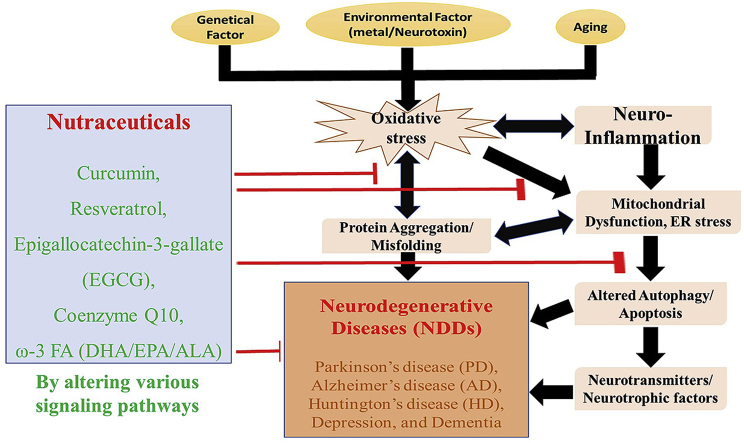
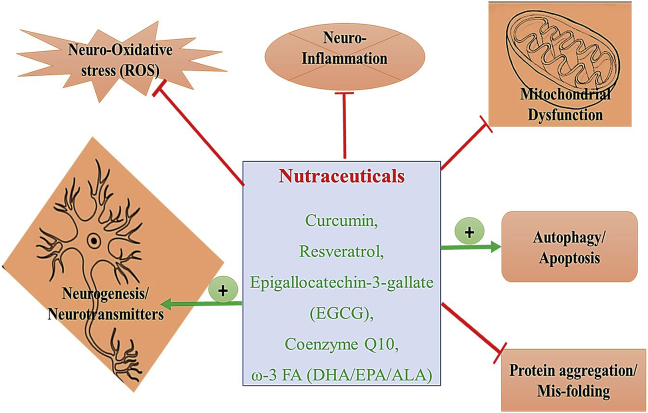
In recent times, many scientists have given great attention to nutraceuticals (complementary medicine) as it widely used for promoting health status. In particular for the prevention and treatment of various neurological diseases or disorders without or less adverse effects. The current mini-review was intended to compile all popular (major) nutraceuticals against various neurodegenerative diseases (NDDs) including Parkinson's disease (PD), Alzheimer's disease (AD), Huntington's disease (HD) with special reference to clinical trials. Preliminary reviews indicated that nutraceuticals like curcumin, resveratrol, Epigallocatechin-3-gallate (EGCG), Coenzyme Q10, ω-3 FA (DHA/EPA/ALA), showed better neuroprotective activity against various NDDs in human setting (clinical trial). Hence this contribution will focus only on those popular nutraceuticals with proposed brief mechanisms (antioxidant, anti-inflammatory, mitochondrial homeostasis, autophagy regulation, promote neurogenesis) and its recommendation. This mini-review would aid common people to choose better nutraceuticals to combat various NDDs along with standard neuroprotective agents and modified lifestyle pattern.
Keywords: AD, Alzheimer’s disease; ATP, Adenosine triphosphate; BBB, Blood-brain barrier; Clinical trial; HD, Huntington’s disease; HO-1, Heme Oxygenase-1; JNK, c-Jun N-terminal Kinase; MAPK, Mitogen-activated protein kinase; NDDs, neurodegenerative diseases; NF-κB, Nuclear factor Kappa B; Neurodegenerative diseases; Neuroprotective agents; Nrf2, Nuclear factor-E2-related factor; Nutraceutical; PD, Parkinson’s disease; PI3K, Phosphatidylinositol-3-kinase; SIRT1, Sirtuin 1.
© 2020 Center for Food and Biomolecules, National Taiwan University. Production and hosting by Elsevier Taiwan LLC.
Conflict of interest statement
All authors declared that no conflict of interest regarding this review paper.
Figures
References
-
- Farkhondeh T., Yazdi H.S., Samarghandian S. The protective effects of green tea catechins in the management of neurodegenerative diseases: a review. Curr Drug Discov Technol. 2019;16:57–65. - PubMed
-
- Adefegha S.A. Functional foods and nutraceuticals as dietary intervention in chronic diseases; novel perspectives for health promotion and disease prevention. J Diet Suppl. 2018;15:977–1009. - PubMed
-
- Agnihotri A., Aruoma O.I. Alzheimer’s disease and Parkinson’s disease: a nutritional toxicology perspective of the impact of oxidative stress, mitochondrial dysfunction, nutrigenomics, and environmental chemicals. J Am Coll Nutr. 2020;39:16–27. - PubMed
-
- Wimo A., Jönsson L., Bond J., Prince M., Winblad B., International A.D. The worldwide economic impact of dementia 2010. Alzheimer Dement. 2013;9:1–10. - PubMed
-
- Qiu C., De Ronchi D., Fratiglioni L. The epidemiology of the dementias: an update. Curr Opin Psychiatr. 2007;20:380–385. - PubMed
Publication types
LinkOut - more resources
Full Text Sources
Research Materials
Miscellaneous