Outcomes with percutaneous mitral repair vs. optimal medical treatment for functional mitral regurgitation: systematic review
- PMID: 32953762
- PMCID: PMC7475445
- DOI: 10.21037/atm.2020.03.202
Outcomes with percutaneous mitral repair vs. optimal medical treatment for functional mitral regurgitation: systematic review
Abstract
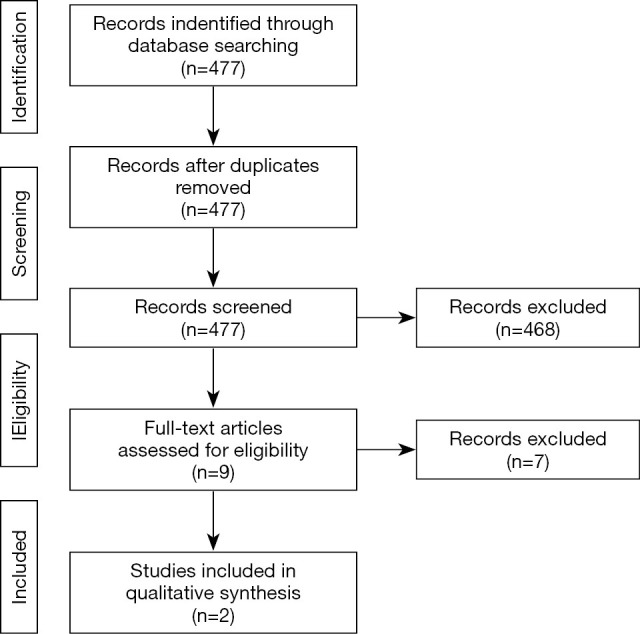
Functional mitral regurgitation (MR) could be defined as a ventricular disease where mitral valve is structurally normal, left chambers are enlarged and mitral annulus is dilated with lack of coaptation of leaflets. Transcatheter mitral valve repair technique has broadened the therapeutic range in the treatment of severe MR. The aim of this study was to review outcomes of MitraClip vs. medical treatment for functional MR. We also planned to review the concept of functional MR, assessment of the degree, prognosis and therapy options. This study followed the Preferred Reporting Items for Systematic Reviews and Meta-Analyses (PRISMA) guidelines. The Medline through PubMed database was used to search. The present review included manuscripts published between January 2009 and September 2019. Two authors independently screened titles and abstracts of all publications, and performed the selection of studies and data extraction. In the case of disagreements, consensus meetings reached the final decision. Inclusion criteria were: (I) randomized controlled trials and (II) works must compare MitraClip versus optimal medical treatment. Transcatheter mitral valve repair along optimal medical treatment has been compared with optimal medical therapy in two different randomized trials. In the COAPT trial, the MitraClip group showed a significant reduction in mortality and heart failure (HF) hospitalizations. In the MITRA-FR trial, no significant differences were observed between both groups. We reviewed important aspects of functional MR and performed a comprehensive review of both trials comparing them and focusing on their differences.
Keywords: Functional mitral regurgitation; MitraClip; heart failure (HF); transcatheter mitral valve repair.
2020 Annals of Translational Medicine. All rights reserved.
Conflict of interest statement
Conflicts of Interest: All authors have completed the ICMJE uniform disclosure form (available at http://dx.doi.org/10.21037/atm.2020.03.202). The series “Structural Heart Disease: The Revolution” was commissioned by the editorial office without any funding or sponsorship. DHV served as the unpaid Guest Editor of the series and serves as an unpaid editorial board member of Annals of Translational Medicine from Aug 2019 to Jul 2021. The authors have no other conflicts of interest to declare.
Figures
References
-
- Zoghbi WA, Adams D, Bonow RO, et al. Recommendations for noninvasive evaluation of native valvular regurgitation: a report from the American Society of Echocardiography Developed in Collaboration with the Society for Cardiovascular Magnetic Resonance. J Am Soc Echocardiogr 2017;30:303-71. 10.1016/j.echo.2017.01.007 - DOI - PubMed
-
- Nishimura RA, Otto CM, Bonow RO, et al. 2017 AHA/ACC Focused Update of the 2014 AHA/ACC Guideline for the Management of Patients With Valvular Heart Disease: A Report of the American College of Cardiology/American Heart Association Task Force on Clinical Practice Guidelines. J Am Coll Cardiol 2017;70:252-89. 10.1016/j.jacc.2017.03.011 - DOI - PubMed
Publication types
LinkOut - more resources
Full Text Sources
Research Materials
Miscellaneous