


A decade of arbovirus emergence in the temperate southern cone of South America: dengue, Aedes aegypti and climate dynamics in Córdoba, Argentina
- PMID: 32954035
- PMCID: PMC7489993
- DOI: 10.1016/j.heliyon.2020.e04858
A decade of arbovirus emergence in the temperate southern cone of South America: dengue, Aedes aegypti and climate dynamics in Córdoba, Argentina
Abstract
Background: Argentina is located at the southern temperate range of arboviral transmission by the mosquito Aedes aegypti and has experienced a rapid increase in disease transmission in recent years. Here we present findings from an entomological surveillance study that began in Córdoba, Argentina, following the emergence of dengue in 2009.
Methods: From 2009 to 2017, larval surveys were conducted monthly, from November to May, in 600 randomly selected households distributed across the city. From 2009 to 2013, ovitraps (n = 177) were sampled weekly to monitor the oviposition activity of Ae. aegypti. We explored seasonal and interannual dynamics of entomological variables and dengue transmission. Cross correlation analysis was used to identify significant lag periods.
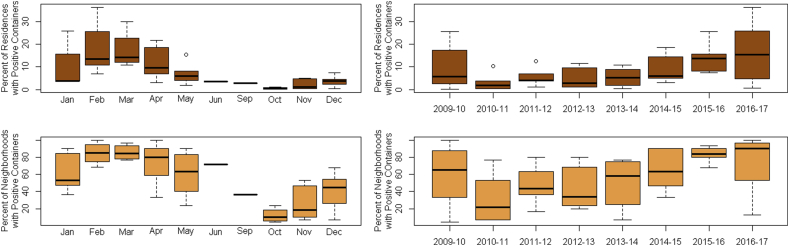
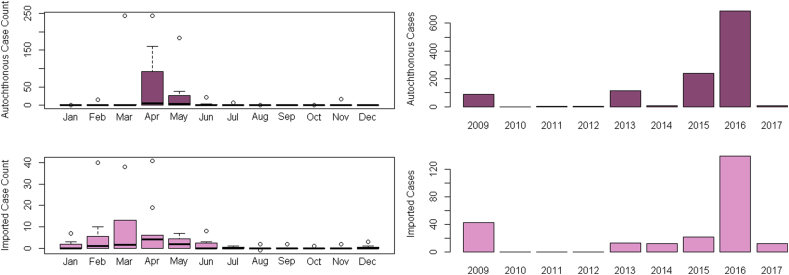
Results: Aedes aegypti were detected over the entire study period, and abundance peaked during the summer months (January to March). We identified a considerable increase in the proportion of homes with juvenile Ae. aegypti over the study period (from 5.7% of homes in 2009-10 to 15.4% of homes in 2016-17). Aedes aegypti eggs per ovitrap and larval abundance were positively associated with temperature in the same month. Autochthonous dengue transmission peaked in April, following a peak in imported dengue cases in March; autochthonous dengue was not positively associated with vector or climate variables.
Conclusions: This longitudinal study provides insights into the complex dynamics of arbovirus transmission and vector populations in a temperate region of arbovirus emergence. Our findings suggest that Córdoba is well suited for arbovirus disease transmission, given the stable and abundant vector populations. Further studies are needed to better understand the role of regional human movement.
Keywords: Aedes aegypti; Argentina; Climate; Dengue; Environmental analysis; Environmental science; Epidemiology; Infectious disease; Larval surveys; Ovitrap; Surveillance; Zoology.
© 2020 The Authors.
Figures
References
-
- Almirón W.R., Almeida F.F. Aedes aegypti (Diptera: Culicidae) en Córdoba, Argentina. Rev. Soc. Entomológica Argent. 1998;57
-
- Asar M.L., Estallo E.L., Benítez E.M., Di Benedetto H.M., Ludueña-Almeida F.F. 2019. Un estudio sobre el efecto Islas de Calor Urbano en la ciudad de Córdoba, Argentina.
-
- Avilés G., Cecchini R., Harrington M.E., Cichero J., Asis R., Rios C. Aedes aegypti in Córdoba province, Argentina. J. Am. Mosq. Control Assoc.-Mosq. News. 1997;13:255–258. - PubMed
-
- Barrera R., Delgado N., Jiménez M., Valero S. Eco-epidemiological factors associated with hyperendemic dengue haemorrhagic fever in Maracay City, Venezuela. Dengue Bull. 2002;26:84–95.
LinkOut - more resources
Full Text Sources
Miscellaneous
