Review
. 2020 Aug 29;6(2):346-360.
doi: 10.1016/j.bioactmat.2020.08.016. eCollection 2021 Feb.

Poly(lactic- co-glycolic acid)-based composite bone-substitute materials

Affiliations
Review

Poly(lactic- co-glycolic acid)-based composite bone-substitute materials

Duoyi Zhao et al. Bioact Mater. .

Abstract

Research and development of the ideal artificial bone-substitute materials to replace autologous and allogeneic bones for repairing bone defects is still a challenge in clinical orthopedics. Recently, poly(lactic-co-glycolic acid) (PLGA)-based artificial bone-substitute materials are attracting increasing attention as the benefit of their suitable biocompatibility, degradability, mechanical properties, and capabilities to promote bone regeneration. In this article, we comprehensively review the artificial bone-substitute materials made from PLGA or the composites of PLGA and other organic and inorganic substances, elaborate on their applications for bone regeneration with or without bioactive factors, and prospect the challenges and opportunities in clinical bone regeneration.

Keywords: Bone regeneration; Bone tissue engineering; Bone-substitute material; Composite organic−inorganic biomaterial; Poly(lactic-co-glycolic acid).


Conflict of interest statement

The authors declare no competing financial interests.

Figures

Image 1
Graphical abstract
Scheme 1
Scheme 1
PLGA-based bone-substitute materials used in treatment of bone defects.
Fig. 1
Fig. 1
Effects of PLGA scaffolds with different pore sizes on bone repair [78]. (A) Schematic diagram of double-layer PLGA scaffolds applied to rabbit knee joint osteochondral defect treatment. (B) Specimen pictures and (C) H&E staining after treatment 12 and 24 weeks. The red circle shows the recovery of the defect model. Yellow arrow indicates the interface between new tissue and natural osteochondral tissue. The length of the white vertical line is 1 mm.
Fig. 2
Fig. 2
Effects of PLGA scaffolds with different printing angles on bone repair [80]. (A) Structure of PLGA scaffolds printed at different angles. (B) Differences in yield strength. (C) Compressive strength between different groups of scaffolds. Data are represented as mean ± SD (standard deviation; n = 5, **P < 0.01).
Fig. 3
Fig. 3
Effect of grafting process on tensile strength of PLGA/HA scaffolds [96]. (A) Schematic diagram of PLGA/HA scaffold preparation process. (B) Schematic diagram of difference in tensile strength of these scaffolds obtained by different preparation methods. Tensile strength (C) and tensile modulus (D) elongation of composite scaffolds with different HA grafting rates. Pre (50) means HA content of 50% in the pre-dispersion process, Pre (70) means HA content of 70% in the pre-dispersion process, Pre (80) means HA content of 80% in the pre-dispersion process, and Pre (90) means HA content of 90% in the pre-dispersion process. Data are represented as mean ± SD (n = 5). Reproduced with permission [96]. Copyright 2019, Elsevier Ltd.
Fig. 4
Fig. 4
Bilayered PLGA/HA composite scaffold for osteochondral tissue engineering [98]. (A) Efficacy comparison. (B) and (C) Schematic of composite scaffold in treatment of rabbit bone defects. (D) H&E staining pictures of treated specimens. The yellow arrows indicate the initial defect sites. Reproduced with permission [98]. Copyright 2018, American Chemical Society.
Fig. 5
Fig. 5
Porous scaffolds of PLGA/PBLG-HA for bone repair in vivo [101]. (A) Schematic diagram of PLGA/PBLG-HA scaffold preparation process. (B) Results of 3D-CT of rabbit radial defects treated with scaffolds grafted with different ratios of PBLG. (C) Bone volume fraction statistics. Nothing (blank group) and porous scaffolds of PLGA, MHA/PLGA, MHA-APS/PLGA, and PBLG-g-MHA/PLGA with PBLG graft amounts of 11, 22, 33, and 50 wt%. Data are represented as mean ± SD (n = 4, *P < 0.05). Reproduced with permission [101]. Copyright 2019, American Chemical Society.
Fig. 6
Fig. 6
Osteogenic Mg incorporated into PLGA/TCP porous scaffold by 3D printing [115]. (A) Surface structures of PLGA/TCP/Mg scaffold and deposition of Ca and Mg. 3D-CT results of bone growth (B) and angiogenesis (C) at 4 and 8 weeks after treatment with different component scaffolds. PT indicates the PLGA/TCP group. PTM indicates the PLGA/TCP/Mg group. Red rectangle represents the bone tunnel site. Reproduced with permission [115]. Copyright 2019, Elsevier Ltd.
Fig. 7
Fig. 7
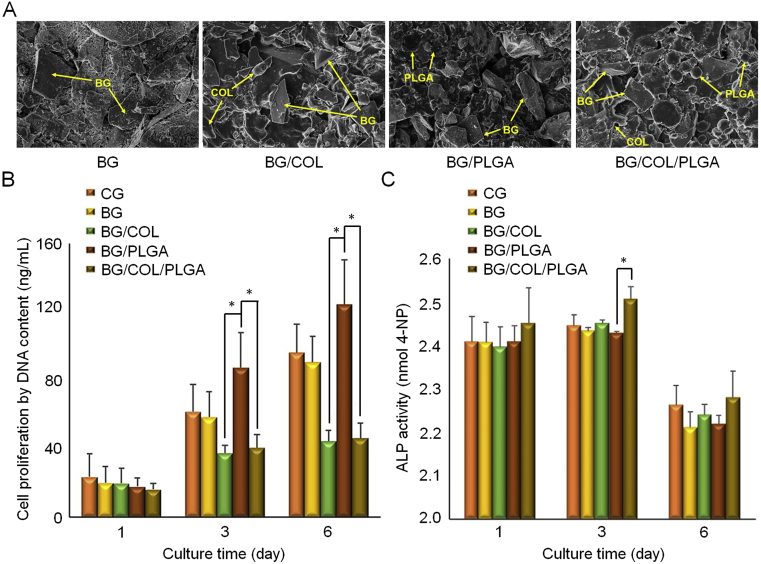
BG-based materials with hierarchical porosity [122]. (A) Microstructure of composite scaffolds with different components. Statistics of cell proliferation activity (B) and ALP activity (C) when different scaffolds are used for osteoblast culture. Data are represented as mean ± SD (n = 4, *P < 0.05). Reproduced with permission [122]. Copyright 2019, Elsevier Ltd.

References

    1. Wascher D.C., Bulthuis L. Extremity trauma: Field management of sports injuries. Curr. Rev. Musculoskelet. Med. 2014;7(4):387–393. - PMC - PubMed
    1. Saridis A., Panagiotopoulos E., Tyllianakis M., Matzaroglou C., Vandoros N., Lambiris E. The use of the Ilizarov method as a salvage procedure in infected nonunion of the distal femur with bone loss. J. Bone Joint Surg. Br. 2006;88(2):232–237. - PubMed
    1. Assouline-Dayan Y., Chang C., Greenspan A., Shoenfeld Y., Gershwin M.E. Pathogenesis and natural history of osteonecrosis. Semin. Arthritis Rheum. 2002;32(2):94–124. - PubMed
    1. Sözen T., Özışık L., Başaran N.Ç. An overview and management of osteoporosis. Eur. J. Rheumatol. 2017;4(1):46–56. - PMC - PubMed
    1. Lems W.F., Raterman H.G. Critical issues and current challenges in osteoporosis and fracture prevention. An overview of unmet needs. Ther. Adv. Musculoskelet. Dis. 2017;9(12):299–316. - PMC - PubMed