Review
. 2019 Oct 16;1(1):fcz025.
doi: 10.1093/braincomms/fcz025. eCollection 2019.

Dependence, withdrawal and rebound of CNS drugs: an update and regulatory considerations for new drugs development

Affiliations
Review

Dependence, withdrawal and rebound of CNS drugs: an update and regulatory considerations for new drugs development

Alicja Lerner et al. Brain Commun. .

Abstract

The purpose of this article is to describe dependence and withdrawal phenomena related to CNS drugs discontinuation and to clarify issues related to the evaluation of clinical drug withdrawal and rebound as they relate to safety in new drug development. The article presents current understanding and definitions of drug dependence and withdrawal which are also relevant and important features of addiction, though not the same. Addiction, called substance use disorder in DSM-5, affects an individual's brain and behaviour, represents uncontrollable drug abuse and inability to stop taking a drug regardless of the harm it causes. Characteristic withdrawal syndromes following abrupt discontinuation of CNS-active drugs from numerous drug classes are described. These include drugs both scheduled and non-scheduled in the Controlled Substances Act, which categorizes drugs in five schedules based on their relative abuse potentials and dependence liabilities and for regulatory purposes. Schedules 1 and 2 contain drugs identified as those with the highest abuse potential and strictest regulations. Less recognized aspects of drug withdrawal, such as rebound and protracted withdrawal syndromes for several drug classes are also addressed. Part I presents relevant definitions and describes clinical withdrawal and dependence phenomena. Part II reviews known withdrawal syndromes for the different drug classes, Part III describes rebound and Part IV describes protracted withdrawal syndromes. To our knowledge, this is the first compilation of withdrawal syndromes for CNS drugs. Part V provides details of evaluation of dependence and withdrawal in the clinical trials for CNS drugs, which includes general design recommendations, and several tools, such as withdrawal questionnaires and multiple scales that are helpful in the systematic evaluation of withdrawal. The limitations of different aspects of this method of dependence and withdrawal evaluation are also discussed.

Keywords: dependence; human dependence evaluation; rebound; withdrawal syndromes.


Figures

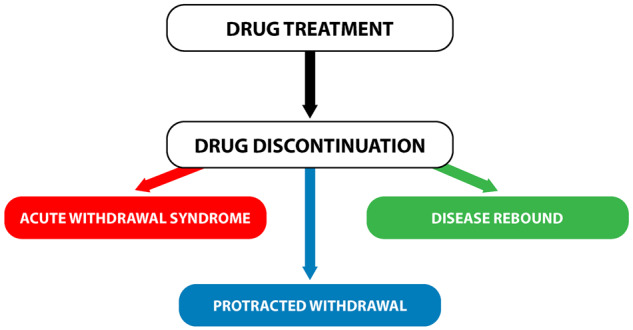
Graphical Abstract
Graphical Abstract
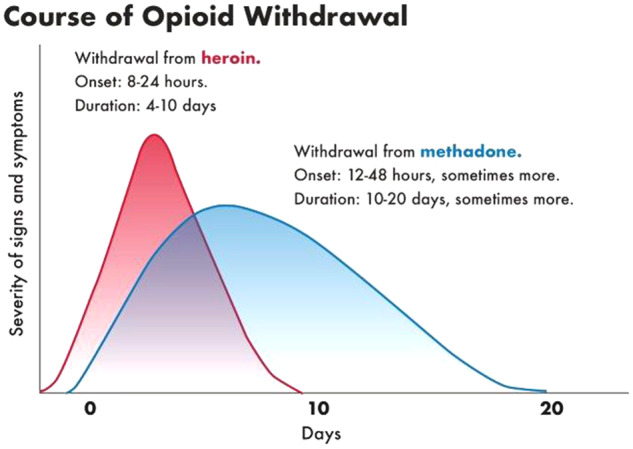
Figure 1
Figure 1
Course of opioid withdrawal. The figure shows different time course for opioids heroine (red curve) and methadone (blue curve). Although heroin half-life is 2–6 min, the withdrawal symptoms start usually at 6–24 h after the last dose, reach a peak at 24–48 h, and resolve after 4–10 days, although this delay as already mentioned, maybe explained by the fact that the main active molecule in the brain after heroin administration is not heroin itself but rather morphine and 6-acetylmorphine, which have much longer half-lives and thus longer-lasting intoxication and withdrawal; for methadone, with a half-life of 15–55 h, the withdrawal symptoms start usually at 36–48 h after the last dose, the withdrawal may be prolonged, and last 3–6 weeks. Adapted from Drug and Alcohol Withdrawal Clinical Practice Guidelines—NSW (New South Wales Government, 2008).
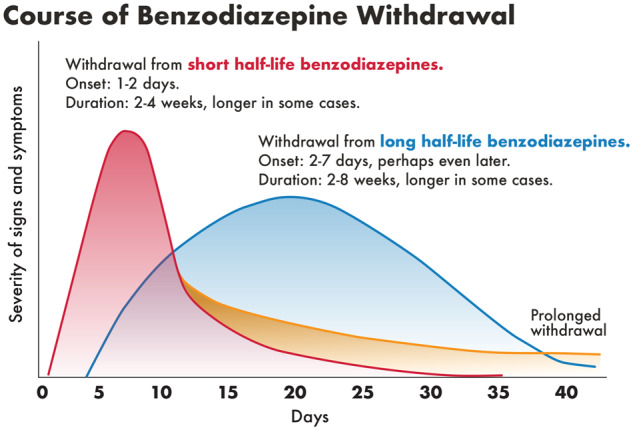
Figure 2
Figure 2
Course of BZ withdrawal. The figure shows different time course for short (red curve) and long half-life BZ (blue curve) which is related to the drugs half-lives. It shows also a formation of protracted withdrawal (yellow curve) for short half-life BZ. Adapted from Drug and Alcohol Withdrawal Clinical Practice Guidelines—NSW (New South Wales Government, 2008).
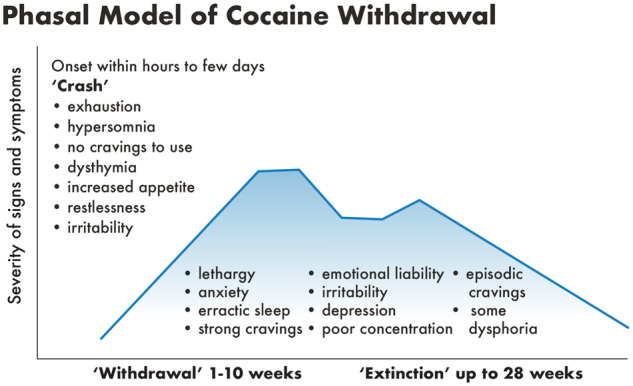
Figure 3
Figure 3
Phasal model of cocaine withdrawal. The figure shows three phases of cocaine withdrawal: crash, withdrawal and extinction, which have somewhat different symptoms profile. Adapted from Baker et al. (2004).
Figure 4
Figure 4
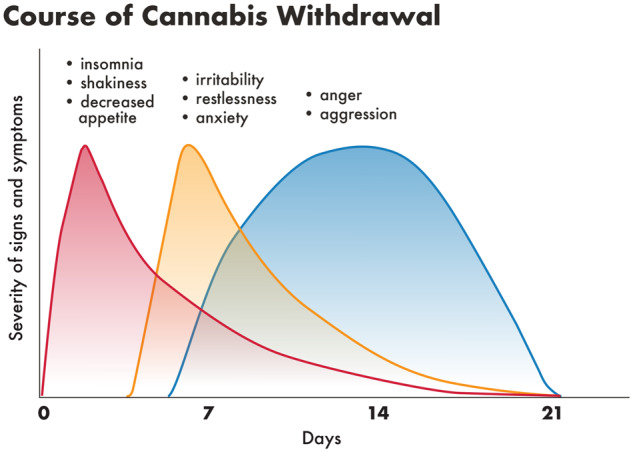
Course of cannabis withdrawal. The figure shows different phases of occurrence of cannabis withdrawal symptoms, with the early phase (red curve) of insomnia, shakiness, decreased appetite symptoms, middle phase (yellow curve) with irritability, anxiety, restlessness symptoms and late somewhat prolonged phase (blue curve) of anger and aggression. Adapted from Drug and Alcohol Withdrawal Clinical Practice Guidelines – NSW (New South Wales Government, 2008).
Figure 5
Figure 5
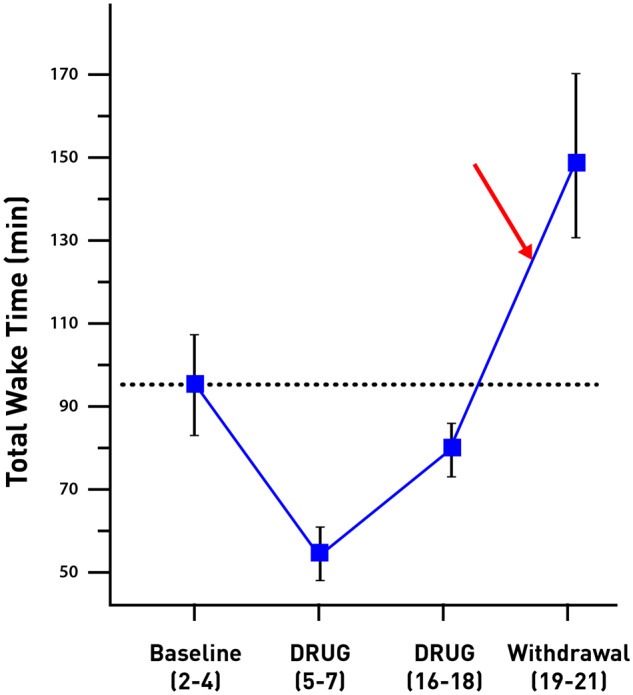
Rebound insomnia in patients treated with triazolam after abrupt drug withdrawal. The figure shows that after abrupt drug discontinuation the symptoms of insomnia (measured as total wake time) not only promptly return but there is a rebound of insomnia, that is worsening of the symptoms far above disease baseline from pre-treatment period (red arrow), in fact, this worsening is considerably greater than the maximal degree of improvement of sleep during the drug treatment. Adapted from Kales et al. (1983a).
Figure 6
Figure 6
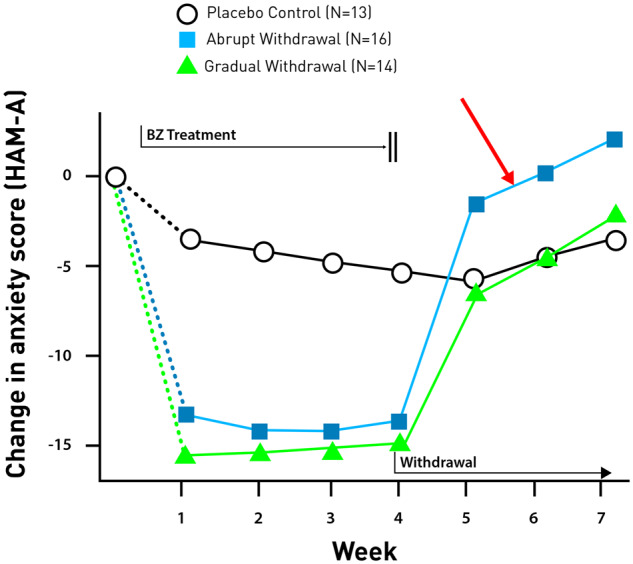
Rebound anxiety in patients treated with diazepam or bromazepam who were abruptly withdrawn. The figure shows anxiety scores (HAM-A) for three arms in the study: patients who were treated with BZ but then either discontinued drug abruptly (blue line) or discontinued drug gradually (green line), the study included also a placebo arm (black line). After abrupt drug discontinuation the symptoms of anxiety not only return to pre-treatment state, but there is also a rebound of anxiety (red arrow), that is a worsening of the symptoms above disease baseline. However, the gradual drug discontinuation does not produce the rebound and is similar to placebo arm. Adapted from Fontaine et al. (1984).

References

    1. Agrawal A, Pergadia ML, Lynskey MT.. Is there evidence for symptoms of cannabis withdrawal in the national epidemiologic survey of alcohol and related conditions? Am J Addict 2008; 17: 199–208. - PubMed
    1. Amore M, Zazzeri N.. Neuroleptic malignant syndrome after neuroleptic discontinuation. Prog Neuropsychopharmacol Biol Psychiatry 1995; 19: 1323–34. - PubMed
    1. Anand KJ, Ingraham J.. Pediatric. Tolerance, dependence, and strategies for compassionate withdrawal of analgesics and anxiolytics in the pediatric ICU. Crit Care Nurse 1996; 16: 87–93. - PubMed
    1. Anand KJ, Willson DF, Berger J, Harrison R, Meert KL, Zimmerman J.. Tolerance and withdrawal from prolonged opioid use in critically ill children. Pediatrics 2010; 125: e1208–25. - PMC - PubMed
    1. APA. Diagnostic and statistical manual of mental disorders, 5th Edition: DSM-5. 5th edn.Arlington, VA: American Psychiatric Publishing; 2013.

LinkOut - more resources