


The safety of paediatric surgery between COVID-19 surges: an observational study
- PMID: 32955100
- PMCID: PMC7537528
- DOI: 10.1111/anae.15264
The safety of paediatric surgery between COVID-19 surges: an observational study
Abstract
Despite the ongoing coronavirus disease 2019 (COVID-19) pandemic, elective paediatric surgery must continue safely through the first, second and subsequent waves of disease. This study presents outcome data from a children's hospital in north-west England, the region with the highest prevalence of COVID-19 in England. Children and young people undergoing elective surgery isolated within their household for 14 days, then presented for real-time reverse transcriptase polymerase chain reaction testing for severe acute respiratory syndrome coronavirus disease-2 (SARS-CoV-2) within 72 h of their procedure (or rapid testing within 24 h in high-risk cases), and completed a screening questionnaire on admission. Planned surgery resumed on 26 May 2020; in the four subsequent weeks, there were 197 patients for emergency and 501 for elective procedures. A total of 488 out of 501 (97.4%) elective admissions proceeded, representing a 2.6% COVID-19-related cancellation rate. There was no difference in the incidence of SARS-CoV-2 among children and young people who had or had not isolated for 14 days (p > 0.99). One out of 685 (0.1%) children who had surgery re-presented to the hospital with symptoms potentially consistent with SARS-CoV-2 within 14 days of surgery. Outcomes were similar to those in the same time period in 2019 for length of stay (p = 1.0); unplanned critical care admissions (p = 0.59); and 14-day hospital re-admission (p = 0.17). However, the current cohort were younger (p = 0.037); of increased complexity (p < 0.001) and underwent more complex surgery (p < 0.001). The combined use of household self-isolation, testing and screening questionnaires has allowed the re-initiation of elective paediatric surgery at high volume while maintaining pre-COVID-19 outcomes in children and young people undergoing surgery. This may provide a model for addressing the ongoing challenges posed by COVID-19, as well as future pandemics.
Keywords: COVID-19; elective surgery; paediatrics; testing.
© 2020 Association of Anaesthetists.
Figures
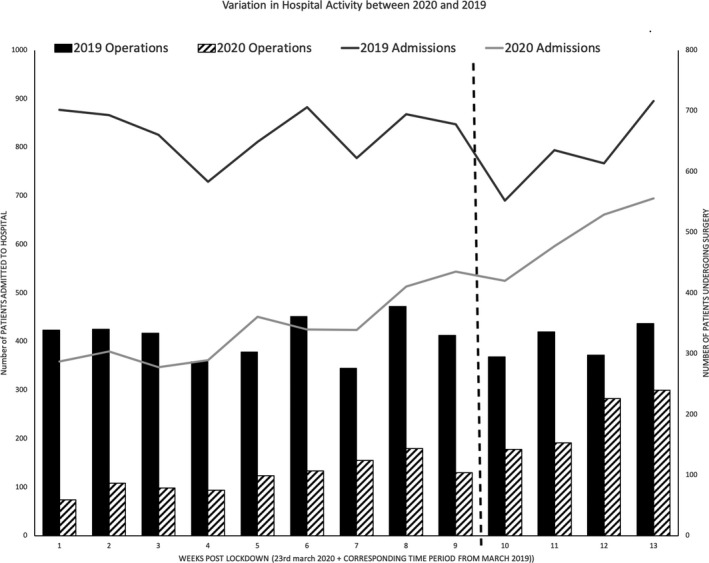
 ) and 2020 admissions (
 ); operations (bar graph) are 2019 operations (
 ) and 2020 operations (
 ).
).References
-
- Campbell D. NHS hospital waiting lists could hit 10 million in England this year. Guardian 2020. https://www.theguardian.com/society/2020/jun/10/nhs‐hospital‐waiting‐lis... (accessed 07/09/2020).
-
- The Royal College of Physicians . Returning the NHS to an even keel. 2020. https://www.rcplondon.ac.uk/guidelines‐policy/returning‐nhs‐even‐keel (accessed 07/09/2020).
-
- The Royal College of Paediatrics and Child Health . National guidance for the recovery of elective surgery in children 2020. https://www.rcpch.ac.uk/resources/national‐guidance‐recovery‐elective‐su... (accessed 29/08/2020).
-
- Department of Health . The NHS Plan: a plan for investment, a plan for reform. Report of a joint working party. 2000. https://webarchive.nationalarchives.gov.uk/20130124064356/http://www.dh.... (accessed 07/09/2020).
-
- Epidemiology Working Group for NCIP Epidemic Response, Chinese Center for Disease Control and Prevention . The epidemiological characteristics of an outbreak of 2019 novel coronavirus diseases. Zhonghua Liu Xing Bing Xue Za Zhi 2020; 41: 145–51. - PubMed
Publication types
MeSH terms
LinkOut - more resources
Full Text Sources
Medical
Miscellaneous
