


Perceived Control Buffers the Effects of the COVID-19 Pandemic on General Health and Life Satisfaction: The Mediating Role of Psychological Distance
- PMID: 32955170
- PMCID: PMC7537495
- DOI: 10.1111/aphw.12232
Perceived Control Buffers the Effects of the COVID-19 Pandemic on General Health and Life Satisfaction: The Mediating Role of Psychological Distance
Abstract
Background: Ways to maintain good health during a pandemic are very important for the general population; however, little is known about the impact of the coronavirus disease 2019 (COVID-19) on individuals' life satisfaction and perceived general health. This study aimed to examine the effects of COVID-19 on life satisfaction and perceived general health and reveal the buffering effect of perceived control on coping with COVID-19.
Methods: We collected 1,847 participants' data from 31 pandemic-affected provinces in China and obtained regional epidemic data of the same provinces. We employed a moderated mediation model with both individuals' self-report data and regional epidemic data to verify the hypotheses.
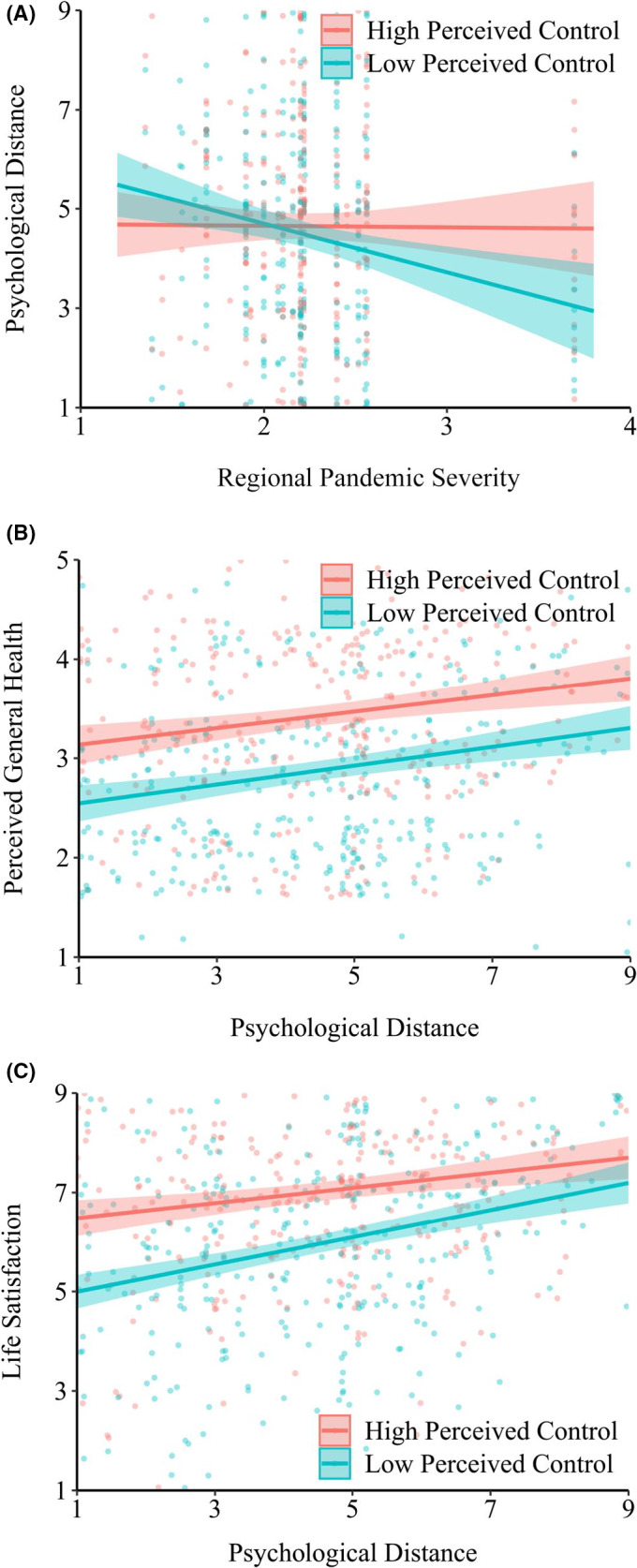
Results: Psychological distance mediated the relationships of regional pandemic severity with perceived general health and life satisfaction. Perceived control moderated the detrimental effects of regional pandemic severity through the moderating effects of regional pandemic severity on psychological distance, as well as the moderating effects of psychological distance on life satisfaction.
Conclusions: Our findings indicate that perceived control may act as a protective factor buffering the psychological impact of the pandemic on general health and life satisfaction. Psychological distance can serve as a mediator that explains how the COVID-19 pandemic impacts perceived general health and life satisfaction.
Keywords: COVID-19; health; life satisfaction; perceived control; psychological distance.
© 2020 International Association of Applied Psychology.
Figures

References
-
- Alonso‐Ferres, M. , Imami, L. , & Slatcher, R.B. (2020). Untangling the effects of partner responsiveness on health and well‐being: The role of perceived control. Journal of Social and Personal Relationships, 37(4), 1150–1171.
-
- Bults, M. , Beaujean, D.J. , de Zwart, O. , Kok, G. , van Empelen, P. , van Steenbergen, J.E. , … Voeten, H.A. (2011). Perceived risk, anxiety, and behavioural responses of the general public during the early phase of the Influenza A (H1N1) pandemic in the Netherlands: Results of three consecutive online surveys. BMC Public Health, 11(1), 2. - PMC - PubMed
-
- Chandran, S. , & Menon, G. (2004). When a day means more than a year: Effects of temporal framing on judgments of health risk. Journal of Consumer Research, 31(2), 375–389.
-
- Drewelies, J. , Schade, H. , Hülür, G. , Hoppmann, C.A. , Ram, N. , & Gerstorf, D. (2020). The more we are in control, the merrier? Partner perceived control and negative affect in the daily lives of older couples. Journals of Gerontology: Series B, 75(2), 338–348. - PubMed
Publication types
MeSH terms
Grants and funding
LinkOut - more resources
Full Text Sources
Medical
