. 2020 Aug;11(8):e00223.
doi: 10.14309/ctg.0000000000000223.

Efficacy of Norfloxacin Prophylaxis to Prevent Spontaneous Bacterial Peritonitis: A Systematic Review and Meta-Analysis

Affiliations

Efficacy of Norfloxacin Prophylaxis to Prevent Spontaneous Bacterial Peritonitis: A Systematic Review and Meta-Analysis

Marcus M Mücke et al. Clin Transl Gastroenterol. 2020 Aug.

Abstract

Introduction: With the emergence of multidrug-resistant organisms, the efficacy of antibiotic prophylaxis to prevent spontaneous bacterial peritonitis (SBP) has been debated. The aim of this study was to assess factors impacting effectiveness of SBP prophylaxis.

Methods: We searched PubMed, Embase, and the Cochrane Registry from inception to May 2019 to identify randomized controlled trials of patients with liver cirrhosis that assessed SBP occurrence/recurrence during antibiotic prophylaxis with the common antibiotic agents. Network meta-analysis was performed, pooling data with regard to incidence rate ratios (IRRs) of SBP, death, or extraperitoneal infections.

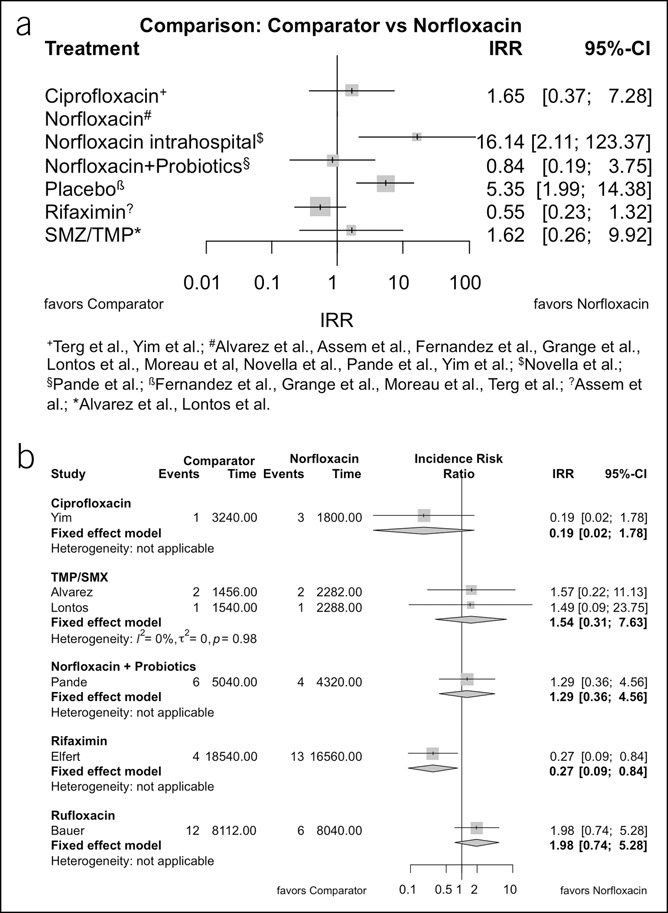
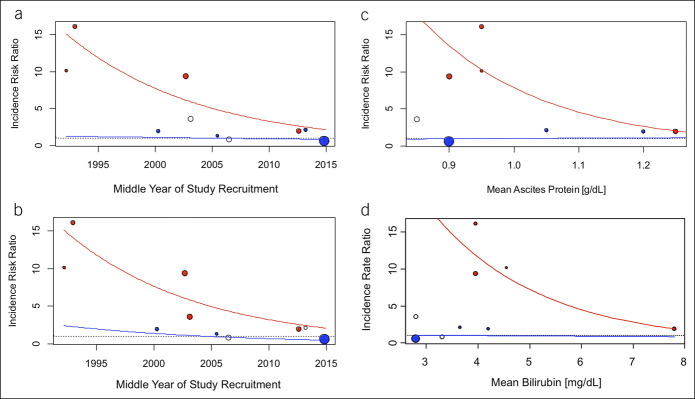
Results: Overall, 1,626 patients in 12 randomized controlled trials were included. During primary prophylaxis, the incidence rate of SBP and death in the norfloxacin-treated patients was 0.117 and 0.438 per patient-year, respectively, and IRRs of placebo vs norfloxacin were significantly higher (IRR 5.35, 95% confidence interval 1.99-14.38, P = 0.0009 for SBP and IRR 2.04, 95% confidence interval 1.20-3.44, P = 0.008 for death). The efficacy of norfloxacin to prevent SBP, but not death, decreased over time (annual percent change from 1992 to 2015 8.2%, P = 0.019), The positive treatment effect was lower in studies including patients with increased ascites protein (P = 0.021) or exceedingly high serum bilirubin (P = 0.012) levels. Norfloxacin was not superior to other antibiotics. The incidence rate of SBP was 2.5-fold higher in patients treated with norfloxacin as secondary compared with primary prophylaxis. No significant differences between treatment designs were observed in secondary prophylaxis.

Discussion: Norfloxacin remained superior to placebo in preventing SBP, yet the efficacy to prevent SBP, not death, decreased over time. Further studies to understand this phenomenon are urgently needed.


Conflict of interest statement

Guarantor of the article: Marcus M. Mücke, MD.

Specific author contributions: Christian M. Lange, MD, and Eva Herrmann, MD, contributed equally to the study/share senior authorship. The authors have contributed to the manuscript by planning the study (M.M.M., E.H., and C.M.L.), reviewing the literature (M.M.M., V.T.M., and C.M.L.), collecting the data (all authors), performing the meta-analyses (E.H. and M.M.M.), and assessment and interpretation of the data (all authors). M.M.M., E.H. and C.M.L. wrote the manuscript, and all authors read, revised, and approved the final version of the manuscript. All authors have seen and approved the final version of the manuscript, and all authors have significantly contributed to the work.

Financial support: None to report.

Potential competing interests: M.M.M. reports speaking fees from AbbVie, travel support from AbbVie, Gilead, and Intercept, and a research grant from Gilead, all unrelated to the submitted work. V.T.M. reports travel support from AbbVie and Gilead, all unrelated to the submitted work. C.G. reports travel support from Gilead, unrelated to the submitted work. K.M.S. reports travel support from AbbVie, unrelated to the submitted work. P.G.F. reports consultancy for SNIPR Biome, unrelated to the submitted work. J.F. reports speaking and/or consulting fees from Grifols and Merck/MSD, all unrelated to the submitted work. S.Z. reports speaking and/or consulting fees from AbbVie, Bristol-Myers Squibb, Falk, Gilead, Janssen, and Merck/MSD, all unrelated to the submitted work. J.T. reports speaking and/or consulting fees for Gore, Bayer, Alexion, MSD, Gilead, Intercept, Norgine, Grifols, Versantis, and Martin Pharmaceutical, all unrelated to the submitted work. C.M.L. reports speaker fees from AbbVie, Gilead, MSD, and Norgine and travel support from AbbVie and Gilead, all unrelated to the submitted work. E.H. reports no conflicts of interest related to this work.

Figures

Figure 1.
Figure 1.
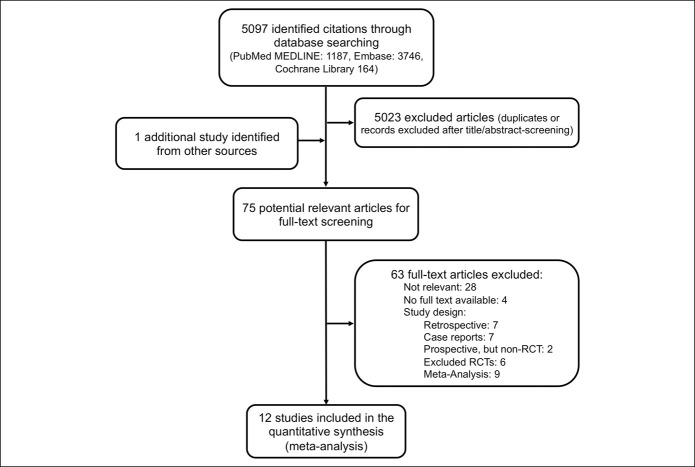
Summary of search results and study selection.
Figure 2.
Figure 2.
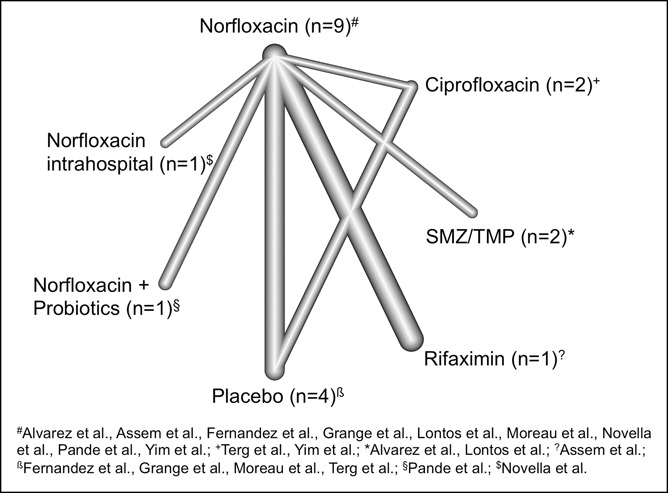
Network graph illustrating the direct treatment comparisons for primary prophylaxis. Evidence of the direct comparisons is illustrated by the thickness of the connecting lines. Note that evidence does not only refer to the number of studies but also to the sample size of the respective studies. SMZ/TMP, sulfamethoxazole/trimethoprim.
Figure 3.
Figure 3.
Forest plot illustrating estimated incidence rate ratios (IRRs) of norfloxacin with the respective antibiotic for spontaneous bacterial peritonitis prophylaxis from direct and indirect comparisons on a logarithmically scaled horizontal axis. (a) Results for primary prophylaxis. (b) Pairwise meta-analysis shows the results of a meta-analysis using subgroups for the different treatment comparators for secondary prophylaxis. CI, confidence interval. SMZ/TMP, sulfamethoxazole/trimethoprim.
Figure 4.
Figure 4.
Meta-regression plot of incidence rate ratios (IRRs) for spontaneous bacterial peritonitis in primary prophylaxis. Red points indicate the studies with estimated IRRs of placebo/norfloxacin intrahospital vs norfloxacin; blue points indicate the studies with estimated IRRs of other active treatments vs norfloxacin. Open circles indicate the studies with norfloxacin plus probiotics vs norfloxacin and placebo vs ciprofloxacin. The size of the circles corresponds to 1/standard error. Red lines show the trend in decreasing IRRs for placebo vs norfloxacin from direct and indirect comparisons, and the blue lines show the missing trend in other active treatments vs norfloxacin from direct and indirect comparisons in a network meta-regression model. (a, b) Results with respect to norfloxacin and all fluoroquinolones, respectively. (c, d) IRR with regard to mean ascites protein and mean serum bilirubin levels. Included studies: (a) and (b) included all studies with primary prophylaxis (see also Figure 1), (c) included all studies except Lontos et al. and Pande et al., and (d) included all studies except Lontos et al. due to insufficient data provided.

Comment in

  • A New Window to Favorable Outcome in Acute-on-Chronic Liver Failure.
    Mir BA, Majeed T, Chauhan A. Mir BA, et al. Am J Gastroenterol. 2022 May 1;117(5):815. doi: 10.14309/ajg.0000000000001703. Epub 2022 Mar 18. Am J Gastroenterol. 2022. PMID: 35311796 No abstract available.
  • Response to Mir et al.
    Kulkarni AV, Kumar K, Premkumar M, Rao PN, Reddy DN. Kulkarni AV, et al. Am J Gastroenterol. 2022 May 1;117(5):816. doi: 10.14309/ajg.0000000000001760. Am J Gastroenterol. 2022. PMID: 35501977 No abstract available.

References

    1. Arvaniti V, D'Amico G, Fede G, et al. Infections in patients with cirrhosis increase mortality four-fold and should be used in determining prognosis. Gastroenterology 2010;139(4):1246–5, 1256 e1-5. - PubMed
    1. Bernard B, Grangé JD, Khac EN, et al. Antibiotic prophylaxis for the prevention of bacterial infections in cirrhotic patients with gastrointestinal bleeding: A meta-analysis. Hepatology 1999;29(6):1655–61. - PubMed
    1. Tito L, Rimola A, Gines P, et al. Recurrence of spontaneous bacterial peritonitis in cirrhosis: Frequency and predictive factors. Hepatology 1988;8(1):27–31. - PubMed
    1. Mücke MM, Rumyantseva T, Mücke VT, et al. Bacterial infection-triggered acute-on-chronic liver failure is associated with increased mortality. Liver Int 2018;38(4):645–53. - PubMed
    1. Wiest R, Lawson M, Geuking M. Pathological bacterial translocation in liver cirrhosis. J Hepatol 2014;60(1):197–209. - PubMed

Publication types

MeSH terms