


Cancer-Associated Fibroblasts: Versatile Players in the Tumor Microenvironment
- PMID: 32957515
- PMCID: PMC7564346
- DOI: 10.3390/cancers12092652
Cancer-Associated Fibroblasts: Versatile Players in the Tumor Microenvironment
Abstract
Cancer-associated fibroblasts (CAFs) are indispensable architects of the tumor microenvironment. They perform the essential functions of extracellular matrix deposition, stromal remodeling, tumor vasculature modulation, modification of tumor metabolism, and participation in crosstalk between cancer and immune cells. In this review, we discuss our current understanding of the principal differences between normal fibroblasts and CAFs, the origin of CAFs, their functions, and ultimately, highlight the intimate connection of CAFs to virtually all of the hallmarks of cancer. We address the remarkable degree of functional diversity and phenotypic plasticity displayed by CAFs and strive to stratify CAF biology among different tumor types into practical functional groups. Finally, we summarize the status of recent and ongoing trials of CAF-directed therapies and contend that the paucity of trials resulting in Food and Drug Administration (FDA) approvals thus far is a consequence of the failure to identify targets exclusive of pro-tumorigenic CAF phenotypes that are mechanistically linked to specific CAF functions. We believe that the development of a unified CAF nomenclature, the standardization of functional assays to assess the loss-of-function of CAF properties, and the establishment of rigorous definitions of CAF subpopulations and their mechanistic functions in cancer progression will be crucial to fully realize the promise of CAF-targeted therapies.
Keywords: CAF therapeutics; cancer-associated fibroblasts; chemoresistance; clinical trials targeting CAFs; hallmarks of cancer; heterogeneity; immunomodulation; tumor microenvironment.
Conflict of interest statement
D.T.T. has received consulting fees from ROME Therapeutics, Foundation Medicine, Inc., NanoString Technologies, EMD Millipore Sigma, and Pfizer that are not related to this work. D.T.T. is a founder and has equity in ROME Therapeutics, PanTher Therapeutics and TellBio, Inc., which is not related to this work. D.T.T. receives research support from ACD-Biotechne, PureTech Health LLC, and Ribon Therapeutics, which was not used in this work. Dr. Ting’s interests were reviewed and are managed by Massachusetts General Hospital and Mass General Brigham in accordance with their conflict of interest policies. All other authors declare no conflict of interest.
Figures


References
-
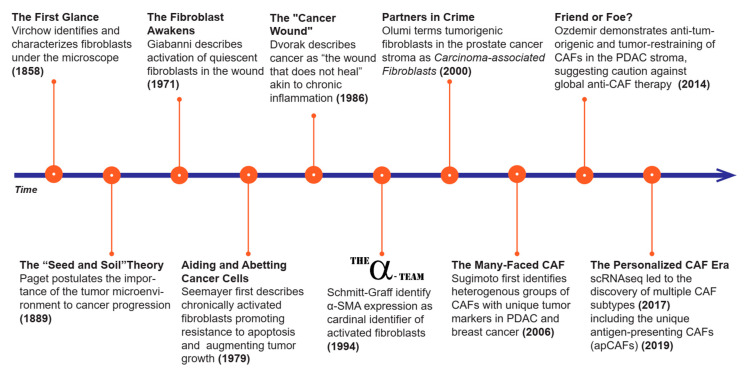
- Paget S. The distribution of secondary growths in cancer of the breast. 1889. Cancer Metastasis Rev. 1989;8:98–101. - PubMed
-
- Özdemir B.C., Pentcheva-Hoang T., Carstens J.L., Zheng X., Wu C.-C., Simpson T.R., Laklai H., Sugimoto H., Kahlert C., Novitskiy S.V., et al. Depletion of Carcinoma-Associated Fibroblasts and Fibrosis Induces Immunosuppression and Accelerates Pancreas Cancer with Reduced Survival. Cancer Cell. 2014;25:719–734. doi: 10.1016/j.ccr.2014.04.005. - DOI - PMC - PubMed
-
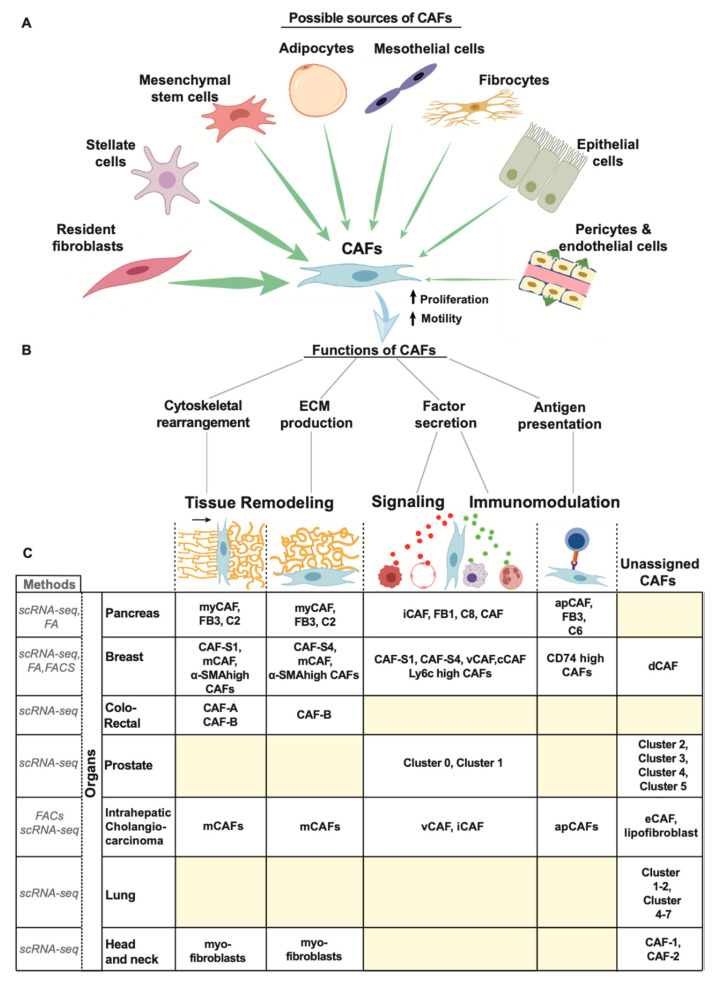
- Elyada E., Bolisetty M., Laise P., Flynn W.F., Courtois E.T., Burkhart R.A., Teinor J.A., Belleau P., Biffi G., Lucito M.S., et al. Cross-species single-cell analysis of pancreatic ductal adenocarcinoma reveals antigen-presenting cancer-associated fibroblasts. Cancer Discov. 2019;9:1102–1123. doi: 10.1158/2159-8290.CD-19-0094. - DOI - PMC - PubMed
Publication types
LinkOut - more resources
Full Text Sources
