Review
. 2020 Sep 21;22(1):220.
doi: 10.1186/s13075-020-02281-1.

A20: a master regulator of arthritis

Affiliations
Review

A20: a master regulator of arthritis

Yongyao Wu et al. Arthritis Res Ther. .

Abstract

A20, also known as TNF-α-induced protein 3 (TNFAIP3), is an anti-inflammatory protein that plays an important part in both immune responses and cell death. Impaired A20 function is associated with several human inflammatory and autoimmune diseases. Although the role of A20 in mediating inflammation has been frequently discussed, its intrinsic link to arthritis awaits further explanation. Here, we review new findings that further demonstrate the molecular mechanisms through which A20 regulates inflammatory arthritis, and we discuss the regulation of A20 by many factors. We conclude by reviewing the latest A20-associated mouse models that have been applied in related research because they reflect the characteristics of arthritis, the study of which will hopefully cast new light on anti-arthritis treatments.

Keywords: A20; Arthritis; Inflammation; Mouse models; Zinc finger domains.


Conflict of interest statement

The authors declare no potential conflicts of interest with respect to the authorship and/or publication of this article.

Figures
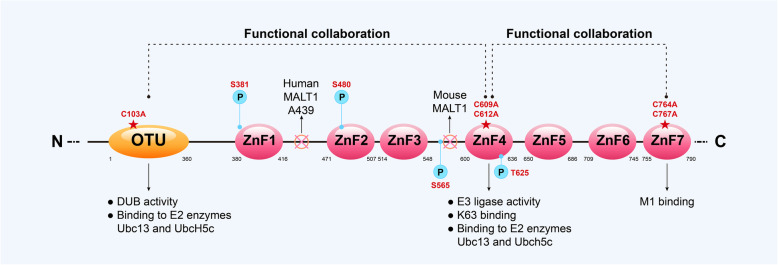
Fig. 1
Fig. 1
Domain structure and biochemical characteristics of the A20 protein. The typical amino acid sequence of human A20 has been digitally annotated. The A20 protein contains an ovarian tumor (OTU) domain in its amino terminus and seven zinc fingers (ZnF) in its carboxy-terminal end, and each domain has its own characteristics in mediating deubiquitylating (DUB) or ubiquitylating (Ub). The OTU domain of A20 has deubiquitylating enzyme activity, which is mediated by the catalytic residue Cys103 (C103). A20 is capable of binding to ubiquitylated E2 enzymes such as Ubc13 and UbcH5c via OTU and ZnF4. The ZnF4 domain of A20 mediates E3 ubiquitin ligase activity and has K63-linked polyubiquitin-binding affinity. ZnF7 has M1-linked polyubiquitin affinity and competes with other Ub-binding proteins to prevent the degradation of M1-linked chains. A20 also interacts with other protein such as RIP1, TAX1-binding protein 1 (TAX1BP1), and UbcH5a via ZF domain, and with TNF receptor associated factor 6 (TRAF6) via OTU domain. What is more, A20’s ZnF4 and ZnF7 Ub-binding domains are synergistic in regulating Ub-dependent signaling. OTU and ZnF4 domains of A20 complement each other in cells, which is facilitated by dimerization of A20 proteins. A20 can be regulated by posttranscriptional modification. For example, Human A20 is cleaved by MALT1 at Ala439, while mouse A20 is cleaved at the site between ZnF3 and ZnF4. Phosphorylation sites of A20 contains Ser381, Ser480, Ser565, and Thr625, and phosphorylation at Ser381 mediated by IKKβ can improve DUB activity. Additionally, domain-specific mutant mice can be generated by mutating OTU (C103A), ZnF4 (C609A and C612A), or ZnF7 (C764A and C767A) and other specific sites
Fig. 2
Fig. 2
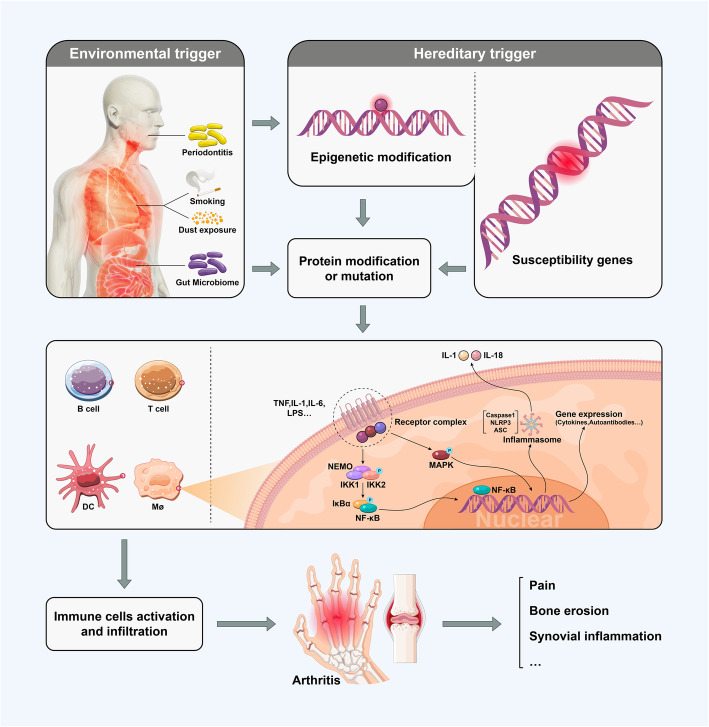
Principle of the development of arthritis. Hereditary and environmental factors synergistically trigger protein mutation or modification. First, the protein mutation results in the activation of immune cells such as macrophages (Møs) and dendritic cells (DCs), leading to hypersensitivity of these cells to TNF, LPS, IL-1, and so on. Second, after modification, the specific peptide of the protein is recognized by DCs, and DCs can also submit abnormal protein fragments to T cells, resulting in the activation of immune cells. Then, NF-κB and MAPK are activated. As a consequence of the activated NF-κB pathway, inflammasomes tend to assemble, pro-inflammatory cytokines and autoantibodies are produced, and immune cells infiltrate. Thereafter, localization of the inflammatory response occurs, and arthritis is initiated
Fig. 3
Fig. 3
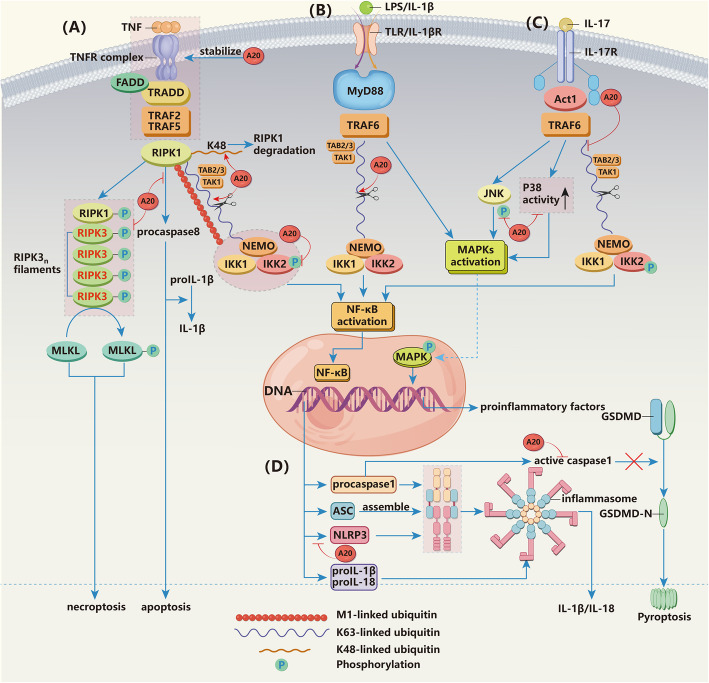
The mechanism by which A20 regulates arthritis. (a) In the TNF-induced NF-κB pathway, A20 can impair IKK complex activation, thus opposing the activation of NF-κB. Moreover, A20 removes lysine-63 (K63)-linked ubiquitin chains from RIPK1 and TNFR1 and adds K48-linked ubiquitin to RIPK1, thus targeting RIPK1 for proteasomal degradation and leading to dissociation of a RIPK1-containing complex from the membrane; these processes eventually block NF-κB-mediated promotion of cell survival. Degradation of RIPK1 avoids procaspase 8-dependent apoptosis and procaspase 8-mediated cleavage of pro-IL-1β. Additionally, phosphorylation of RIPK3 in the RIPK3-dependent RIPK1-RIPK3 complex is suppressed when A20 is present, and RIPK1-RIPK3-MLKL-dependent necroptosis is accordingly reduced. Furthermore, A20 stabilizes the connection of the M1-linked ubiquitin chain to complex I through its ZnF7 domain to protect them from being degraded by other DUBs and avoid necroptosis. b TLR-induced NF-κB activation due to LPS and IL-1β stimulation can be interrupted by A20 by impairing IKK complex activation as described above. A20 can also remove K63 ubiquitin chains on TRAF6, thereby blocking NF-κB and preventing MAPK activation to reduce IL-17 expression. c IL-17-induced activation of NF-κB can be restricted by A20 by removing K63-linked ubiquitin chains from TRAF6 and interrupting IKK complex activation. Moreover, A20 can restrict MAPK activation. On the one hand, A20 hinders the phosphorylation of JNK, thereby restricting MAPK signaling and reducing the production of pro-inflammatory factors. On the other hand, the existence of A20 inhibits p38 MARK and PKC activity to decrease IL-17 levels to hinder further inflammatory responses mediated by IL-17. d A20 can reduce the transcription of NLRP3, ASC, procaspase 1, pro-IL-1β, and proIL-18, and this regulation relies on the activation of NF-κB and directly lowers the basal expression of NLRP3 to impair inflammatory activation, thus blocking the secretion of IL-1β and IL-18. A20 also has the ability to inhibit pyroptosis in a mechanism that is dependent on active Casp1, thereby restoring the IL-1β production process

References

    1. Oikonomopoulou K, Diamandis EP, Hollenberg MD, Chandran V. Proteinases and their receptors in inflammatory arthritis: an overview. Nat Rev Rheumatol. 2018;14(3):170–180. - PubMed
    1. Sparks JA. Rheumatoid Arthritis. Ann Intern Med. 2019;170(1):Itc1–itc16. - PubMed
    1. Hunter DJ, Bierma-Zeinstra S. Osteoarthritis. Lancet. 2019;393(10182):1745–1759. - PubMed
    1. Gwinnutt JM, Symmons DPM, MacGregor AJ, Chipping JR, Marshall T, Lunt M, Verstappen SMM. Have the 10-year outcomes of patients with early inflammatory arthritis improved in the new millennium compared with the decade before? Results from the Norfolk Arthritis Register. Ann Rheum Dis. 2018;77(6):848–854. - PMC - PubMed
    1. Urbano PCM, Aguirre-Gamboa R, Ashikov A, van Heeswijk B, Krippner-Heidenreich A, Tijssen H, Li Y, Azevedo VF, Smits LJT, Hoentjen F, et al. TNF-alpha-induced protein 3 (TNFAIP3)/A20 acts as a master switch in TNF-alpha blockade-driven IL-17A expression. J Allergy Clin Immunol. 2018;142(2):517–529. - PubMed

Publication types

Substances