


Clinical utility of perfusion (Q)-single-photon emission computed tomography (SPECT)/CT for diagnosing pulmonary embolus (PE) in COVID-19 patients with a moderate to high pre-test probability of PE
- PMID: 32959115
- PMCID: PMC7505736
- DOI: 10.1007/s00259-020-05043-y
Clinical utility of perfusion (Q)-single-photon emission computed tomography (SPECT)/CT for diagnosing pulmonary embolus (PE) in COVID-19 patients with a moderate to high pre-test probability of PE
Abstract
Purpose: We reviewed the clinical utility of perfusion (Q)-single-photon emission computed tomography (SPECT)/CT for diagnosing pulmonary embolus (PE) in patients hospitalized with severe acute respiratory syndrome coronavirus 2 (SARS-CoV2).
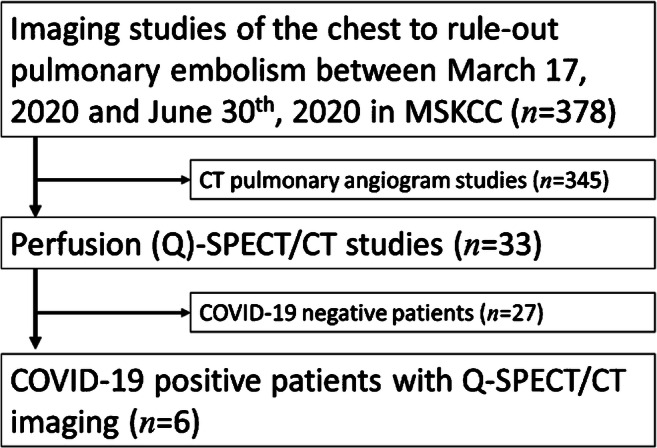
Methods: Following the World Health Organization's declaration of a global pandemic, our department policy recommended Q-only SPECT/CT for all patients undergoing nuclear medicine evaluation for suspected PE to reduce the risk of aerosolization of respiratory droplets. We performed a retrospective review of sequential patients admitted with COVID-19 imaged with Q-SPECT/CT between March 17, 2020, and June 30, 2020, at Memorial Sloan Kettering Cancer Center. We recorded patient demographics, clinical symptoms, Wells score (to stratify patients according to pre-test probability for PE prior to Q-SPECT/CT), and noted ancillary imaging findings on CT.
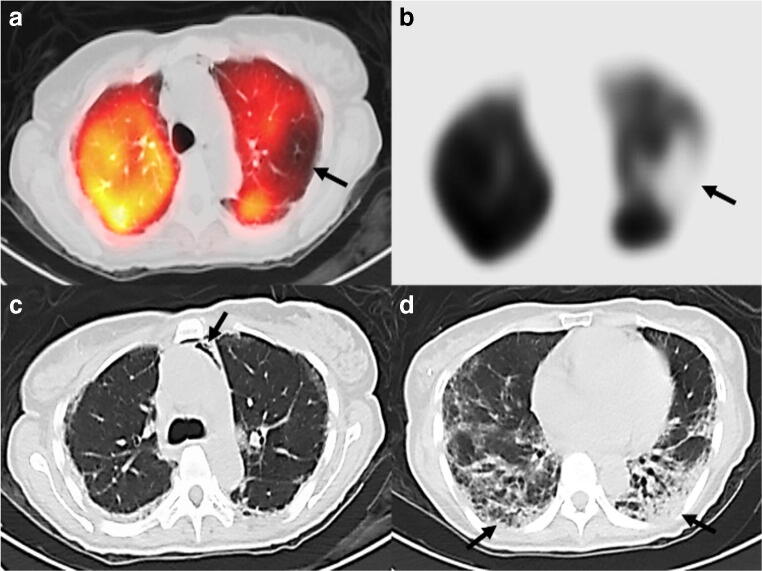
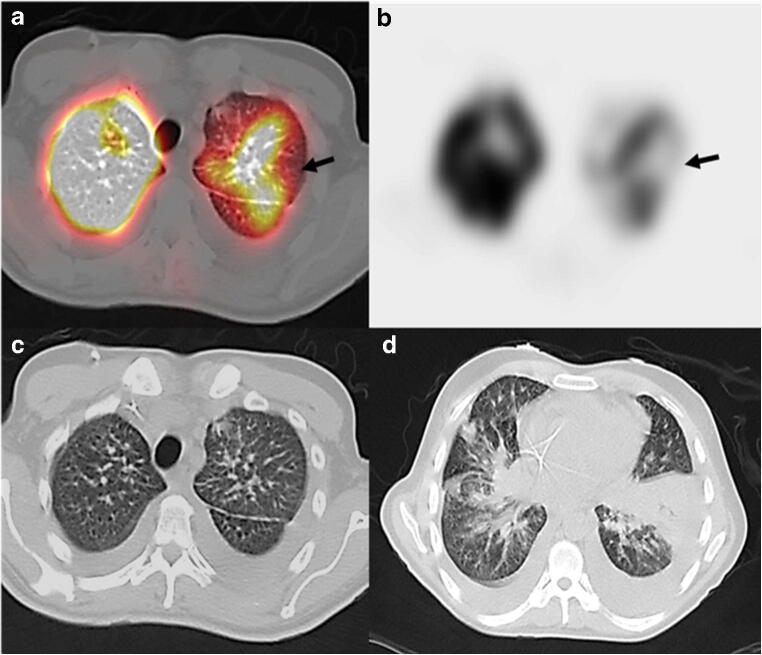
Results: Of the 33 patients imaged with Q-SPECT/CT, 6 patients (3 men, 3 women) had a laboratory confirmed diagnosis of COVID-19 (mean age, 55, ± 11.4 years, range 33-68). All patients had a current diagnosis of malignancy and had a moderate or high pre-test probability for PE (mean Wells score 2.8, range 2-4). Q-SPECT/CT was positive in 4/6 (67%) of patients. Distribution of pulmonary emboli was bilateral and segmental in 75% of patients. Ancillary acute findings on SPECT/CT included bilateral parenchymal ground glass opacities (n = 5), pleural effusions (n = 2), and pneumomediastinum (n = 1).
Conclusion: Q-SPECT/CT has clinical utility for diagnosing PE in patients with COVID-19 where there is a contraindication for iodinated contrast media and a moderate or high pre-test probability for PE.
Keywords: COVID-19; Coagulopathy; Pulmonary embolism; V/Q SPECT/CT.
Conflict of interest statement
The authors declare that they have no conflict of interest.
Figures
Comment in
-
The heterogeneity of lung perfusion patterns in SPECT/CT during COVID-19: not only embolism.Eur J Nucl Med Mol Imaging. 2021 Sep;48(10):3020-3021. doi: 10.1007/s00259-021-05377-1. Epub 2021 May 5. Eur J Nucl Med Mol Imaging. 2021. PMID: 33954825 Free PMC article. No abstract available.
References
-
- Simpson S, Kay FU, Abbara S, Bhalla S, Chung JH, Chung M, et al. Radiological Society of North America expert consensus statement on reporting chest CT findings related to COVID-19. Endorsed by the Society of Thoracic Radiology, the American College of Radiology, and RSNA - Secondary Publication. J Thorac Imaging 2020.35:219–227. - PMC - PubMed
Publication types
MeSH terms
Substances
Grants and funding
LinkOut - more resources
Full Text Sources
Medical
Miscellaneous
