Comparative Study
. 2020 Jan-Dec:35:1533317520953041.
doi: 10.1177/1533317520953041.

The Dual GLP-1/GIP Receptor Agonist DA4-JC Shows Superior Protective Properties Compared to the GLP-1 Analogue Liraglutide in the APP/PS1 Mouse Model of Alzheimer's Disease

Affiliations
Comparative Study

The Dual GLP-1/GIP Receptor Agonist DA4-JC Shows Superior Protective Properties Compared to the GLP-1 Analogue Liraglutide in the APP/PS1 Mouse Model of Alzheimer's Disease

Mark Maskery et al. Am J Alzheimers Dis Other Demen. 2020 Jan-Dec.

Abstract

Alzheimer's disease (AD) is a neurodegenerative disorder for which there is no cure. Here, we test a dual GLP-1/GIP receptor agonist (DA4-JC) that has a cell penetrating sequence added to enhance blood-brain barrier penetration. We show in a receptor activity study that DA4-JC has balanced activity on both GLP-1 and GIP receptors but not on GLP-2 or Glucagon receptors. A dose-response study in the APP/PS1 mouse model of AD showed both a dose-dependent drug effect on the inflammation response and the reduction of amyloid plaques in the brain. When comparing DA4-JC with the GLP-1 analogue liraglutide at equal doses of 10nmol/kg bw ip. once-daily for 8 weeks, DA4-JC was more effective in reversing memory loss, enhancing synaptic plasticity (LTP) in the hippocampus, reducing amyloid plaques and lowering pro-inflammatory cytokine levels in the brain. The results suggest that DA4-JC may be a novel treatment for AD.

Keywords: TNF-alpha; brain; growth factor; inflammation; insulin; synaptic plasticity.


Conflict of interest statement

The authors declared no potential conflicts of interest with respect to the research, authorship, and/or publication of this article.

Figures
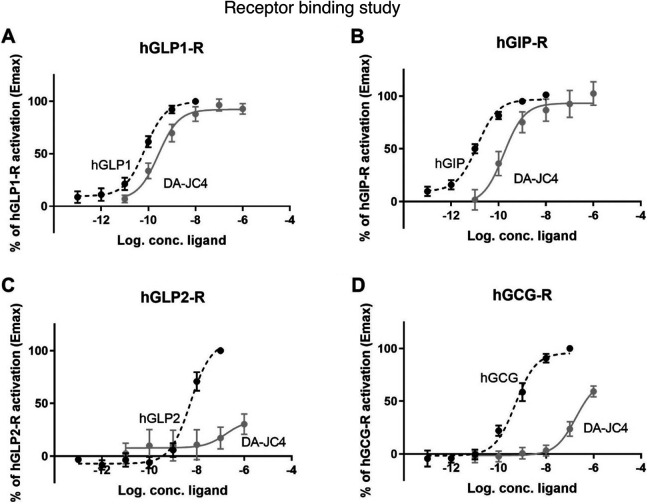
Figure 1.
Figure 1.
Activation of hGLP1-R, hGIP-R, hGLP2-R and hGCG-R by endogenous agonist and DA4-JC and cAMP accumulation in COS-7 cells transfected with (A) hGLP-1 receptor, treated with increasing concentrations of hGLP-1 and DA4-JC (B) hGIP-R treated with increasing concentrations of hGIP and DA4-JC (C) hGLP2-R treated with increasing concentrations of hGLP-2 and DA4-JC (C) hGCG-R treated with increasing concentrations of hGCG and DA4-JC.
Figure 2.
Figure 2.
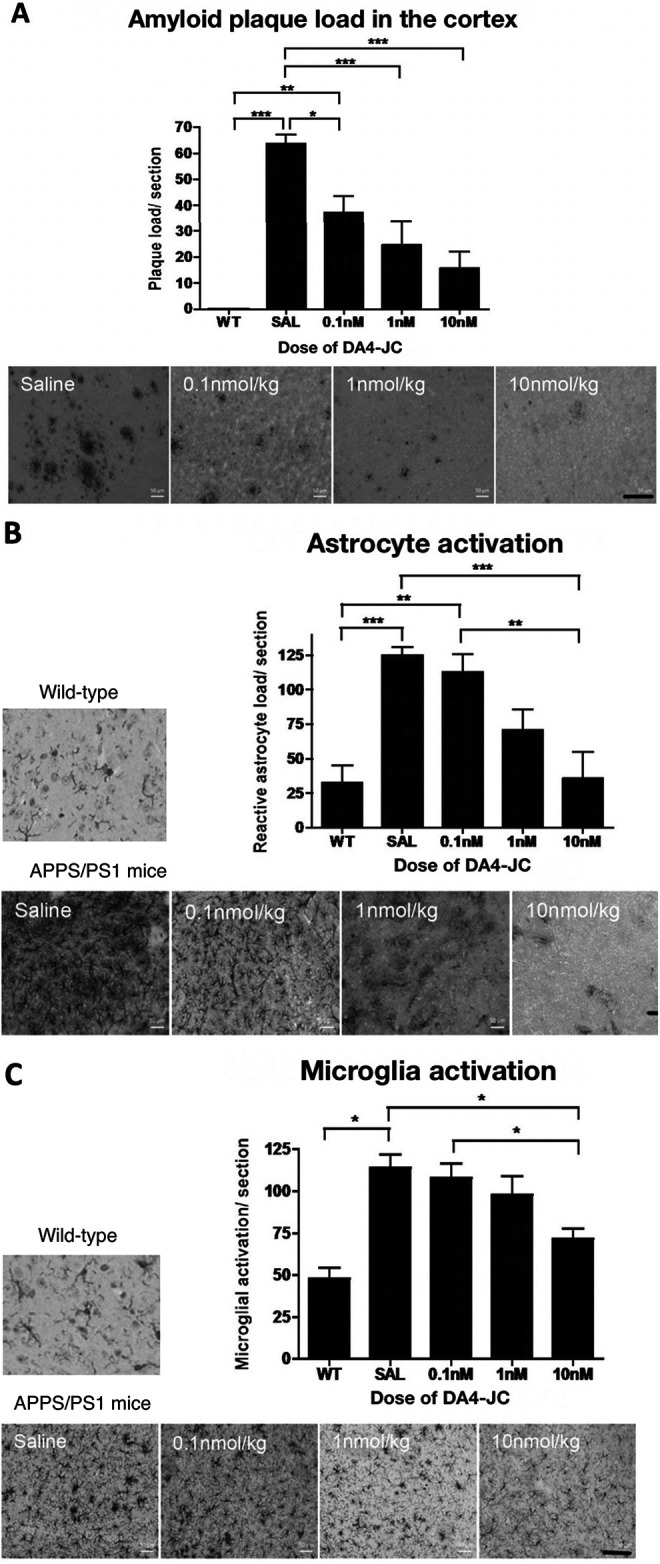
DA4-JC4 dose-response study in the APP/PS1 mouse model of AD. A: Immunohistochemical analysis of amyloid plaque load in the cortex of 9-month old APP/PS1 mice. The 4 different treatments given to the APP/PS1 mice, are shown in the images above, presenting a reduced number of amyloid plaques in the cortex (scale bar 100 µm). Data shown as mean ± S.E.M. (One-way ANOVA, Tukey’s Multiple Comparison post-hoc test, *=p < 0.05, **=p < 0.01, ***=p < 0.001). B: Immunohistochemical analysis of the number of reactive astrocytes in the cortex of 9-month old APP/PS1 mice. DA4-JC treatment reduced the number of activated astrocytes in the brain. The 5 images are illustrating the different treatments given to the APP/PS1 mice, showing the reduction in the number of reactive astrocytes per section within the cortex (scale bar 100 µm). Data shown as mean ± S.E.M. (*=p < 0.05, **=p < 0.01, ***=p < 0.001). C: Immunohistochemical analysis of the number of activated microglia in the cortex of 9-month old APP/PS1 mice. DA4-JC treatment reduced the number of activated microglia in the brain. The 5 images are illustrating the different treatments given to the wild-type and APP/PS1 mice, showing the reduction in activated microglia within the cortex (scale bar 100 µm). Data shown as mean ± S.E.M. (*=p < 0.05, **=p < 0.01, ***=p < 0.001).
Figure 3.
Figure 3.
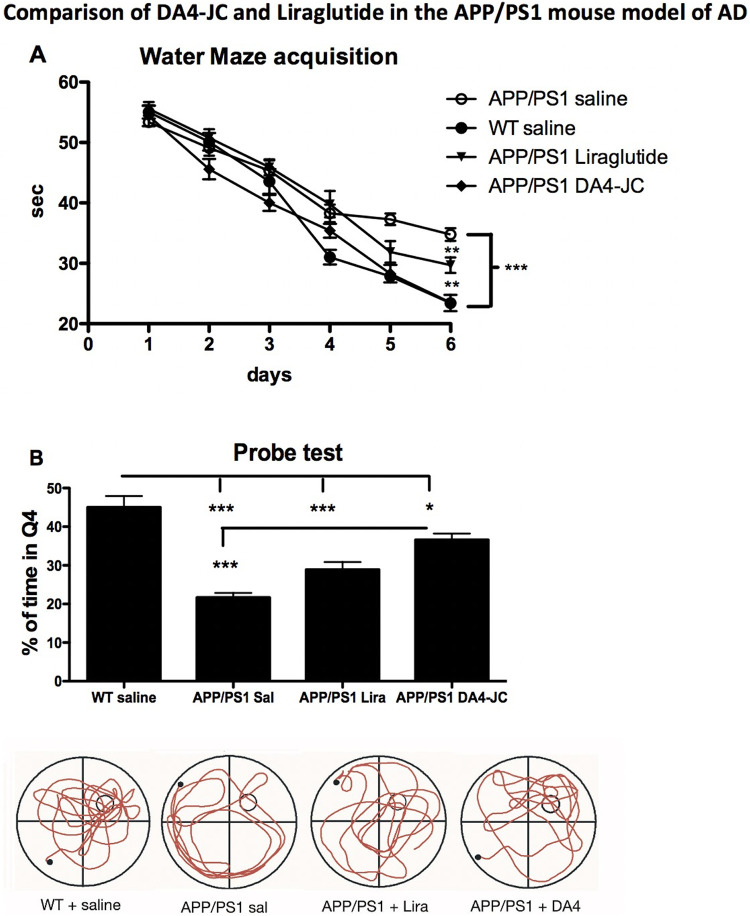
(A): Acquisition times for water maze training. A 2-way ANOVA found an overall difference for drug treatment (p < 0.001) and over time (p < 0.001). Post-hoc tests showed differences between groups. (B): Probe test percentage of target quadrant swim times. A 1-way ANOVA found an overall difference between groups (p < 0.001). Post-hoc tests showed differences between groups. *=p < 0.05; **=p < 0.01; ***=p < 0.001. N = 12 per group.
Figure 4.
Figure 4.
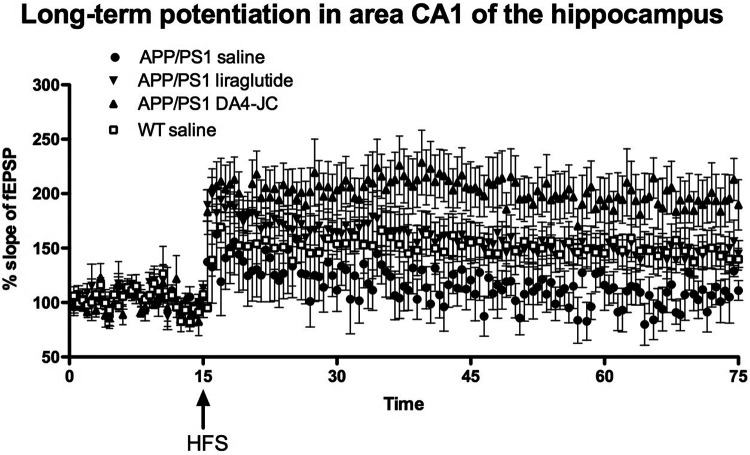
Long-term potentiation of synaptic transmission in area CA1 of the hippocampus is much improved by DA4-JC. A 2-way ANOVA found an overall difference between groups (p < 0.001) and over time (P < 0.001). The APP/PS1 DA4-JC group is significantly different from the other 3 groups. The APP/PS1 saline group is significantly different from the wild type (p < 0.001) and the APP/PS1 liraglutide group (p < 0.01). N = 6 per group.
Figure 5.
Figure 5.
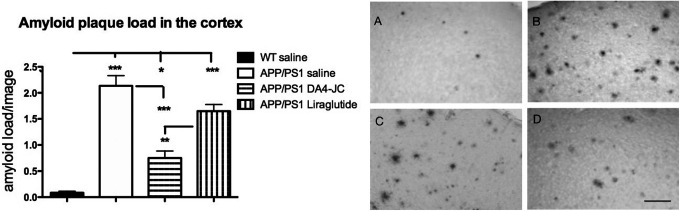
Quantification of beta-amyloid plaque loads in the neocortex. A 1-way ANOVA found an overall difference between groups (p < 0.001). DA4-JC was more effective in reducing the amyloid load compared to liraglutide in Tukey’s multiple comparison post-hoc tests. *=p < 0.05; **=p < 0.01; **=p < 0.001. N = 6-10 per group. Sample micrographs are shown. A = WT; B = APP/PS1 sal; C = APP/PS1 Lira; D = APP/PS1 DA4-JC. Scale bar = 50 µm.
Figure 6.
Figure 6.
Quantification of pro-inflammatory cytokines in the brain. A 1-way ANOVA found an overall difference between groups (p < 0.001). Western blots were repeated 3 times. DA4-JC was more effective in reducing the levels compared to liraglutide in Tukey’s multiple comparison post-hoc tests. *=p < 0.05; **=p < 0.01; **=p < 0.001. Sample bands are shown below.

References

    1. Cole A, Astell A, Green C, Sutherland C. Molecular connexions between dementia and diabetes. Neurosci Biobehav Rev. 2007;31:1046–1063. - PubMed
    1. Strachan MW, Reynolds RM, Marioni RE, Price JF. Cognitive function, dementia and type 2 diabetes mellitus in the elderly. Nat Rev Endocrinol. 2011;7:108–114. - PubMed
    1. Schrijvers EMC, Witteman JCM, Sijbrands EJG, Hofman A, Koudstaal PJ, Breteler MMB. Insulin metabolism and the risk of Alzheimer disease: the Rotterdam study. Neurology. 2010;75:1982–1987. - PMC - PubMed
    1. Craft S. Insulin resistance and Alzheimer’s disease pathogenesis: potential mechanisms and implications for treatment. Curr Alzheimer Res. 2007;4:147–152. - PubMed
    1. Hoyer S. Glucose metabolism and insulin receptor signal transduction in Alzheimer disease. Eur J Pharmacol. 2004;490:115. - PubMed

Publication types

Substances