


A Longitudinal Analysis of Inflammation and Depression in Patients With Metastatic Lung Cancer: Associations With Survival
- PMID: 32959680
- PMCID: PMC8755948
- DOI: 10.1177/1099800420959721
A Longitudinal Analysis of Inflammation and Depression in Patients With Metastatic Lung Cancer: Associations With Survival
Abstract
Background: Depression and inflammation are concomitantly elevated in patients with lung cancer and may have collective survival implications. However, the longitudinal relationship between depression and inflammation in patients with metastatic lung cancer is not fully appreciated. We hypothesized that longitudinal changes in inflammation and depression would be concordant; that longitudinally elevated inflammation would lead to greater depression over time; and that depression with inflammation would be more persistent than depression without inflammation.
Methods: Patients with metastatic lung cancer (n = 68) were assessed for clinically significant depression (Hospital Anxiety and Depression Scale ≥ 8) and inflammation (C-Reactive Protein ≥ 1 mg/L) along with demographic variables. Survival estimations were made using Cox Proportional Hazard Model and Kaplan-Meier plot analyses.
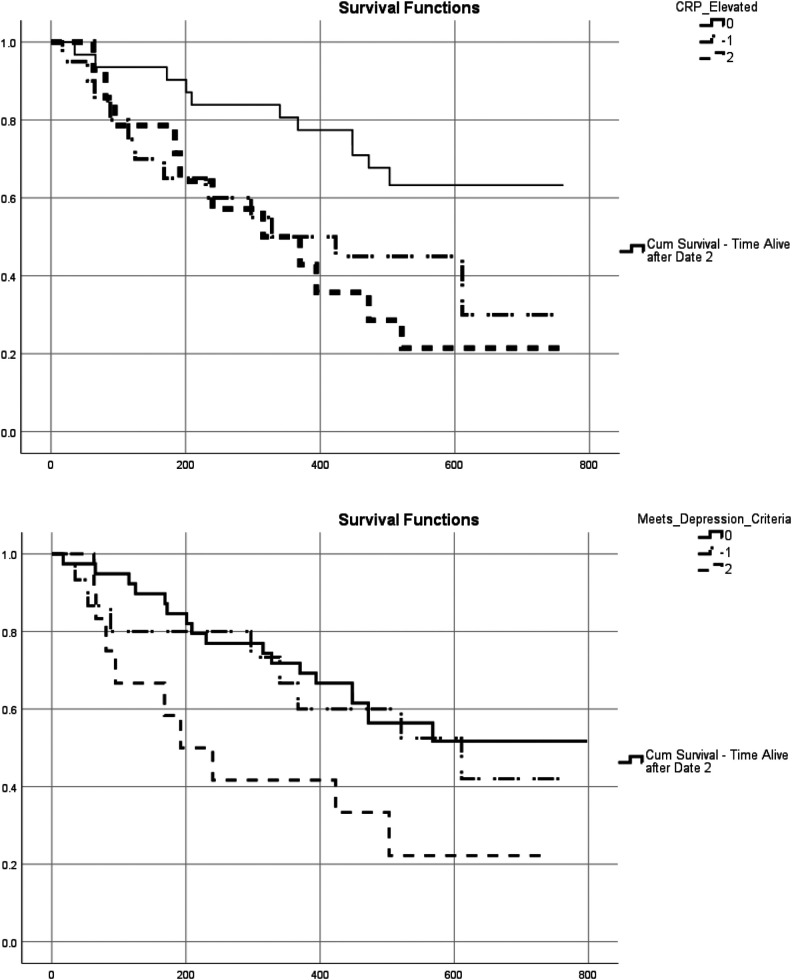
Results: At baseline (T1), 15% had depression and 35% had increased inflammation followed by 18% with depression and 38% with increased inflammation 4.7 months later (T2). The odds ratio of depression in the presence of clinically significant inflammation was 4.8 at T1 and 5.3 at T2. Between time points, inflammation difference correlated with depression difference (r = -.26, p = .03). Significant depression at both time points was associated with a 4 fold risk of inferior survival while significant inflammation at any time point was associated with >3 fold risk of inferior survival.
Conclusions: Depression and inflammation track together over time and have variable implications on survival. Persistent depression is particularly detrimental but incidental inflammation is more sensitive to predicting poor survival. These findings have implications for treating depression early in the lung cancer trajectory.
Keywords: C-reactive protein; depression; inflammation; longitudinal; lung cancer; prognosis; survival.
Conflict of interest statement
Figures
References
-
- Araujo A. S., Nogueira I. C., Gomes Neto A., de Medeiros I. L., Morano M. T., da Silva G. P., Santos F. A., De Moraes Filho M. O., Pereira E. D. (2016). The impact of lung cancer resection surgery on fibrinogen and C-reactive protein and their relationship with patients outcomes: A prospective follow up study. Cancer Biomarkers, 16(1), 47–53. 10.3233/CBM-150539 - DOI - PubMed
-
- Arrieta O., Angulo L. P., Nunez-Valencia C., Dorantes-Gallareta Y., Macedo E. O., Martinez-Lopez D., Alvarado S., Corona-Cruz J. F., Onate-Ocana L. F. (2013). Association of depression and anxiety on quality of life, treatment adherence, and prognosis in patients with advanced non-small cell lung cancer. Annals of Surgical Oncology, 20(6), 1941–1948. 10.1245/s10434-012-2793-5 - DOI - PubMed
-
- Bjelland I., Dahl A. A., Haug T. T., Neckelmann D. (2002). The validity of the Hospital Anxiety and Depression Scale. An updated literature review. Journal of Psychosomatic Research, 52(2), 69–77. - PubMed
Publication types
MeSH terms
Grants and funding
LinkOut - more resources
Full Text Sources
Medical
Research Materials
