


Progesterone for prevention of preterm birth in women with short cervical length: 2-year infant outcomes
- PMID: 32959909
- PMCID: PMC7986902
- DOI: 10.1002/uog.23126
Progesterone for prevention of preterm birth in women with short cervical length: 2-year infant outcomes
Abstract
Objective: To evaluate the long-term outcomes of children born to women with a short cervix and otherwise low risk for preterm birth, after antenatal exposure to vaginal progesterone vs placebo.
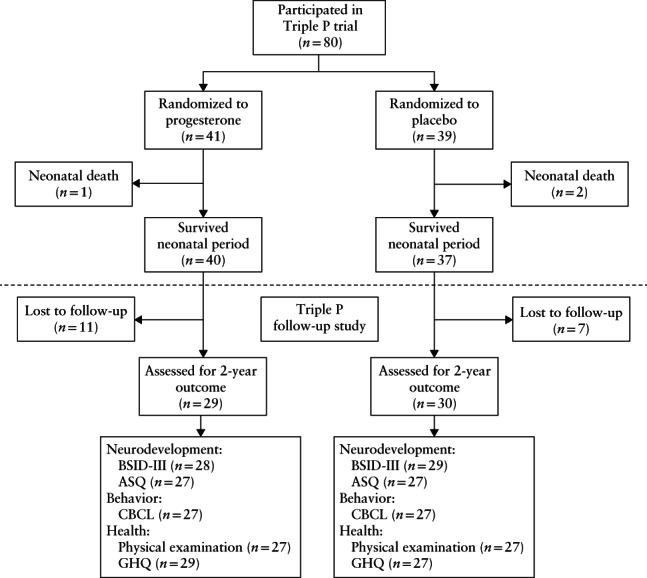
Methods: This was a follow-up study of the Triple P trial, which randomized 80 low-risk women with a short cervix (≤ 30 mm) at 18-22 weeks' gestation to progesterone (n = 41) or placebo (n = 39). At 2 years of corrected age, children were invited for a neurodevelopmental assessment, using the Bayley Scales of Infant and Toddler Development, third edition (BSID-III), and a neurological and physical examination by an assessor blinded to the allocated treatment. Parents filled out the Ages and Stages Questionnaire, the Child Behavior Checklist (CBCL) and a general-health questionnaire. The main outcome of interest was mean BSID-III cognitive and motor scores. Additionally, a composite score of mortality and abnormal developmental outcome, including BSID-III ≤-1 SD, CBCL score in the clinical range and/or parental reported physical problems (at least two operations or at least two hospital admissions in the previous 2 years), was evaluated. Our sample size, dictated by the original sample of the Triple P trial, provided 80% power to detect a mean difference (MD) of 15 points (1 SD) between groups for the BSID-III tests.
Results: Of the 80 children born to the randomized women, one in the progesterone group and two in the placebo group died in the neonatal period. Follow-up data were obtained for 59/77 (77%) children and BSID-III outcomes in 57 children (n = 28 in the progesterone group and n = 29 in the placebo group) born at a median gestational age of 38 + 6 weeks (interquartile range (IQR), 37 + 3 to 40 + 1 weeks) with a median birth weight of 3240 g (IQR, 2785-3620 g). In the progesterone vs placebo groups, mean BSID-III cognitive development scores were 101.6 vs 105.0 (MD, -3.4 (95% CI, -9.3 to 2.6); P = 0.29) while mean motor scores were 102.4 vs 107.3 (MD, -4.9 (95% CI, -11.2 to 1.4); P = 0.13). No differences were seen between the two groups in physical (including genital and neurological examination), behavioral and health-related outcomes.
Conclusion: In this sample of children born to low-risk women with a short cervix at screening, no relevant differences in neurodevelopmental, behavioral, health-related and physical outcomes were found between offspring exposed to vaginal progesterone and those exposed to placebo. © 2020 The Authors. Ultrasound in Obstetrics & Gynecology published by John Wiley & Sons Ltd on behalf of International Society of Ultrasound in Obstetrics and Gynecology.
Keywords: child; development; preterm birth; progesterone.
© 2020 The Authors. Ultrasound in Obstetrics & Gynecology published by John Wiley & Sons Ltd on behalf of International Society of Ultrasound in Obstetrics and Gynecology.
Figures
References
-
- Hille ET, Weisglas‐Kuperus N, van Goudoever JB, Jacobusse GW, Ens‐Dokkum MH, de Groot L, Wit JM, Geven WB, Kok JH, de Kleine MJK, Kollée LAA, Mulder ALM, van Straaten HLM, de Vries LS, van Weissenbruch MM, Verloove‐Vanhorick SP, Dutch Collaborative POPS 19 Study Group . Functional outcomes and participation in young adulthood for very preterm and very low birth weight infants: the Dutch Project on Preterm and Small for Gestational Age Infants at 19 years of age. Pediatrics 2007; 120: e587–595. - PubMed
-
- Iams JD, Goldenberg RL, Meis PJ, Mercer BM, Moawad A, Das A, Thom E, McNellis D, Copper RL, Johnson F, Roberts JM. The length of the cervix and the risk of spontaneous premature delivery. National Institute of Child Health and Human Development Maternal Fetal Medicine Unit Network. N Engl J Med 1996; 334: 567–572. - PubMed
-
- Romero R, Conde‐Agudelo A, Da Fonseca E, O'Brien JM, Cetingoz E, Creasy GW, Hassan SS, Nicolaides KH. Vaginal progesterone for preventing preterm birth and adverse perinatal outcomes in singleton gestations with a short cervix: a meta‐analysis of individual patient data. Am J Obstet Gynecol 2018; 218: 161–180. - PMC - PubMed
-
- Norman JE, Marlow N, Messow CM, Shennan A, Bennett PR, Thornton S, Robson SC, McConnachie A, Petrou S, Sebire NJ, Lavender T, Whyte S, Norrie J; OPPTIMUM study group . Vaginal progesterone prophylaxis for preterm birth (the OPPTIMUM study): a multicentre, randomised, double‐blind trial. Lancet 2016; 387: 2106–2116. - PMC - PubMed
Publication types
MeSH terms
Substances
LinkOut - more resources
Full Text Sources
Other Literature Sources
