Healthy lifestyle and life expectancy in people with multimorbidity in the UK Biobank: A longitudinal cohort study
- PMID: 32960883
- PMCID: PMC7508366
- DOI: 10.1371/journal.pmed.1003332
Healthy lifestyle and life expectancy in people with multimorbidity in the UK Biobank: A longitudinal cohort study
Abstract
Background: Whether a healthy lifestyle impacts longevity in the presence of multimorbidity is unclear. We investigated the associations between healthy lifestyle and life expectancy in people with and without multimorbidity.
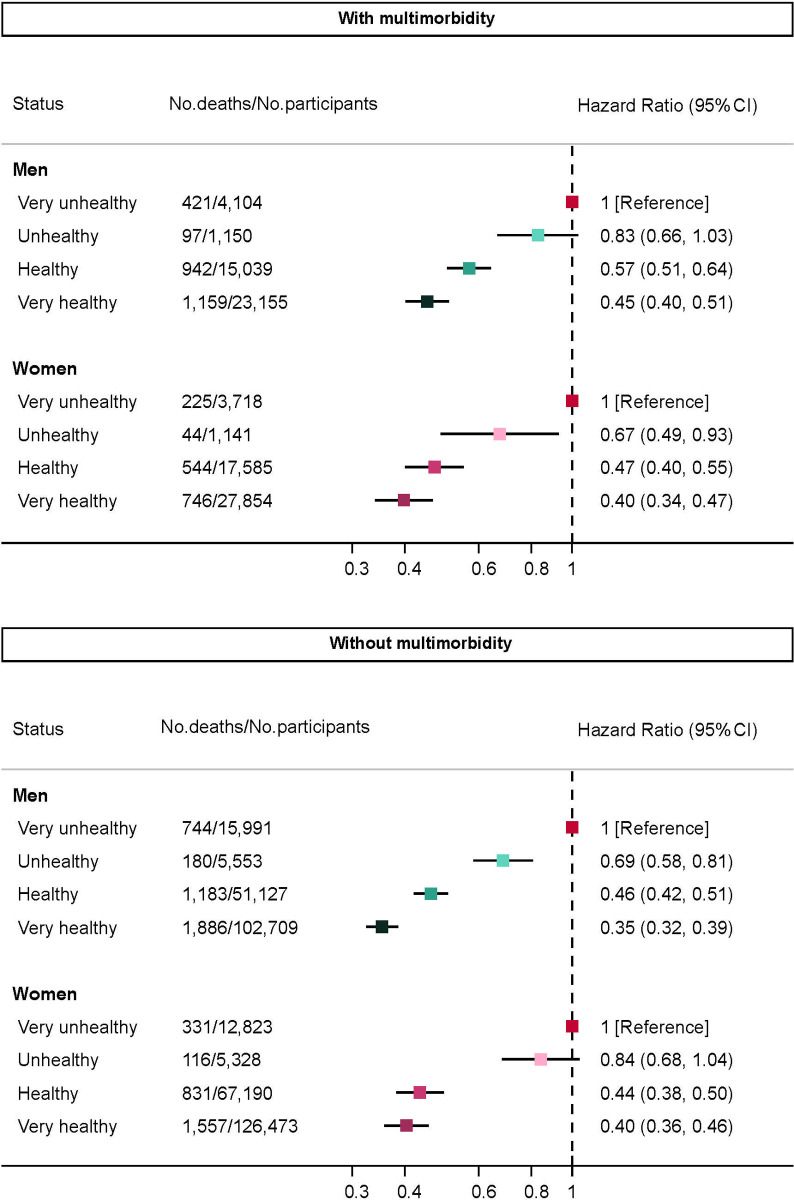
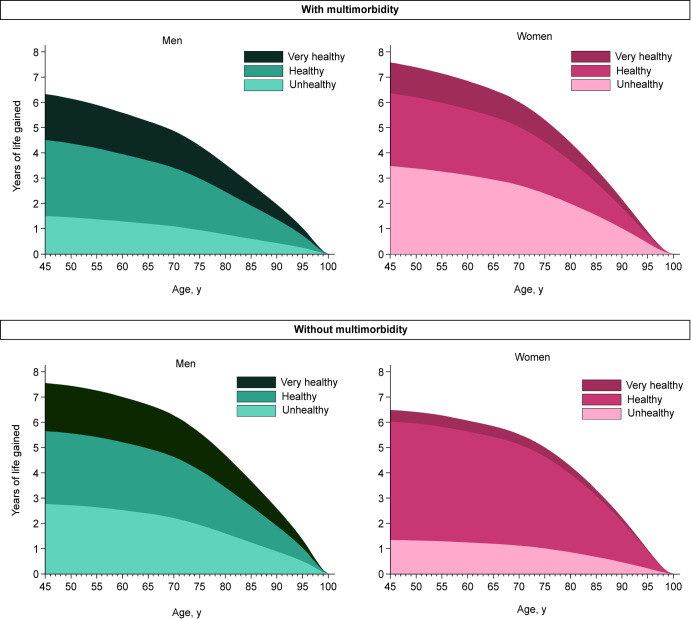
Methods and findings: A total of 480,940 middle-aged adults (median age of 58 years [range 38-73], 46% male, 95% white) were analysed in the UK Biobank; this longitudinal study collected data between 2006 and 2010, and participants were followed up until 2016. We extracted 36 chronic conditions and defined multimorbidity as 2 or more conditions. Four lifestyle factors, based on national guidelines, were used: leisure-time physical activity, smoking, diet, and alcohol consumption. A combined weighted score was developed and grouped participants into 4 categories: very unhealthy, unhealthy, healthy, and very healthy. Survival models were applied to predict life expectancy, adjusting for ethnicity, working status, deprivation, body mass index, and sedentary time. A total of 93,746 (19.5%) participants had multimorbidity. During a mean follow-up of 7 (range 2-9) years, 11,006 deaths occurred. At 45 years, in men with multimorbidity an unhealthy score was associated with a gain of 1.5 (95% confidence interval [CI] -0.3 to 3.3; P = 0.102) additional life years compared to very unhealthy score, though the association was not significant, whilst a healthy score was significantly associated with a gain of 4.5 (3.3 to 5.7; P < 0.001) life years and a very healthy score with 6.3 (5.0 to 7.7; P < 0.001) years. Corresponding estimates in women were 3.5 (95% CI 0.7 to 6.3; P = 0.016), 6.4 (4.8 to 7.9; P < 0.001), and 7.6 (6.0 to 9.2; P < 0.001) years. Results were consistent in those without multimorbidity and in several sensitivity analyses. For individual lifestyle factors, no current smoking was associated with the largest survival benefit. The main limitations were that we could not explore the consistency of our results using a more restrictive definition of multimorbidity including only cardiometabolic conditions, and participants were not representative of the UK as a whole.
Conclusions: In this analysis of data from the UK Biobank, we found that regardless of the presence of multimorbidity, engaging in a healthier lifestyle was associated with up to 6.3 years longer life for men and 7.6 years for women; however, not all lifestyle risk factors equally correlated with life expectancy, with smoking being significantly worse than others.
Conflict of interest statement
I have read the journal's policy and the authors of this manuscript have the following competing interests. FZ is funded with an unrestricted educational grant from the NIHR CLAHRC East Midlands to the University of Leicester. KK has acted as a consultant and speaker for Novartis, Novo Nordisk, Sanofi-Aventis, Lilly, Servier, and Merck Sharp & Dohme. He has received grants in support of investigator and investigator-initiated trials from Novartis, Novo Nordisk, Sanofi-Aventis, Lilly, Pfizer, Boehringer Ingelheim, and Merck Sharp & Dohme. KK has received funds for research and honoraria for speaking at meetings and has served on advisory boards for Lilly, Sanofi-Aventis, Merck Sharp & Dohme, and Novo Nordisk. MJD has acted as consultant, advisory board member, and speaker for Novo Nordisk, Sanofi-Aventis, Lilly, Merck Sharp & Dohme, Boehringer Ingelheim, AstraZeneca, and Janssen; an advisory board member for Servier and Gilead Sciences Ltd; and as a speaker for NAPP, Mitsubishi Tanabe Pharma Corporation, and Takeda Pharmaceuticals International Inc. TY has received funding from the Leicester NIHR Leicester BRC. All other authors have declared that no competing interests exist.
Figures
References
-
- Barnett K, Mercer SW, Norbury M, Watt G, Wyke S, Guthrie B. Epidemiology of multimorbidity and implications for health care, research, and medical education: a cross-sectional study. Lancet. 2012;380(9836):37–43. - PubMed
-
- National Institute for Health and Care Excellence. Multimorbidity: clinical assessment and management. NICE in development [GID-CGWAVE0704]: NICE; 2016. [cited 2020 Aug 31]. Available from: https://www.nice.org.uk/guidance/NG56.
-
- The Academy of Medical Sciences April 2018. Multimorbidity: a priority for global health research Portland Place, London, UK: The Academy of Medical Sciences 2018. Updated April 2018. 127. [cited 2020 Aug 31]. Available from: https://acmedsci.ac.uk/file-download/82222577.
Publication types
MeSH terms
Grants and funding
LinkOut - more resources
Full Text Sources
Medical