Review
. 2020 Sep 19;9(9):2125.
doi: 10.3390/cells9092125.

Transcriptional Regulation of Wnt/β-Catenin Pathway in Colorectal Cancer

Affiliations
Review

Transcriptional Regulation of Wnt/β-Catenin Pathway in Colorectal Cancer

Jia Bian et al. Cells. .

Abstract

The Wnt/β-catenin signaling pathway exerts integral roles in embryogenesis and adult homeostasis. Aberrant activation of the pathway is implicated in growth-associated diseases and cancers, especially as a key driver in the initiation and progression of colorectal cancer (CRC). Loss or inactivation of Adenomatous polyposis coli (APC) results in constitutive activation of Wnt/β-catenin signaling, which is considered as an initiating event in the development of CRC. Increased Wnt/β-catenin signaling is observed in virtually all CRC patients, underscoring the importance of this pathway for therapeutic intervention. Prior studies have deciphered the regulatory networks required for the cytoplasmic stabilisation or degradation of the Wnt pathway effector, β-catenin. However, the mechanism whereby nuclear β-catenin drives or inhibits expression of Wnt target genes is more diverse and less well characterised. Here, we describe a brief synopsis of the core canonical Wnt pathway components, set the spotlight on nuclear mediators and highlight the emerging role of chromatin regulators as modulators of β-catenin-dependent transcription activity and oncogenic output.

Keywords: Wnt/β-catenin signaling pathway; colorectal cancer; epigenetic regulation; transcriptional regulation.


Conflict of interest statement

The authors declare no conflicts of interest.

Figures
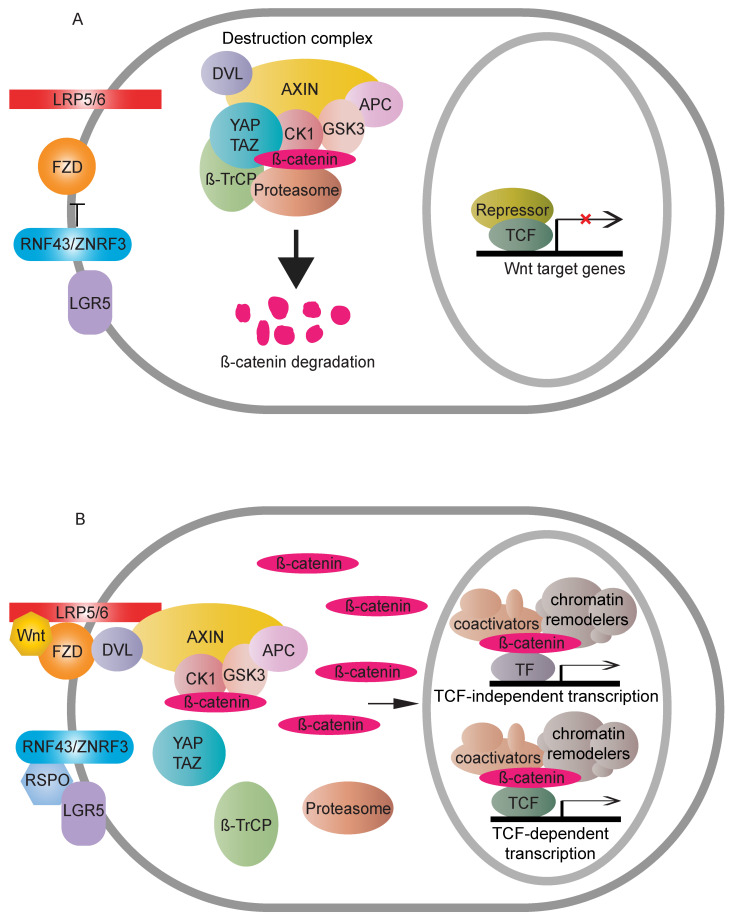
Figure 1
Figure 1
Overview of the Wnt canonical (β-catenin-dependent) pathway. (A) In the absence of a Wnt signal, cytoplasmic β-catenin is degraded by the destruction complex. RNF43/ZNRF3 targets FZD to antagonise Wnt signalling. The accumulative result is a transcriptional “off” state. (B) Wnt binding causes dimerisation of FZD and LRP5/6. The receptor complex recruits the destruction complex to the cell membrane, and DVL assists the interactions between LRP5/6 and AXIN. Cytoplasmic β-catenin, thus, can be relieved from proteasome-dependent degradation. Stable β-catenin accumulates in the cytoplasm, followed by nuclear transport. There, β-catenin displaces repressive complexes and forms active complexes through associations with transcription factors and recruitment of coactivators and chromatin remodelers to upregulate Wnt responsive targets. RNF43/ZNRF3′s inhibition on the Wnt pathway can be counteracted by binding of RSPO to LGR5.
Figure 2
Figure 2
Multidimensional regulators in the Wnt signalling pathway. The hallmark determinants of β-catenin transcriptional output are depicted.
Figure 3
Figure 3
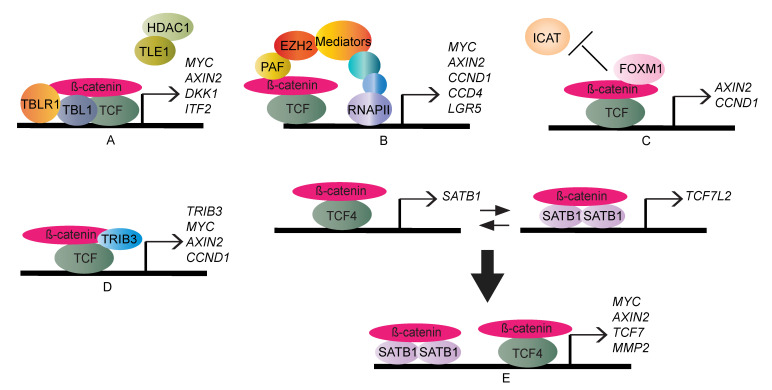
Schematic depicting the molecular mechanism of co-activators involved in TCF/LEF-dependent β-catenin transcriptional activities and their functional consequences. (A) TBL1 (Transducin β-like protein 1) and TBLR1 (TBL1-related protein) interact with nuclear β-catenin, and the interaction promotes their binding to the promoters of Wnt target genes. Subsequently, TLE1 and histone deacetylase 1 (HDAC1), two transcriptional repressors, are displaced to initiate downstream transcriptional cascades. (B) PAF (PCNA-associated factor) recruits EZH2, a histone-lysine N-methyltransferase, to the β-catenin-TCF/LEF complex. Consequently, EZH2 and the Mediator complex recruit RNA polymerase II-dependent transcriptional machinery to activate Wnt target gene expression. (C) Under Wnt stimulation, stabilised FOXM1 (Forkhead box protein M1) can release β-catenin from ICAT (aka CTNNBIP1, β-catenin-interacting protein 1), thus abolishing its inhibition on β-catenin-TCF/LEF complex to transcribe Wnt target genes. (D) TRIB3 (Tribbles pseudo-kinase 3) participates in a positive feedback loop. TRIB3, a downstream target of the Wnt pathway, can stabilise the β-catenin-TCF4 complex, thus improving its transcriptional activity. (E) SATB1 (Special AT-rich sequence-binding protein-1) regulates TCF4 expression, and complexes with β-catenin to transcribe Wnt downstream genes.
Figure 4
Figure 4
Schematic representing the molecular mechanism of transcriptional repression in TCF/LEF-dependent Wnt outcomes. Β-catenin-TCF/LEF-regulated transcription can be inhibited via various mechanisms, including 1. interfering with the interaction between β-catenin and TCF/LEF, as shown for ICAT (aka CNNTBIP1, β-catenin-interacting protein 1), DACT2 (Dapper homolog 2), Chibby, CtBP (C-terminal-binding protein 1), 2. binding with β-catenin to facilitate its nuclear export, such as Chibby and CtBP, 3. interfering with the interaction between β-catenin and its co-activators, such as ICAT—targeting the β-catenin-p300 complex and LATS2—targeting the β-catenin-BCL9 complex and 4. interfering with the binding of TCF/LEF to DNA, such as OSX (Osterix).
Figure 5
Figure 5
Overview of chromatin modifiers involved in β-catenin-dependent transcriptional regulation and their roles in the Wnt pathway. HATs (histone acetyltransferases, transferring acetyl groups to histones): CBP (CREB-binding protein)/p300, PCAF (p300/CBP-associated factor), TRRAP (Transformation/transcription domain-associated protein)/TIP60; HDACs (Histone deacetylase, removing acetyl groups from histones): HDAC1 (Histone deacetylase 1), HDAC2 (Histone deacetylase 2), SIRT1 (NAD-dependent deacetylase sirtuin-1); HMTs (Histone methyltransferases, transferring methyl groups to histones): MLL1 (Mixed-lineage leukemia 1 or Histone-lysine N-methyltransferase 2A), hSETD1A (human SET domain containing protein 1A), EZH2 (Enhancer of zeste 2 polycomb repressive complex 2 subunit), SET8 (SET domain-containing protein 8), SETDB1 (SET domain bifurcated 1), DOT1L (DOT1 like histone lysine methyltransferase), PRMT5 (Protein arginine N-methyltransferase 5); HDMs (Histone demethylases, removing methyl groups from histones): KDM3 (Lysine-specific demethylase 3), KDM3A (Lysine demethylase 3A), KDM4D (Lysine-specific demethylase 4D), KDM1A (Lysine demethylase 1A); SWI/SNF: BRG1 (Transcription activator BRG1), SNF5 (BRG1-associated factor 47), BAF57 (BRG1-associated factor 57), AGGF1 (Angiogenic factor with G patch and FHA domains 1), ARID1A (AT-rich interactive domain-containing protein 1A), ARID1B (AT-rich interactive domain-containing protein 1B).

References

    1. Huber A.H., Nelson W.J., Weis W.I. Three-dimensional structure of the armadillo repeat region of beta-catenin. Cell. 1997;90:871–882. doi: 10.1016/S0092-8674(00)80352-9. - DOI - PubMed
    1. Liu C., Li Y., Semenov M., Han C., Baeg G.H., Tan Y., Zhang Z., Lin X., He X. Control of beta-catenin phosphorylation/degradation by a dual-kinase mechanism. Cell. 2002;108:837–847. doi: 10.1016/S0092-8674(02)00685-2. - DOI - PubMed
    1. Aberle H., Bauer A., Stappert J., Kispert A., Kemler R. β-catenin is a target for the ubiquitin–proteasome pathway. EMBO J. 1997;16:3797–3804. doi: 10.1093/emboj/16.13.3797. - DOI - PMC - PubMed
    1. Hart M., Concordet J.P., Lassot I., Albert I., del los Santos R., Durand H., Perret C., Rubinfeld B., Margottin F., Benarous R., et al. The F-box protein beta-TrCP associates with phosphorylated beta-catenin and regulates its activity in the cell. Curr. Biol. 1999;9:207–210. doi: 10.1016/S0960-9822(99)80091-8. - DOI - PubMed
    1. Wu G., Huang H., Garcia Abreu J., He X. Inhibition of GSK3 phosphorylation of beta-catenin via phosphorylated PPPSPXS motifs of Wnt coreceptor LRP6. PLoS ONE. 2009;4:e4926. doi: 10.1371/journal.pone.0004926. - DOI - PMC - PubMed

MeSH terms