Review
. 2020 Sep 20;12(9):2684.
doi: 10.3390/cancers12092684.

Canonical and Noncanonical Roles of Fanconi Anemia Proteins: Implications in Cancer Predisposition

Affiliations
Review

Canonical and Noncanonical Roles of Fanconi Anemia Proteins: Implications in Cancer Predisposition

Giacomo Milletti et al. Cancers (Basel). .

Abstract

Fanconi anemia (FA) is a clinically and genetically heterogeneous disorder characterized by the variable presence of congenital somatic abnormalities, bone marrow failure (BMF), and a predisposition to develop cancer. Monoallelic germline mutations in at least five genes involved in the FA pathway are associated with the development of sporadic hematological and solid malignancies. The key function of the FA pathway is to orchestrate proteins involved in the repair of interstrand cross-links (ICLs), to prevent genomic instability and replication stress. Recently, many studies have highlighted the importance of FA genes in noncanonical pathways, such as mitochondria homeostasis, inflammation, and virophagy, which act, in some cases, independently of DNA repair processes. Thus, primary defects in DNA repair mechanisms of FA patients are typically exacerbated by an impairment of other cytoprotective pathways that contribute to the multifaceted clinical phenotype of this disease. In this review, we summarize recent advances in the understanding of the pathogenesis of FA, with a focus on the cytosolic noncanonical roles of FA genes, discussing how they may contribute to cancer development, thus suggesting opportunities to envisage novel therapeutic approaches.

Keywords: DNA repair; Fanconi anemia; cancers; inflammation; mitochondria.


Conflict of interest statement

The authors declare that the research was conducted in the absence of any commercial or financial relationships that could be construed as a potential conflict of interest.

Figures
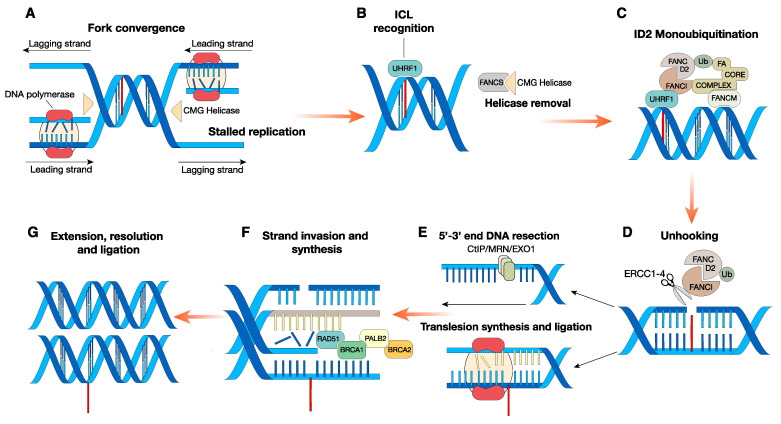
Figure 1
Figure 1
A combination of multiple DNA repair pathways promotes interstrand cross-link repair. (A) Converging replication forks stall in proximity of DNA lesion; (B) ICL identification by UHRF1. Concurrently, FANCS removes the CMG helicase complex that obstructs the replication fork site, making it available for the FA core complex. (C) As a consequence, both the core complex and the FANCD2‒FANCI heterodimer are recruited and the FANCD2‒FANCI complex is monoubiquitinated by the E3 ligase FANCL and its partner, the E2 ligase UBE2T (both members of the FA core complex). (D) When ubiquitinated, the ID2 complex promotes the activity of multiple factors such as ERCC1, ERCC4, and SLX4, which coordinate the nucleotide excision responsible for the unhooking. (E) At this stage, the two strands have diverging fates: the one that underwent the incision is further processed by nucleases such as CtBP-interacting protein (CtIP), MRN (MRE11–RAD50–NBS1), or exonuclease 1 (EXO1); on the other strand, translation synthesis polymerases bypass the lesion and provide the complementary filament. (F) Next, the ssDNA overhang acts as a template for the homologous recombination mediated by RAD51/BRCA2/PALB2/BRCA1 proteins. (G) Eventually, after extension and ligation, DNA damage is resolved.
Figure 2
Figure 2
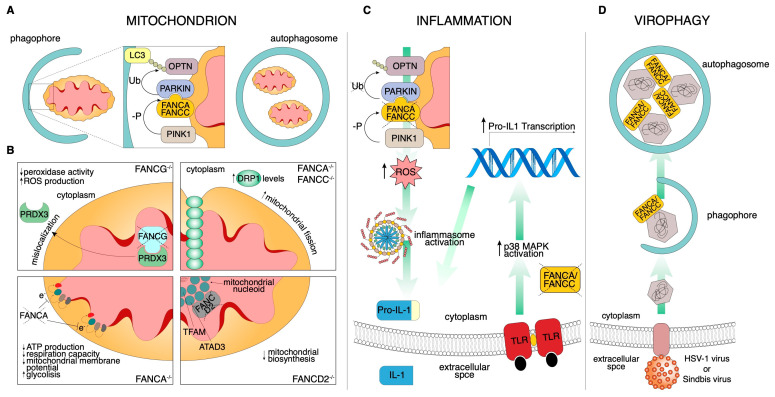
Schematic of the noncanonical FA pathways. (A) During mitophagy, damaged mitochondria are selectively engulfed by the phagophore. To properly identify the substrate, the E3 ligase PARKIN ubiquitinates the mitophagy receptor, which acts as an adapter for LC3-mediated autophagosome recognition. In this context, FANCC assists PARKIN localization to the mitochondria. (B) FA protein-related mitochondrial functions. (Top left) FANCG-deficient cells display PRDX3 mislocalization. The consequent reduced mitochondrial peroxidase activity increases ROS production. (Top right) FANCA and FANCC downregulated cells show increased DRP1 levels resulting in an increment of mitochondrial fission. (Bottom left) FANCA deficiency impacts negatively on mitochondrial electron transport chain efficiency, reducing ATP production and respiration capacity and altering the mitochondrial membrane potential. This inevitably leads to a shift from aerobic to glycolytic metabolism. (Bottom right) FANCD2 mitochondrial nucleoid complex interaction regulates mitochondrial biosynthesis. (C) FANCA and FANCC knockdown increase the pro-inflammatory secretion of IL-1β in a dual convergent manner. On the left, impaired mitophagy stimulates inflammasome activation through ROS overproduction and, consequently, IL-1β is secreted. On the right, exogenously stimulated Toll-like receptors activate a signal transduction cascade that culminates with Pro-IL-1β transcription. (D) Both FANCA and FANCC are required for Sindbis and HSV-1 nucleocapsid recognition to control viral infection by virophagy.

References

    1. Rosenberg P.S., Tamary H., Alter B.P. How high are carrier frequencies of rare recessive syndromes? Contemporary estimates for Fanconi Anemia in the United States and Israel. Am. J. Med. Genet. A. 2011;155:1877–1883. doi: 10.1002/ajmg.a.34087. - DOI - PMC - PubMed
    1. Auerbach A.D. Fanconi anemia and its diagnosis. Mutat. Res. 2009;668:4–10. doi: 10.1016/j.mrfmmm.2009.01.013. - DOI - PMC - PubMed
    1. Petryk A., Kanakatti Shankar R., Giri N., Hollenberg A.N., Rutter M.M., Nathan B., Lodish M., Alter B.P., Stratakis C.A., Rose S.R. Endocrine Disorders in Fanconi Anemia: Recommendations for Screening and Treatment. J. Clin. Endocrinol. Metab. 2015;100:803–811. doi: 10.1210/jc.2014-4357. - DOI - PMC - PubMed
    1. Orkin S.H., Nathan D.G., Ginsburg D., Look A.T., Fisher D.E., Lux S. Nathan and Oski’s Hematology of Infancy and Childhood E-Book. Elsevier Health Sciences; Amsterdam, The Netherlands: 2008.
    1. Alter B.P. Inherited bone marrow failure syndromes: Considerations pre- and posttransplant. Blood. 2017;130:2257–2264. doi: 10.1182/blood-2017-05-781799. - DOI - PMC - PubMed

LinkOut - more resources