. 2020 Sep 20;21(18):6904.
doi: 10.3390/ijms21186904.

Freeze-Drying of Platelet-Rich Plasma: The Quest for Standardization

Affiliations

Freeze-Drying of Platelet-Rich Plasma: The Quest for Standardization

Isabel Andia et al. Int J Mol Sci. .

Abstract

The complex biology of platelets and their involvement in tissue repair and inflammation have inspired the development of platelet-rich plasma (PRP) therapies for a broad array of medical needs. However, clinical advances are hampered by the fact that PRP products, doses and treatment protocols are far from being standardized. Freeze-drying PRP (FD-PRP) preserves platelet function, cytokine concentration and functionality, and has been proposed as a consistent method for product standardization and fabrication of an off-the-shelf product with improved stability and readiness for future uses. Here, we present the current state of experimental and clinical FD-PRP research in the different medical areas in which PRP has potential to meet prevailing medical needs. A systematic search, according to PRISMA (Preferred Reported Items for Systematic Reviews and Meta-Analyses) guidelines, showed that research is mostly focused on wound healing, i.e., developing combination products for ulcer management. Injectable hydrogels are investigated for lumbar fusion and knee conditions. In dentistry, combination products permit slow kinetics of growth factor release and functionalized membranes for guided bone regeneration.

Keywords: dentistry; fibrin; freeze-drying; orthopedics; platelet-rich plasma; wound healing.


Conflict of interest statement

The authors declare that they have no competing interests.

Figures
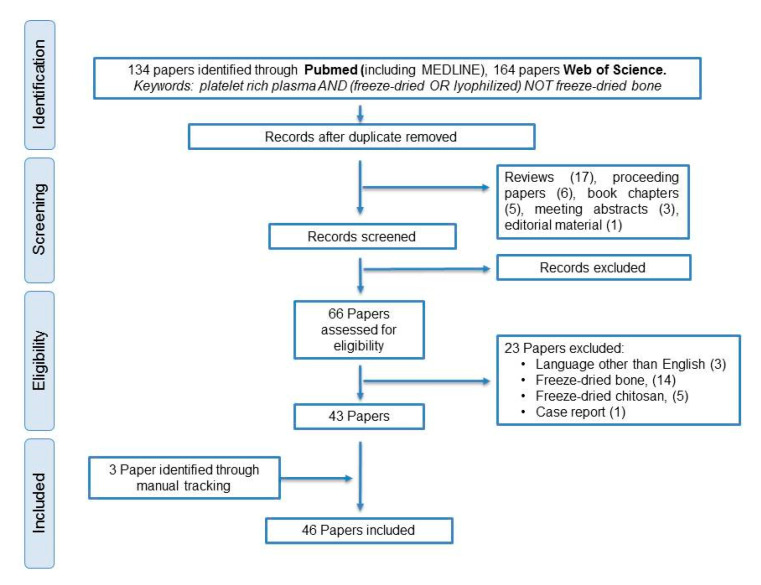
Figure 1
Figure 1
PRISMA (Preferred Reported Items for Systematic Reviews and Meta-Analyses) workflow.
Figure 2
Figure 2
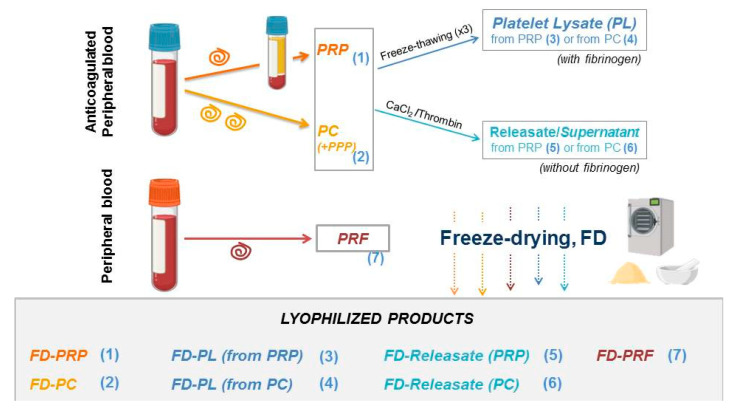
Preparation of different plasma formulations for lyophilization. Single spinning of anticoagulated whole blood yields platelet-rich plasma (PRP) with moderate concentration of platelets (and optionally leukocytes), for the purpose of this study designed as (1); alternatively, double spinning or plateletpheresis systems produce platelet concentrates (PCs) designed as (2). The pellet can be resuspended in a determined volume of Platelet-Poor Plasma (PPP) and platelet count adjusted, or platelets can be used without plasma. When PRP or PC products are freeze-thawed multiple times (commonly 3) or sonicated, the resultant platelet lysates (PLs) contains platelet secretome along with platelet membranes (ghost platelets) designed as (3) and (4), respectively. Alternatively, the platelet secretome can be obtained after the activation of platelets by adding calcium chloride/ thrombin. The supernatant released from the clot (from PRP (5) or PCs (6)) contains the whole platelet secretome. PRF (7) is obtained by centrifuging noncoagulated peripheral blood and disposing of the formed hydrogel the red blood cells. Terminology: PRP, platelet-rich plasma; PC, platelet concentrate; PPP, platelet-poor plasma; PL, platelet lysate; PRF, platelet-rich fibrin; FD-PRP, freeze-dried platelet-rich plasma; FD-PC, freeze-dried platelet concentrate; FD-PL, freeze-dried platelet lysate; FD-PRF, freeze-dried platelet-rich fibrin.

References

    1. Andia I., Maffulli N. A contemporary view of platelet-rich plasma therapies: Moving toward refined clinical protocols and precise indications. Regen. Med. 2018;13:717–728. doi: 10.2217/rme-2018-0042. - DOI - PubMed
    1. Harrison P., The Subcommittee on Platelet Physiology The use of platelets in regenerative medicine and proposal for a new classification system: Guidance from the SSC of the ISTH. J. Thromb. Haemost. 2018;16:1895–1900. doi: 10.1111/jth.14223. - DOI - PubMed
    1. Pusateri A.E., Butler F.K., Shackelford S.A., Sperry J.L., Moore E.E., Cap A.P., Taylor A.L., Homer M.J., Hoots W.K., Weiskopf R.B., et al. The need for dried plasma—A national issue. Transfusion. 2019;59:1587–1592. doi: 10.1111/trf.15261. - DOI - PubMed
    1. Daban J., Clapson P., Ausset S., Deshayes A.V., Sailliol A. Freeze dried plasma: A French army specialty. Crit. Care. 2010;14:412. doi: 10.1186/cc8937. - DOI - PMC - PubMed
    1. Feuerstein S.J., Skovmand K., Møller A.M., Wildgaard K. Freeze-dried plasma in major haemorrhage: A systematic review. Vox Sang. 2020;115:263–274. doi: 10.1111/vox.12898. - DOI - PubMed

Publication types

MeSH terms