


Genotypic characterisation and antimicrobial resistance of Pseudomonas aeruginosa strains isolated from patients of different hospitals and medical centres in Poland
- PMID: 32962640
- PMCID: PMC7507710
- DOI: 10.1186/s12879-020-05404-w
Genotypic characterisation and antimicrobial resistance of Pseudomonas aeruginosa strains isolated from patients of different hospitals and medical centres in Poland
Abstract
Background: Pseudomonas aeruginosa is a Gram-negative bacteria responsible for infections in immunocompromised patients and is one of the most common causes of nosocomial infections particularly in intensive care and burn units. We aimed to investigate the population structure of P. aeruginosa strains isolated from patients at different hospital wards.
Methods: We analysed the possible presence of P. aeruginosa epidemic or endemic strains in hospitals of the selected region. A genotyping analysis was performed for P. aeruginosa isolates (n = 202) collected from patients of eleven hospitals in north-western Poland. Collections of P. aeruginosa were genotyped using pulsed-field gel electrophoresis (PFGE). Phenotypic screening for antibiotic susceptibility was performed for the common antimicrobial agents.
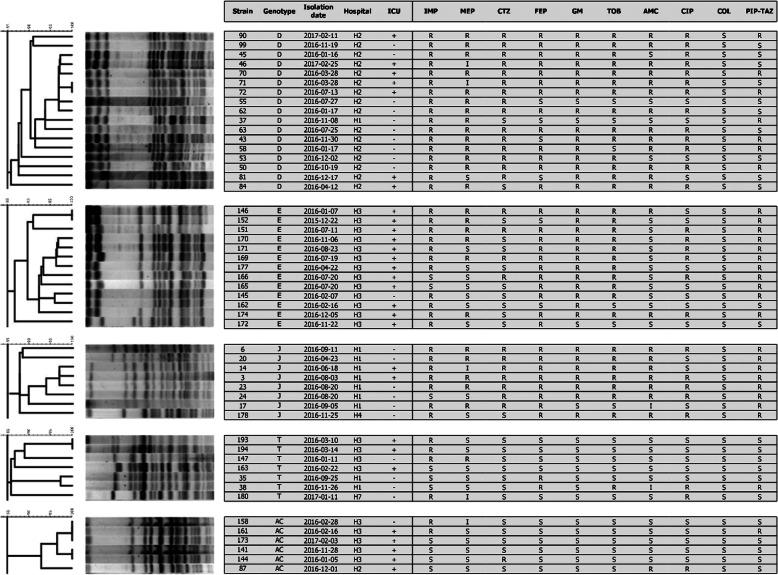
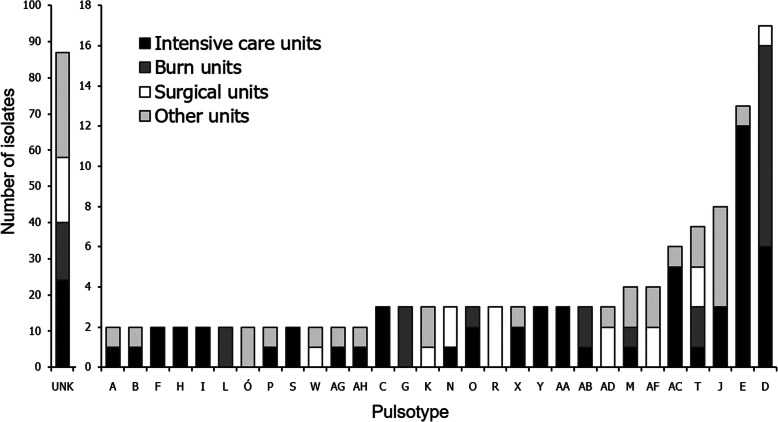
Results: Pseudomonas aeruginosa isolates were distributed among 116 different pulsotype groups. We identified 30 groups of clonally related strains, each containing from 2 to 17 isolates and typed the obtained 13 unique patterns, designated as A, D, E, J, K, M, N, Ó, P, T, X, AC, AD, and AH. The two largest clusters, D and E, contained 17 and 13 isolates, respectively. Strains of these groups were continuously isolated from patients at intensive care units and burn units, indicating transmission of these strains.
Conclusions: In this study, we demonstrate the clonal relatedness of P. aeruginosa strains and their constant exchange in hospitals over a period of 15 months. The obtained results indicate a predominantly non-clonal structure of P. aeruginosa.
Keywords: Antimicrobial resistance; Genotyping; PFGE; Population structure; Pseudomonas aeruginosa.
Conflict of interest statement
The authors declare that they have no competing interests.
Figures
References
-
- Vincent JL, Rello J, Marshall J, et al. International study of the prevalence and outcomes of infection in intensive care units. JAMA. 2009;302:2323–2329. - PubMed
-
- Livermore DM. Multiple mechanisms of antimicrobial resistance in Pseudomonas aeruginosa: our worst nightmare? Clin Infect Dis. 2002;34:634–640. - PubMed
-
- Muscarella LF. Contribution of tap water and environmental surfaces to nosocomial transmission of antibiotic-resistant Pseudomonas aeruginosa. Infect Control Hosp Epidemiol. 2004;25:342–345. - PubMed
-
- Gómez-Zorrilla S, Camoez M, Tubau F, Cañizares R, Periche E, Dominguez MA, Ariza J, Peña C. Prospective observational study of prior rectal colonization status as a predictor for subsequent development of Pseudomonas aeruginosa clinical infections. Antimicrob Agents Chemother. 2015;59:5213–5219. - PMC - PubMed
-
- D’Agata E. Pseudomonas aeruginosa and other Pseudomonas species. In: Bennet JE, Dolin R, Blaser M, editors. Principles and practice of infectious diseases. 8. Philadelphia: Elsevier; 2015. pp. 2518–2532.
Publication types
MeSH terms
Substances
Grants and funding
LinkOut - more resources
Full Text Sources
Medical
