. 2020 Sep 22;20(1):697.
doi: 10.1186/s12879-020-05427-3.

Altered respiratory microbiota composition and functionality associated with asthma early in life

Affiliations

Altered respiratory microbiota composition and functionality associated with asthma early in life

Mohammad T Al Bataineh et al. BMC Infect Dis. .

Abstract

Background: The microbiota of the respiratory tract has an important role in maintaining respiratory health. However, little is known on the respiratory microbiota in asthmatic patients among Middle Eastern populations. This study investigated the respiratory microbiota composition and functionality associated with asthma in Emirati subjects.

Methods: We performed 16S rRNA and ITS2-gene based microbial profiling of 40 expectorated sputum samples from adult and pediatric Emirati individuals averaging 52 and 7 years of age, respectively with or without asthma.

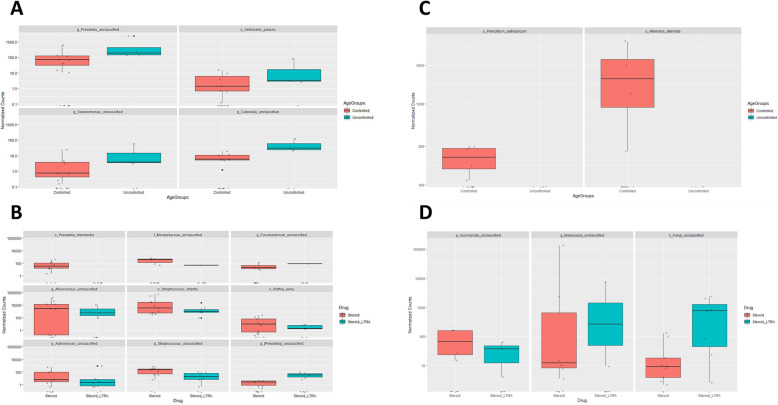
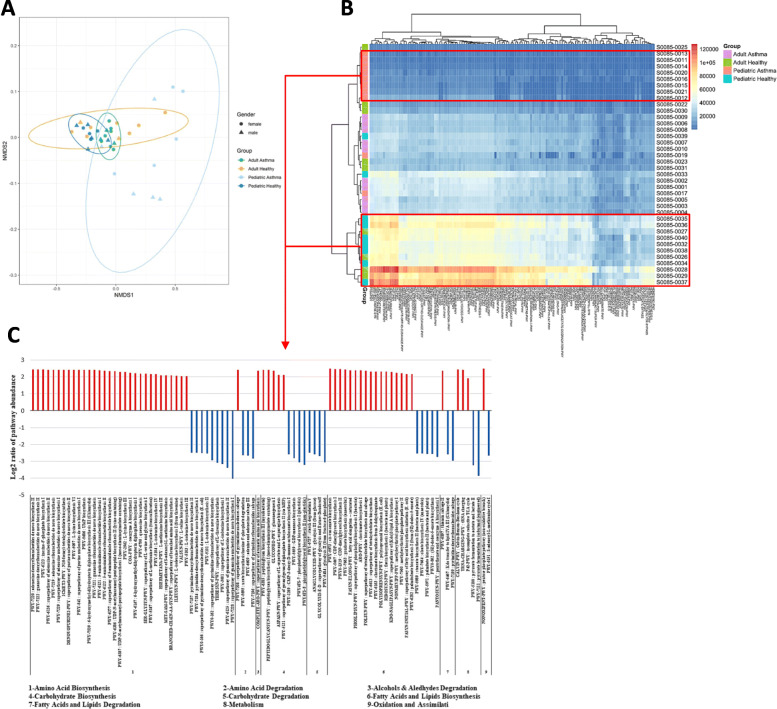
Results: We report bacterial difference belonging to Bacteroidetes, Firmicutes, Fusobacteria and Proteobacteria phyla between asthmatic and non-asthmatic controls. Similarly, fungal difference belonging to Ascomycota, Basidiomycota phyla and other unclassified fungi. Differential abundance testing among asthmatic individuals with relation to Asthma Control Test show a significant depletion of Penicillium aethiopicum and Alternaria spp., among poorly controlled asthmatics. Moreover, data suggest a significant expansion of Malassezia spp. and other unclassified fungi in the airways of those receiving steroids and leukotriene receptor antagonists' combination therapy, in contrast to those receiving steroids alone. Functional profiling from 16S data showed marked differences between pediatric asthmatic and non-asthmatic controls, with pediatric asthmatic patients showing an increase in amino acid (p-value < 5.03 × 10- 7), carbohydrate (p-value < 4.76 × 10- 7), and fatty acid degradation (p-value < 6.65 × 10- 7) pathways, whereas non-asthmatic controls are associated with increase in amino acid (p-value < 8.34 × 10- 7), carbohydrate (p-value < 3.65 × 10- 7), and fatty acid (p-value < 2.18 × 10- 6) biosynthesis pathways in concordance with enterotype composition.

Conclusions: These differences provide an insight into respiratory microbiota composition in Emirati population and its possible role in the development of asthma early in life. This study provides important information that may eventually lead to the development of screening biomarkers to predict early asthma development and novel therapeutic approaches.

Keywords: Asthma; Fungal; Microbiota.


Conflict of interest statement

The authors declare that they have no competing interests.

Figures
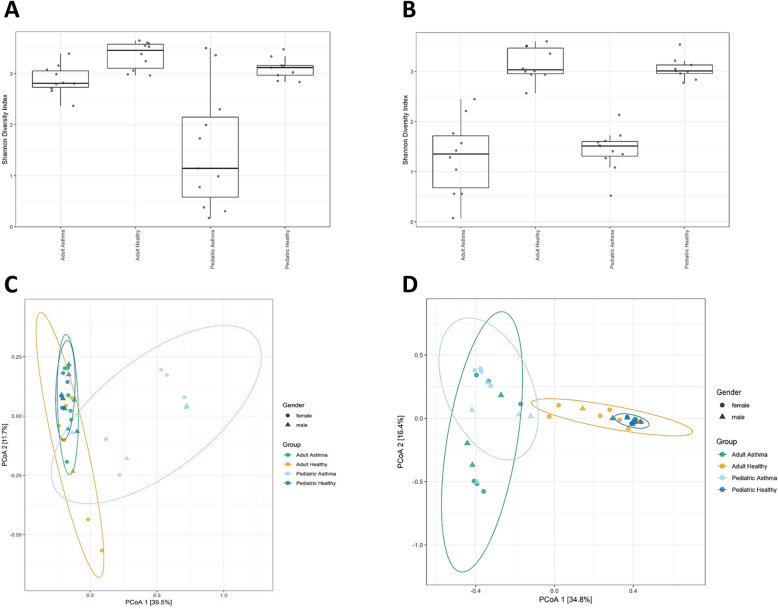
Fig. 1
Fig. 1
Lung microbiota of asthmatic subjects show lower levels of richness and complexity compared to healthy subjects. Evaluation of the alpha- and beta- diversity in the 40 analyzed samples. Panel showing alpha-diversity (Shannon index) computed and illustrated for each sample. ANOVA test determined significant differences in the Shannon diversity index based on different groups for bacterial data at p < 0.002 (a) and fungal data at p < 0.000 (b). To obtain a graphical representation of microbiome composition similarity among samples and beta-diversity, we summarized OTU abundances into Bray-Curtis dissimilarities and performed a PCoA ordination. Permutational analysis of variance (adonis R function, or Permanova) determined significant differences in beta-diversity among groups for bacterial data at p < 0.0009 (c) and fungal data at p < 0.0001 (d)
Fig. 2
Fig. 2
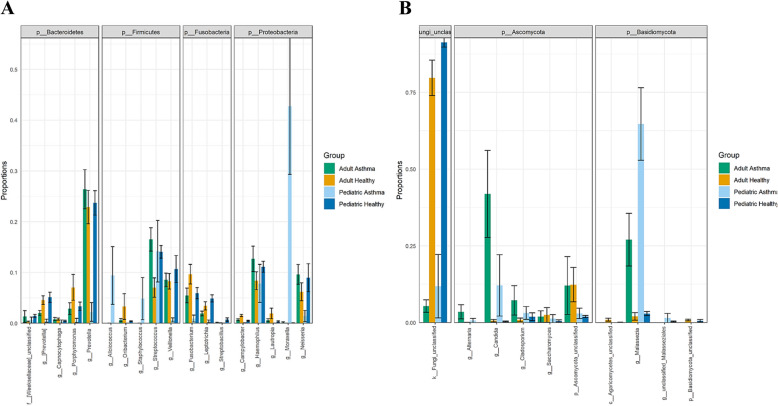
Relative abundances of the most abundant taxa. The following plot illustrates the mean and standard error of the relative abundances of the 5 most abundant genus-level taxa within the 4 most abundant Phyla for bacteria (a) and fungi (b). The Genus-level plots are grouped according to Phylum along the x-axis. The groupings along the y-axis represent the column of metadata. The barplot colors represent different groups
Fig. 3
Fig. 3
Investigation of bacterial and fungal differential abundance among asthmatic individuals with relation to current medications and asthma control test (ACT). Differential abundance testing using DESeq2, R package to identify differentially abundant taxa among drug + ACT variables. The bar plot reports bacterial genera (a, b) and fungal genera (c, d) with significant abundance with relation to drug and ACT scores at a p-value < 0.05 and the Log2Fc / Fold Change > 1.5 or < − 1.5 for both bacterial and fungal genera. Controlled and uncontrolled ACT scores as well as steroid and steroid + LTRA current treatment corresponding abundance are colored in red and blue, respectively
Fig. 4
Fig. 4
Functional profiling of asthmatic and healthy microbiomes based on PICRUSt2 analyses of 16S data. To obtain a graphical representation of PICRUSt2 functional composition among samples, we summarized PICRUSt abundances into Bray-Curtis dissimilarities and performed a NMDS ordination (a). Permutational analysis of variance (adonis R function, or Permanova) determined significant differences in beta-diversity among different groups at p-value < 0.0001. Significant functional pathways were plotted in a heatmap, only pediatric healthy and pediatric asthma groups from red boxes were used for B (b). The bar plot shows log2 ratios of the average pathway abundance for pediatric healthy and pediatric asthma subjects of each pathway displaying ANOVA with p-value < 0.05. Pediatric healthy and pediatric asthma more abundant pathways are colored in red and blue, respectively (c)

References

    1. Teo SM, Tang HHF, Mok D, Judd LM, Watts SC, Pham K, Holt BJ, Kusel M, Serralha M, Troy N, et al. Airway microbiota dynamics uncover a critical window for interplay of pathogenic Bacteria and allergy in childhood respiratory disease. Cell Host Microbe. 2018;24(3):341–352. - PMC - PubMed
    1. Nguyen LD, Viscogliosi E, Delhaes L. The lung mycobiome: an emerging field of the human respiratory microbiome. Front Microbiol. 2015;6:89. - PMC - PubMed
    1. Mathieu E, Escribano-Vazquez U, Descamps D, Cherbuy C, Langella P, Riffault S, Remot A, Thomas M. Paradigms of lung microbiota functions in health and disease, particularly, in asthma. Front Physiol. 2018;9:1168. - PMC - PubMed
    1. Man WH, de Steenhuijsen Piters WA, Bogaert D. The microbiota of the respiratory tract: gatekeeper to respiratory health. Nat Rev Microbiol. 2017;15(5):259–270. - PMC - PubMed
    1. Yun Y, Srinivas G, Kuenzel S, Linnenbrink M, Alnahas S, Bruce KD, Steinhoff U, Baines JF, Schaible UE. Environmentally determined differences in the murine lung microbiota and their relation to alveolar architecture. PLoS One. 2014;9(12):e113466. - PMC - PubMed

MeSH terms