. 2020 Sep 22;15(1):258.
doi: 10.1186/s13023-020-01528-z.

Dietary mannose supplementation in phosphomannomutase 2 deficiency (PMM2-CDG)

Affiliations

Dietary mannose supplementation in phosphomannomutase 2 deficiency (PMM2-CDG)

Roman Taday et al. Orphanet J Rare Dis. .

Abstract

Background: PMM2-CDG (CDG-Ia) is the most frequent N-glycosylation disorder. While supplying mannose to PMM2-deficient fibroblasts corrects the altered N-glycosylation in vitro, short term therapeutic approaches with mannose supplementation in PMM2-CDG patients have been unsuccessful. Mannose found no further mention in the design of a potential therapy for PMM2-CDG in the past years, as it applies to be ineffective. This retrospective study analyzes the first long term mannose supplementation in 20 PMM2-CDG patients. Mannose was given at a total of 1-2 g mannose/kg b.w./d divided into 5 single doses over a mean time of 57,75 ± 25,85 months. Protein glycosylation, blood mannose concentration and clinical presentation were monitored in everyday clinical practice.

Results: After a mean time period of more than 1 year the majority of patients showed significant improvements in protein glycosylation.

Conclusion: Dietary mannose supplementation shows biological effects in PMM2-CDG patients improving glycosylation in the majority of patients. A double-blind randomized study is needed to examine the role of mannose in the design of a therapy for children with PMM2-CDG in more detail.

Keywords: Congenital disorder of glycosylation (CDG); Glycoprotein profile; Mannose; PMM2; Therapy.


Conflict of interest statement

The authors declare that they have no competing interests.

Figures
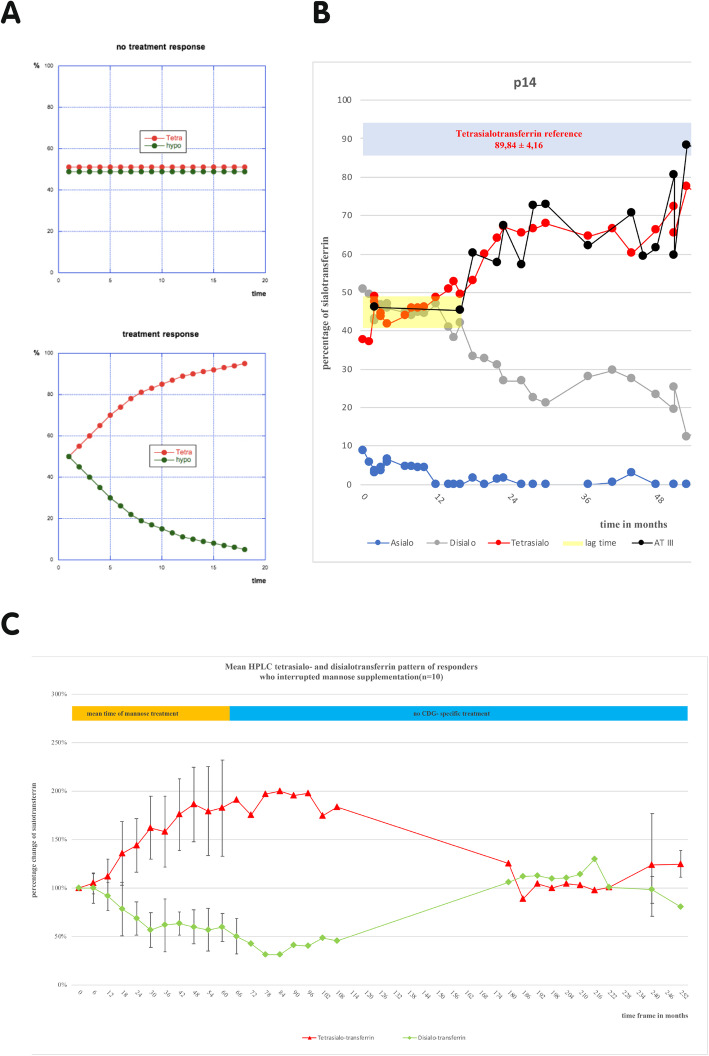
Fig. 1
Fig. 1
a Hypothetical scheme showing expected curves with response or non-response to mannose treatment. b Many responders showed a lag time of fluctuating sialo-transferrin values before response (mean 21 ± 8 months). The graph shows the sialo-transferrin-HPLC pattern during mannose supplementation of an index patient. Red line represents tetrasialo-transferrin, green line represents hypoglycosylated disialo-transferrin. This patient showed physiological fluctuations under mannose treatment for approximately 17 months, before hypoglycosylation improved (yellow area). The example of AT III (black graph) shows, that other glycoproteins like coagulation parameters reacted concordantly to the sialo-transferrin pattern. The blue area represents the physiological value of tetrasialo-transferrin. c Graph showing the percentage change of tetra- (red graph) and disialo-transferrin (green graph) quantified by HPLC of the responding patients. The initial pretreatment values of tetrasialo- and disialo-transferrin were defined as 100%. The sialo-transferrin values measured during mannose supplementation were set in relation to the initial value to show the follow up. Under mannose therapy tetra- and disialo-transferrin values improved steadily to twice the initial value. After cessation of mannose treatment (orange mark), the sialo-transferrin rates declined to nearly pretreatment values (n = 10)
Fig. 2
Fig. 2
One patient’s pretreatment NCV (nerve conduction velocity) of the posterior tibial nerve improved and stayed stable within 2 years of mannose treatment (NCV reference of posterior tibial nerve > 40 m/s; blue dashed line; find nerve conduction velocity scale on the right in m/s). Improvement of the sialo-transferrin pattern was concordant to NCV development (blue area = tetrasialo-transferrin reference; find sialo-transferrin scale in % on the left). When mannose treatment was discontinued for this patient after 24 months (purple mark), the NCV of the posterior tibial nerve fell and stayed low for four more years without mannose

Comment in

  • Mannose supplementation in PMM2-CDG.
    Taday R, Park JH, Grüneberg M, DuChesne I, Reunert J, Marquardt T. Taday R, et al. Orphanet J Rare Dis. 2021 Aug 11;16(1):359. doi: 10.1186/s13023-021-01988-x. Orphanet J Rare Dis. 2021. PMID: 34380532 Free PMC article.

References

    1. Jaeken J. Congenital disorders of glycosylation. Handb Clin Neurol. 2013;113:1737–1743. doi: 10.1016/B978-0-444-59565-2.00044-7. - DOI - PubMed
    1. Van Schaftingen E, Jaeken J. Phosphomannomutase deficiency is a cause of carbohydrate-deficient glycoprotein syndrome type I. FEBS Lett. 1995;377:318–320. doi: 10.1016/0014-5793(95)01357-1. - DOI - PubMed
    1. Stibler H, Blennow G, Kristiansson B, Lindehammer H, Hagberg B. Carbohydrate-deficient glycoprotein syndrome: clinical expression in adults with a new metabolic disease. J Neurol Neurosurg Psychiatry. 1994;57:552–556. doi: 10.1136/jnnp.57.5.552. - DOI - PMC - PubMed
    1. de Lonlay P, Seta N, Barrot S, Chabrol B, Drouin V, Gabriel BM, Journel H, Kretz M, Laurent J, Le Merrer M, et al. A broad spectrum of clinical presentations in congenital disorders of glycosylation I: a series of 26 cases. J Med Genet. 2001;38:14–19. doi: 10.1136/jmg.38.1.14. - DOI - PMC - PubMed
    1. Niehues R, Hasilik M, Alton G, Körner C, Schiebe-Sukumar M, Koch HG, Zimmer KP, Wu R, Harms E, Reiter K, et al. Carbohydrate-deficient glycoprotein syndrome type Ib. Phosphomannose isomerase deficiency and mannose therapy. J Clin Invest. 1998;101:1414–1420. doi: 10.1172/JCI2350. - DOI - PMC - PubMed

Publication types

Substances

Supplementary concepts
