Review
. 2020 Sep 22;5(1):212.
doi: 10.1038/s41392-020-00318-0.

Receptor-binding domain-specific human neutralizing monoclonal antibodies against SARS-CoV and SARS-CoV-2

Affiliations
Review

Receptor-binding domain-specific human neutralizing monoclonal antibodies against SARS-CoV and SARS-CoV-2

Fei Yu et al. Signal Transduct Target Ther. .

Abstract

The outbreaks of severe acute respiratory syndrome (SARS) and Coronavirus Disease 2019 (COVID-19) caused by SARS-CoV and SARS-CoV-2, respectively, have posed severe threats to global public health and the economy. Treatment and prevention of these viral diseases call for the research and development of human neutralizing monoclonal antibodies (NMAbs). Scientists have screened neutralizing antibodies using the virus receptor-binding domain (RBD) as an antigen, indicating that RBD contains multiple conformational neutralizing epitopes, which are the main structural domains for inducing neutralizing antibodies and T-cell immune responses. This review summarizes the structure and function of RBD and RBD-specific NMAbs against SARS-CoV and SARS-CoV-2 currently under development.


Conflict of interest statement

The authors declare no competing interests.

Figures
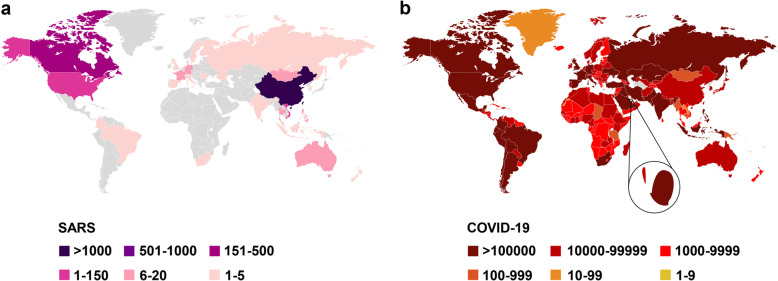
Fig. 1
Fig. 1
Statistical charts of cumulative cases. Statistical charts of cumulative number of SARS cases (a) and COVID-19 cases (b)
Fig. 2
Fig. 2
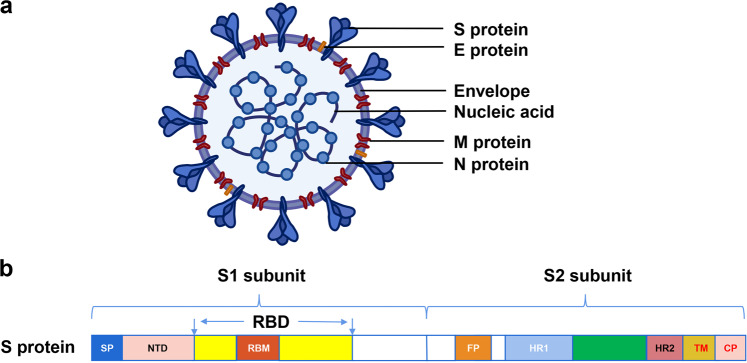
Schematic diagram of coronavirus particle and S protein gene partitioning. (a) Major structural proteins of the coronavirus particle include Spike glycoprotein (S protein); Membrane (M) protein; Nucleocapsid (N) protein; and Envelope (E) protein. (b) The S protein is mainly divided into S1 and S2 subunits and subdivided again into signal peptide (SP); N-terminal domain (NTD); receptor-binding domain (RBD), which contains receptor binding motif (RBM); fusion peptide (FP); heptad repeat region 1 (HR1); heptad repeat region 2 (HR2); transmembrane region (TM); and cytoplasmic tail (CP) according to different functions
Fig. 3
Fig. 3
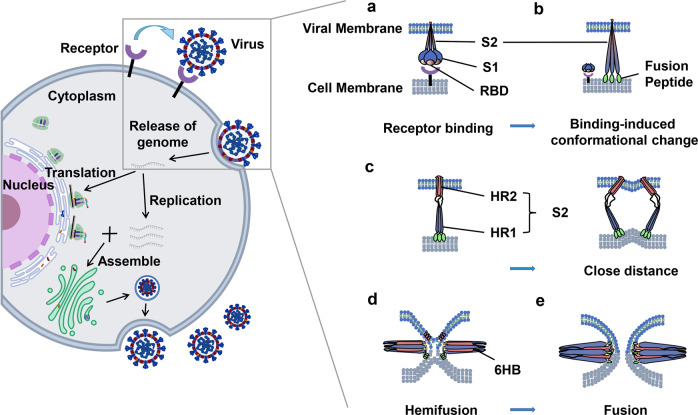
Schematic diagram of coronavirus life cycle. The virion enters the cell through recognizing specific receptor, uses the host cell resources to carry on genome replication and synthesis of major structural proteins, and then finally assembles into the mature virion which is then released out of cell. The invasion process mainly includes (a) coronavirus S protein recognition and binding to cell receptors, along with virus attachment to the cell; (b) induction of conformational changes in the S protein upon binding, in which the fusion protein is exposed and inserted into the host cell membrane; (c) HR1 and HR2 of the S2 subunit gradually approaching each other, narrowing the distance between viral envelope and host cell membrane; (d, e) HR1 and HR2 forming a six helical bundle (6-HB), which causes the virus envelope and host cell membrane to fuse from the hemifusion state to complete fusion, thus releasing the virus gene into the host. Viral genes replicate and translate within cells to produce genomic RNA and viral proteins, which are assembled with the proteins to form viral particles
Fig. 4
Fig. 4
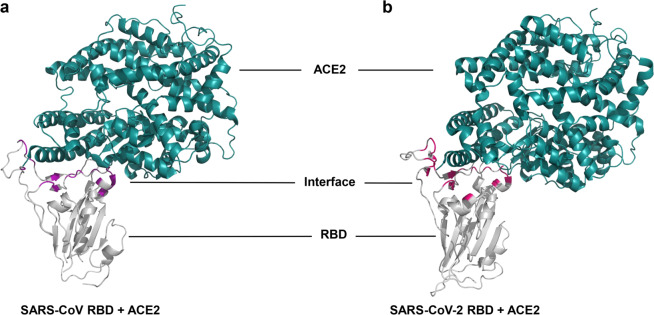
Crystal structure of RBD binding to ACE2. (a) RBD (gray) of SARS-CoV specifically binds the receptor ACE2 (dark green) (PDB: 2AJF), and the interface is marked purple; (b) RBD (gray) of SARS-CoV-2 specifically binds the receptor ACE2 (PDB: 6LZG), and the interface is marked hot pink
Fig. 5
Fig. 5
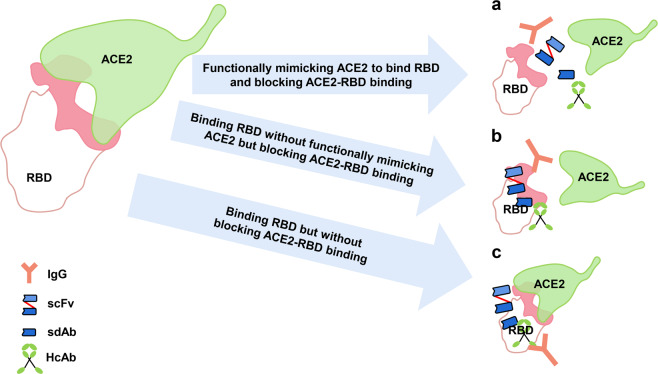
Pattern of NMAbs action. The major types of neutralizing monoclonal antibodies (NMAbs) include immunoglobulin G (IgG), single-stranded variable region fragments (scFvs), heavy-chain antibody (HcAb) and single-domain antibodies (sdAbs). NMAbs exert antiviral activity by (a) NMAbs functionally mimicking ACE2 to bind RBD and blocking ACE2-RBD binding; (b) NMAbs binding RBD without functionally mimicking ACE2 but blocking ACE2-RBD binding; (c) NMAbs binding RBD but without blocking ACE2-RBD binding (interface is marked pink)
Fig. 6
Fig. 6
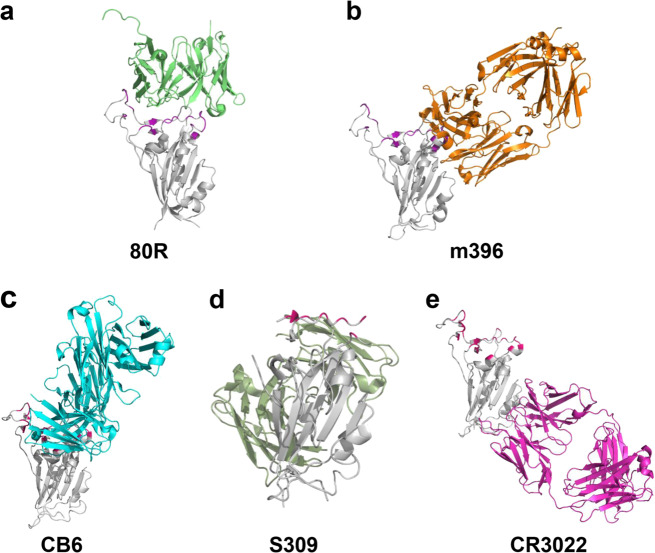
Crystal structure of NMAb binding to RBD. (a) 80 R (light green) imitates ACE2 binding to the interface (purple) on RBD of SARS-CoV (PDB: 7BZ5); (b) m396 (orange) binds to RBD of SARS-CoV without functionally mimicking ACE2, preventing RBD from binding to ACE2 (PDB: 2DD8). (c) CB6 (sky blue) functionally mimics ACE2 binding to the interface (hot pink) on RBD of SARS-CoV-2 (PDB: 7C01); (d) S309 (grass green) binds to RBD of SARS-CoV-2 without blocking the binding of RBD to ACE2 (PDB: 6WPS). (e) The SARS-CoV-specific NMAb CR3022 (purple) binds to RBD of SARS-CoV-2 without blocking the binding of RBD of SARS-CoV-2 to ACE2 (PDB: 6W41)

References

    1. Jiang S, Hillyer C, Du L. Neutralizing antibodies against SARS-CoV-2 and other human coronaviruses. Trends Immunol. 2020;41:355–359. - PMC - PubMed
    1. Xiao X, et al. The SARS-CoV S glycoprotein: expression and functional characterization. Biochem. Biophys. Res. Commun. 2003;312:1159–1164. - PMC - PubMed
    1. Dimitrov DS. The secret life of ACE2 as a receptor for the SARS virus. Cell. 2003;115:652–653. - PMC - PubMed
    1. Wong SK, et al. A 193-amino acid fragment of the SARS coronavirus S protein efficiently binds angiotensin-converting enzyme 2. J. Biol. Chem. 2004;279:3197–3201. - PMC - PubMed
    1. Du L, et al. The spike protein of SARS-CoV–a target for vaccine and therapeutic development. Nat. Rev. Microbiol. 2009;7:226–236. - PMC - PubMed

Publication types

MeSH terms