


Eye-Tracking Analysis for Emotion Recognition
- PMID: 32963512
- PMCID: PMC7492682
- DOI: 10.1155/2020/2909267
Eye-Tracking Analysis for Emotion Recognition
Abstract
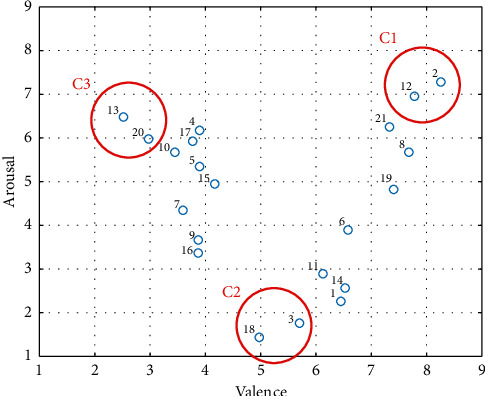
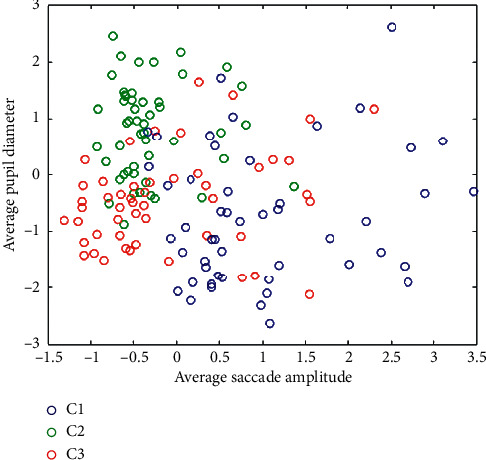
This article reports the results of the study related to emotion recognition by using eye-tracking. Emotions were evoked by presenting a dynamic movie material in the form of 21 video fragments. Eye-tracking signals recorded from 30 participants were used to calculate 18 features associated with eye movements (fixations and saccades) and pupil diameter. To ensure that the features were related to emotions, we investigated the influence of luminance and the dynamics of the presented movies. Three classes of emotions were considered: high arousal and low valence, low arousal and moderate valence, and high arousal and high valence. A maximum of 80% classification accuracy was obtained using the support vector machine (SVM) classifier and leave-one-subject-out validation method.
Copyright © 2020 Paweł Tarnowski et al.
Conflict of interest statement
The authors declare that there are no conflicts of interest regarding the publication of this paper.
Figures





References
-
- Daily S. B., James M. T., Cherry D., et al. Emotions and Affect in Human Factors and Human-Computer Interaction. San Diego, CA, USA: Elsevier Academic Press; 2017. Affective computing: historical foundations, current applications, and future trends; pp. 213–231. - DOI
-
- Karpouzis K., Yannakakis G. N. Emotion in Games. Vol. 4. Cham, Switzerland: Springer International Publishing; 2016.
-
- Holmgård C., Yannakakis G. N., Karstoft K.-I., Andersen H. S. Stress detection for PTSD via the StartleMart game. Proceedings of the 2013 Humaine Association Conference on Affective Computing and Intelligent Interaction; September 2013; Geneva, Switzerland. pp. 523–528. - DOI
-
- Pampouchidou A., Simos P. G., Marias K., et al. Automatic assessment of depression based on visual cues: a systematic review. IEEE Transactions on Affective Computing. 2019;10(4):445–470. doi: 10.1109/TAFFC.2017.2724035. - DOI
MeSH terms
LinkOut - more resources
Full Text Sources
