. 2020 Sep 8:2020:2565320.
doi: 10.1155/2020/2565320. eCollection 2020.

Exercise Therapies for Parkinson's Disease: A Systematic Review and Meta-Analysis

Affiliations

Exercise Therapies for Parkinson's Disease: A Systematic Review and Meta-Analysis

Hyun-Young Choi et al. Parkinsons Dis. .

Abstract

Recently, rehabilitative exercise therapies have been described as an important method of overcoming the limitations of the conventional therapies for Parkinson's disease. The present study aimed to evaluate efficacy and safety of exercise therapies for Parkinson's disease. Randomized controlled trials that evaluated exercise therapies in patients with Parkinson's disease until December 2016 were searched for in five electronic databases: PubMed, CENTRAL, EMBASE, OASIS, and CNKI. Eighteen studies (1,144 patients) were included. The overall methodological quality was not high. Patients who underwent exercise therapies exhibited statistically significant improvements in the total UPDRS, UPDRS II and III, Berg Balance Scale, preferred walking speed, and Timed Up and Go Test compared to patients who underwent nonexercise therapies. In comparison to patients who performed regular activity, patients who underwent exercise therapies exhibited statistically significant improvements in the total UPDRS, UPDRS II, and UPDRS III. Exercise therapies were found to be relatively safe. Exercise therapies might promote improvements in the motor symptoms of Parkinson's disease. However, due to the small number of randomized controlled trials and methodological limitations, we are unable to draw concrete conclusions. Therefore, further studies with better designs will be needed.


Conflict of interest statement

The authors declare that there are no conflicts of interest regarding the publication of this paper.

Figures
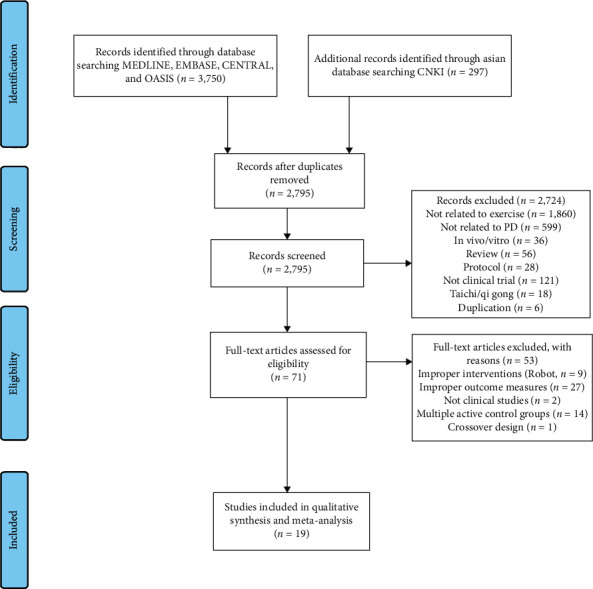
Figure 1
Figure 1
PRISMA flow chart of the study selection and identification process [22].
Figure 2
Figure 2
(a) The graph of risk of bias; (b) the summary of risk of bias: “+” = low risk of bias, “−” = high risk of bias, and “?” = unclear risk of bias.
Figure 3
Figure 3
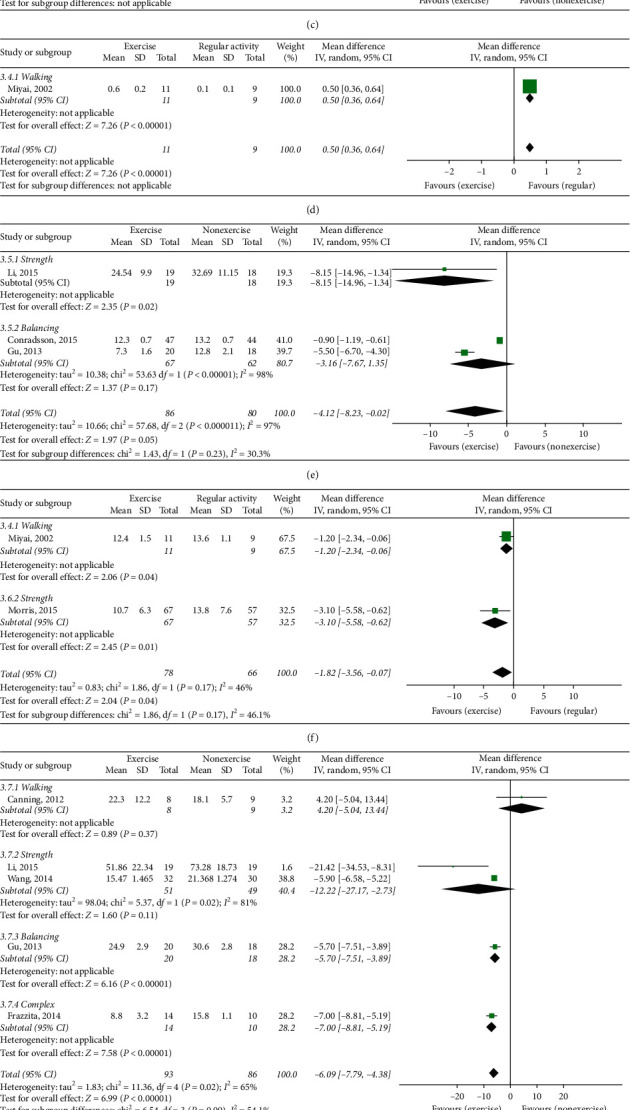
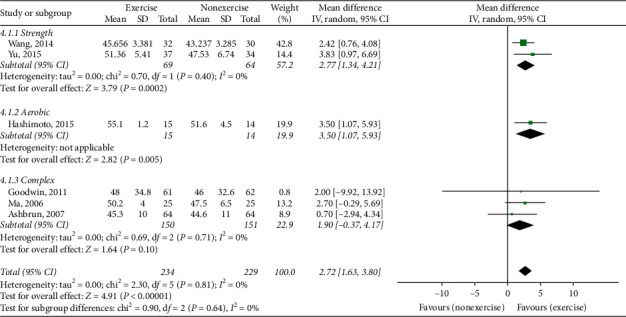
(a) Total UPDRS score, exercise therapy group versus nonexercise group. (b) Total UPDRS score, exercise therapy group versus regular activity group. (c) UPDRS I exercise therapy group versus nonexercise group. (d) UPDRS I exercise therapy group versus regular activity group. (e) UPDRS II, exercise therapy group versus nonexercise group. (f) UPDRS II, exercise therapy group versus regular activity group. (g) UPDRS III, exercise therapy group versus nonexercise group. (h) MDS-UPDRS III, exercise therapy group versus nonexercise group. (i) UPDRS III, exercise therapy group versus regular activity group.
Figure 4
Figure 4
Berg Balance Scale, exercise therapy group versus nonexercise group.
Figure 5
Figure 5
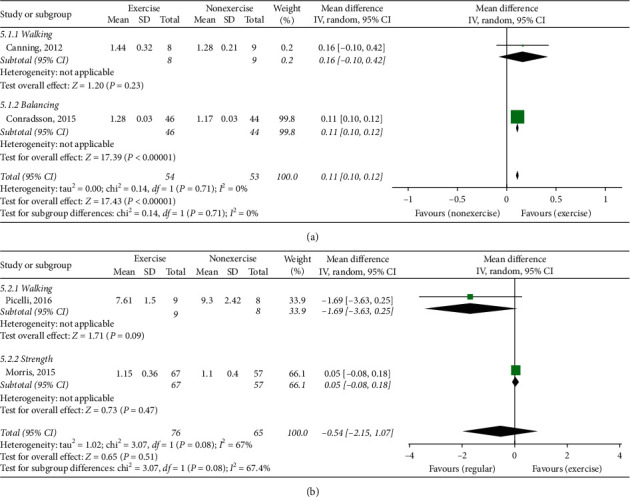
(a) Preferred walking speed, exercise therapy group versus nonexercise group. (b) Preferred walking speed, exercise therapy group versus regular activity group.
Figure 6
Figure 6
Fast walking speed, exercise therapy group versus nonexercise group (placebo exercise).
Figure 7
Figure 7
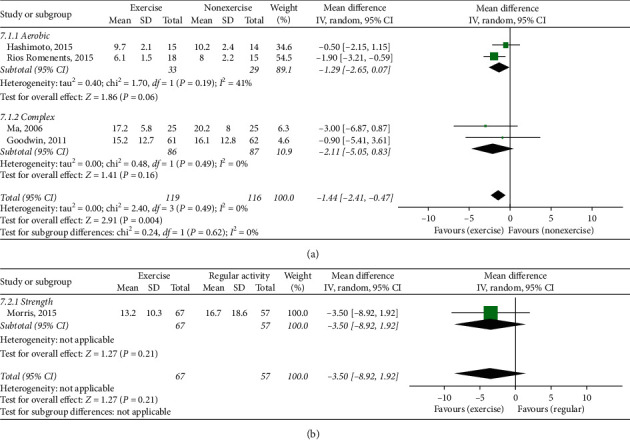
(a) Timed Up and Go Test, exercise therapy group versus nonexercise group. (b) Timed Up and Go Test, exercise therapy group versus regular activity group.
Figure 8
Figure 8
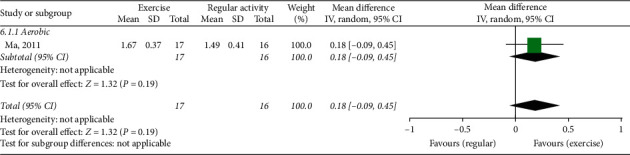
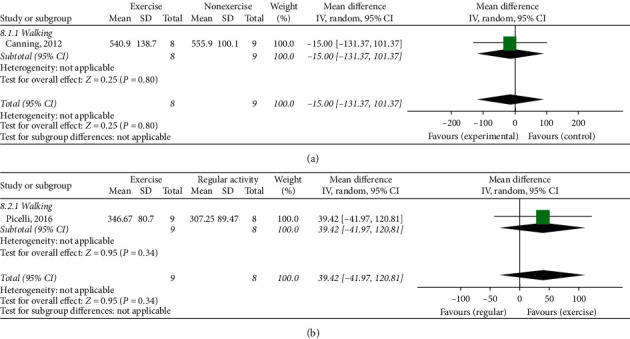
(a) Six-minute walk test, exercise therapy group versus nonexercise group. (b) Six-minute walk test, exercise therapy group versus regular activity group.

References

    1. Hughes A. J., Daniel S. E., Kilford L., Lees A. J. Accuracy of clinical diagnosis of idiopathic Parkinson’s disease: a clinico-pathological study of 100 cases. Journal of Neurology, Neurosurgery & Psychiatry. 1992;55(3):181–184. doi: 10.1136/jnnp.55.3.181. - DOI - PMC - PubMed
    1. Kalia L. V., Lang A. E. Parkinson’s disease. The Lancet. 2015;386(9996):896–912. doi: 10.1016/s0140-6736(14)61393-3. - DOI - PubMed
    1. Müller B., Assmus J., Herlofson K., Larsen J. P., Tysnes O.-B. Importance of motor vs. non-motor symptoms for health-related quality of life in early Parkinson’s disease. Parkinsonism & Related Disorders. 2013;19(11):1027–1032. doi: 10.1016/j.parkreldis.2013.07.010. - DOI - PubMed
    1. Skelly R., Brown L., Fakis A., Walker R. Hospitalization in Parkinson’s disease: a survey of UK neurologists, geriatricians and Parkinson’s disease nurse specialists. Parkinsonism & Related Disorders. 2015;21(3):277–281. doi: 10.1016/j.parkreldis.2014.12.029. - DOI - PubMed
    1. Park J. H., Kim D. H., Kwon D. Y., et al. Trends in the incidence and prevalence of Parkinson’s disease in Korea: a nationwide, population-based study. BMC Geriatrics. 2019;19(1):p. 320. doi: 10.1186/s12877-019-1332-7. - DOI - PMC - PubMed

LinkOut - more resources