


Antimalarial Activity of Ethyl Acetate Extract and Fraction of Bidens pilosa against Plasmodium berghei (ANKA)
- PMID: 32963817
- PMCID: PMC7502121
- DOI: 10.1155/2020/8832724
Antimalarial Activity of Ethyl Acetate Extract and Fraction of Bidens pilosa against Plasmodium berghei (ANKA)
Abstract
Background: Malaria is one of the most critical diseases causing about 219 million cases worldwide in developing countries. The spread and development of resistance against chemical antimalarial drugs is one of the major problems associated with malaria control. The present study was to investigate the antimalarial efficacy of ethyl acetate extract and one fraction of Bidens pilosa in vivo in order to support the usage of this plant by traditional healers to treat malaria.
Methods: The extracts were prepared by maceration of B. pilosa leaf powder in ethyl acetate. The liquid filtrate of the extract and the best in vitro antiplasmodial fraction using HPLC were concentrated and evaporated using a rotavapor under vacuum to dryness. The antimalarial activity of B. pilosa plant products were evaluated in vivo against Plasmodium berghei infected mice according to the Peter and Rane test. The antimalarial efficacy of the a selected crude extract (ethyl acetate extract) was evaluated at 125, 250, and 500 mg/kg, while a selected fraction from ethyl acetate extract (fraction 12) was evaluated at 62.5 and 125 mg/kg. Blood from experimental animals was collected to assess hematological parameters.
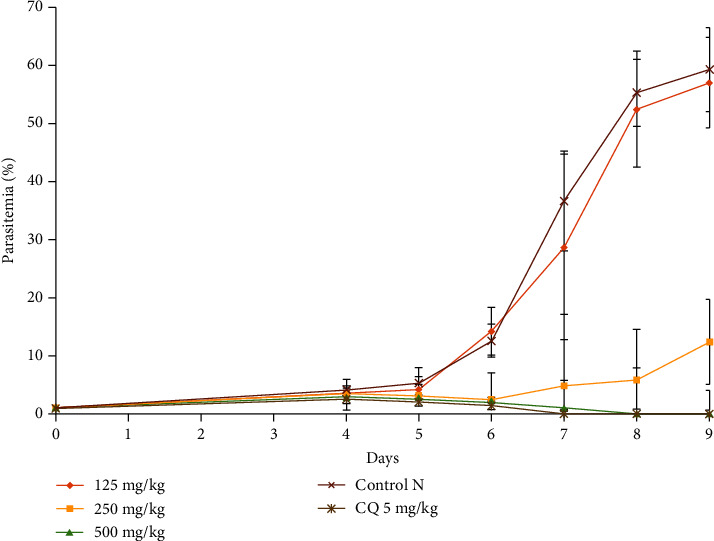
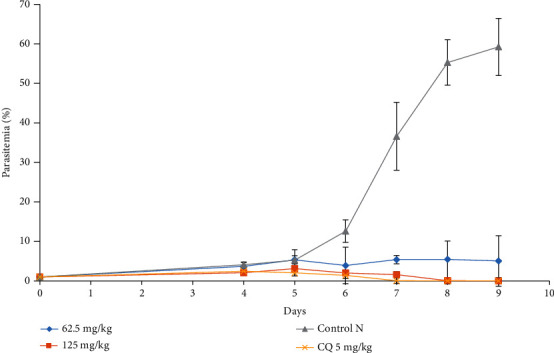
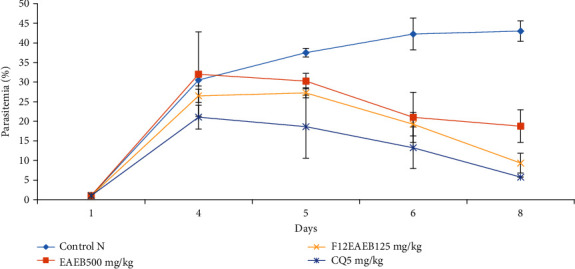
Results: The crude extract of ethyl acetate and fraction 12 demonstrated 100% in vivo parasite suppressive activity at doses of 500 mg/kg and 125 mg/kg, respectively, for the crude extract and fraction 12. The mice treated with 250 and 500 mg/kg had their parasitemia (intraerythrocytic phase of P. Berghei) drop considerably, disappearing by the 8th day in mice receiving 500 mg/kg. The ethyl acetate extract of B. pilosa, fraction 12 showed an even higher antiplasmodial activity. By the 5th day of the experiment, the treatment led to a modification of hematological parameters in mice. The chloroquine (5 mg/kg), fraction 12 (125 mg/kg), and the crude extract (500 mg/kg) groups all survived the 30 days of the experiment, while the negative control group registered 100% of the deaths.
Conclusion: This study scientifically supports the use of Bidens pilosa leaves in the traditional treatment of malaria. However, the mode of action and in vivo toxicity of the plant still need to be assessed.
Copyright © 2020 Noumedem Anangmo Christelle Nadia et al.
Conflict of interest statement
The authors declared that they have no competing interest.
Figures
References
-
- WHO. World Malaria Report. Geneva, Switzerland: World Health Organization; 2018.
-
- WHO. Sceptibility of Plasmodium falciparum to antimalarial drugs. Report on global monitoring 1996-2004. Document WHO/HTM/MAL/2005.1103, Genève. 2005.
-
- Noumedem Anangmo C. N., Wabo Pone J., Kumar Kaushi N., et al. In vitro antiplasmodial activity and cytotoxicity of extracts and fractions of Bidens pilosa. Asian Journal of Biomedical and Pharmaceutical Sciences. 2017;7(61):28–34.
LinkOut - more resources
Full Text Sources
